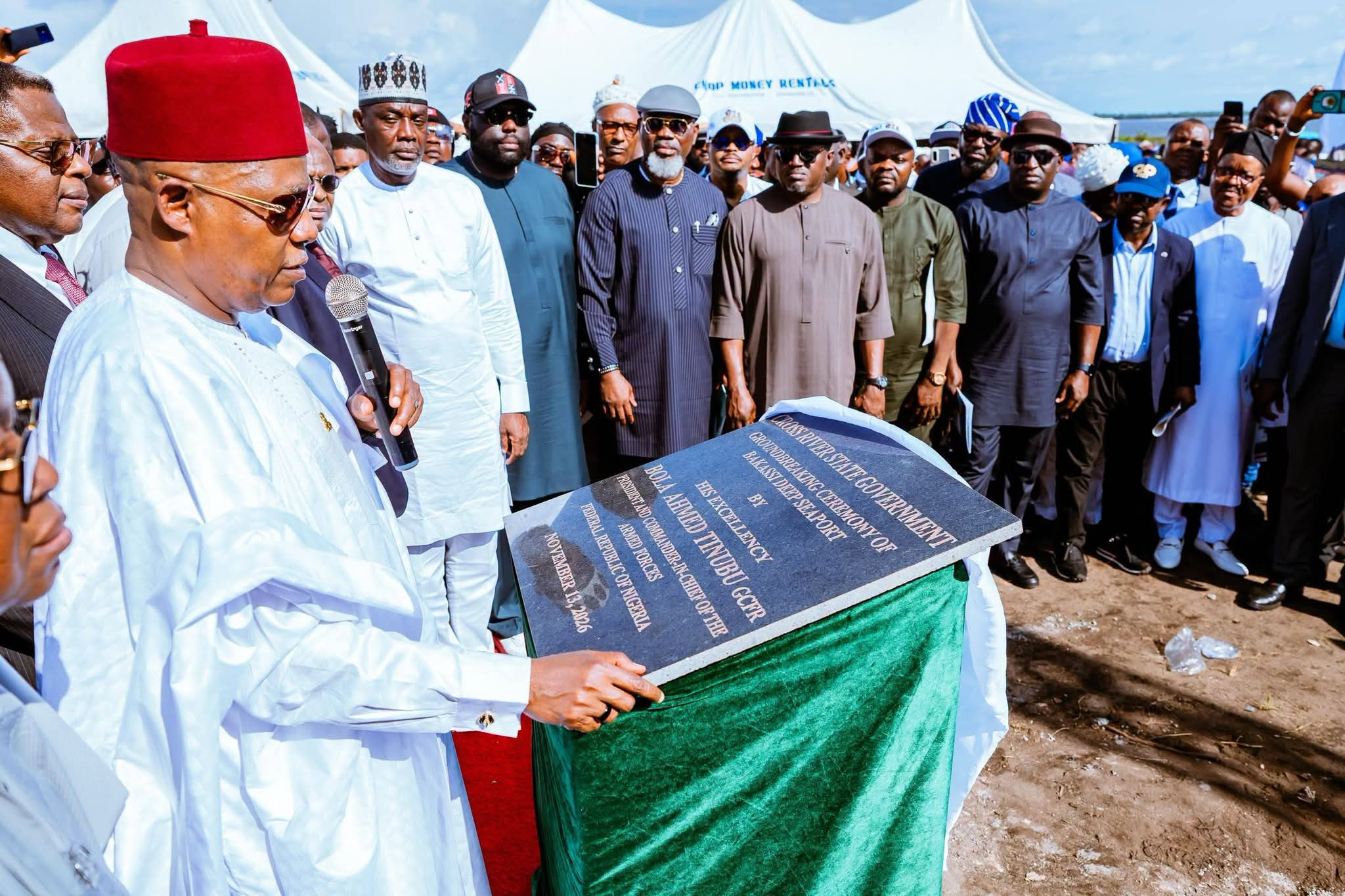
President Bola Ahmed Tinubu has officially flagged off the construction of the $3.5 billion Bakassi Deep Seaport in Cross River State, describing the landmark project as a strategic national investment and a defining milestone in Nigeria’s economic diversification.
The historic groundbreaking ceremony took place on Friday, November 13, 2026, at Ikang in the Bakassi Local Government Area of Cross River State. Official statements detailing the event were released by the Presidency on Friday evening and reiterated by the Office of the Vice President on Saturday morning, November 14, 2026.
Represented at the Ikang project site by Vice President Kashim Shettima, President Tinubu declared that the commencement of work on the seaport ends decades of false starts and scepticism surrounding Cross River’s maritime ambitions.
According to a press statement issued by Stanley Nkwocha, Senior Special Assistant to the President on Media and Communications (Office of the Vice President), the President emphasized that his administration is focused on tangible delivery rather than mere ceremony.
”I have not come to Calabar to cut a ribbon and dance Ekpe masquerade. I am here to break ground and break a centuries-old jinx,” Shettima stated on behalf of the President.
“Many people believed this port would never happen. They said it would be a pipe dream. They said Bakassi would only be remembered for what we lost. Today, we answer them with a shovel, with concrete, with steel, and with hope, a renewed hope that a dream deferred can become a dream actualised.”
During the address, President Tinubu also dismissed long-standing rumours that the Federal Government or South-West interests had worked against the establishment of viable seaports outside Lagos.
Explaining that over 80 per cent of Nigeria’s foreign trade currently passes through Lagos ports alone, he warned that such over-concentration fuels congestion, shipping delays, and inflated commodity prices in inland markets such as Onitsha, Maiduguri, and Calabar.
”Lagos is not our enemy. Lagos is our elder brother in trade. No country eats with one hand; no country carries all its loads on one shoulder. That shoulder will break,” the President remarked, adding that the project is for the collective good of Nigeria rather than a rival to Lagos.
“When Lagos is free, Nigeria breathes. When Calabar works, Nigeria walks on two legs.” He further projected that Nigeria stands to generate $44 billion annually from its marine and blue economy if it successfully captures regional transit cargo currently diverted to neighbouring ports.
Conceived decades ago and re-engineered in 2014, with its Environmental and Social Impact Assessment (ESIA) completed in March 2015, the project gained decisive momentum after the Cross River State Government formalised a Public-Private Partnership (PPP) in February 2025 and secured $3.5 billion in financing from the African Export-Import Bank (Afreximbank).
Engineered with a 20-metre deep draft capable of berthing large, modern ocean-going vessels, the seaport will be supported by a 260-kilometre superhighway and seamless integration with the ongoing Lagos-Calabar Coastal Highway to move cargo efficiently into northern and eastern hinterland markets.
Crediting Cross River State Governor Bassey Otu for reviving the project and securing Afreximbank backing, the President commended the state’s preparation for the facility. Speaking at the ceremony in Ikang, Governor Otu noted that the deep seaport, alongside the Lagos-Calabar Coastal Highway and planned airport expansions, provides Cross River with three strategic economic gateways.
He also disclosed that Cross River indigenes are undergoing specialised technical training for the port’s construction and operations, while inviting investors to leverage the state’s one-stop investment hub and tax incentives.
Also addressing the gathering, the Minister of Marine and Blue Economy, Adegboyega Oyetola, described the flag-off as a major shift in Nigeria’s maritime geography.
Oyetola highlighted recent sectoral gains, including the lifting of United States Coast Guard restrictions on Nigerian-bound vessels in August 2026, the disbursement of the Cabotage Vessel Financing Fund, and agency revenues rising from ₦700.79 billion in 2023 to ₦1.83 trillion in 2025, pledging full ministerial support for an environmentally sustainable and efficient port.
Representing Afreximbank President and Chairman Dr. George Elombi, the Executive Vice-President of the Intra-African Trade Bank at Afreximbank, Mrs. Kanayo Awani, reaffirmed the institution’s commitment to developing an industrial and agro-processing economic corridor around the seaport to lower freight costs and boost the competitiveness of Nigerian exports.
The ceremony was attended by senior federal and state officials, maritime industry operators, development finance executives, and traditional rulers from across Cross River State.