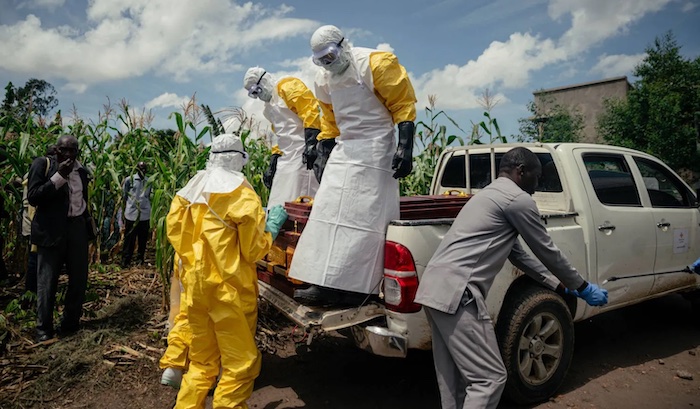
The World Health Organisation (WHO) confirmed during a high-level emergency briefing at 10:00 AM CET today that the ongoing outbreak of Ebola disease caused by the Bundibugyo virus has now extended across eight provinces in the Democratic Republic of the Congo (DRC).
Since the WHO Director-General Dr. Tedros Adhanom Ghebreyesus officially declared the outbreak a Public Health Emergency of International Concern (PHEIC) on May 17, 2026, community transmission has continued to surge despite international response efforts.
As of November 5, 2026, health authorities have recorded over 10,700 confirmed cases and 5,230 deaths across the DRC. The virus has infected 67 health zones spanning eight provinces: Ituri (the primary epicenter of the outbreak), Nord-Kivu, Sud-Kivu, Tshopo, Haut-Uélé Bas-Uélé, Sud-Ubangi and Nord-Ubangi.
Cross-border travel has also heightened international concern, following localized case importations reported in Kenya and Nigeria in late October. Speaking from WHO Headquarters in Geneva, WHO Regional Director for Africa Dr. Matshidiso Moeti addressed journalists regarding response challenges: ”Active community transmission across eight provinces poses a severe threat to regional health security.
Unlike the Zaire strain, there is currently no licensed vaccine specifically approved for the Bundibugyo virus. Our immediate priority is rapid isolation, intensive contact tracing, and reinforcing infection control across all frontline health facilities.” At a simultaneous press conference at 11:00 AM WAT at the Ministry of Health headquarters in Kinshasa, Minister of Public Health Dr. Jean-Jacques Mbungani called for urgent international logistics support:
”Our surveillance networks and emergency isolation units in Ituri and Nord-Kivu are working under extreme pressure. We require immediate deployments of personal protective equipment and clinical support to prevent further interprovincial spread.”
The WHO, alongside the European Centre for Disease Prevention and Control (ECDC) and international emergency partners, is scaling up rapid response teams, mobile diagnostic laboratories, and experimental therapeutic trials to contain the transmission.
The agency maintains its advice against imposing international travel or trade restrictions, urging countries instead to enhance points-of-entry screening and local preparedness.