By Charles Obiajulu Ugwu
Some evenings, when the light goes off on my street, I count the seconds before the first generator coughs awake. It rarely takes ten. A second one joins, then a third, and within a minute the whole close is droning like the engine room of a ship that is going nowhere. Nobody curses. Nobody calls anybody. A neighbour’s child shouts “NEPA don take light!” with the cheerful resignation of a weather report, and life resumes under the smell of petrol fumes. I have lived with that sound for most of my adult life, and only recently did I begin to hear what it was actually saying.
It was saying that we have stopped expecting.
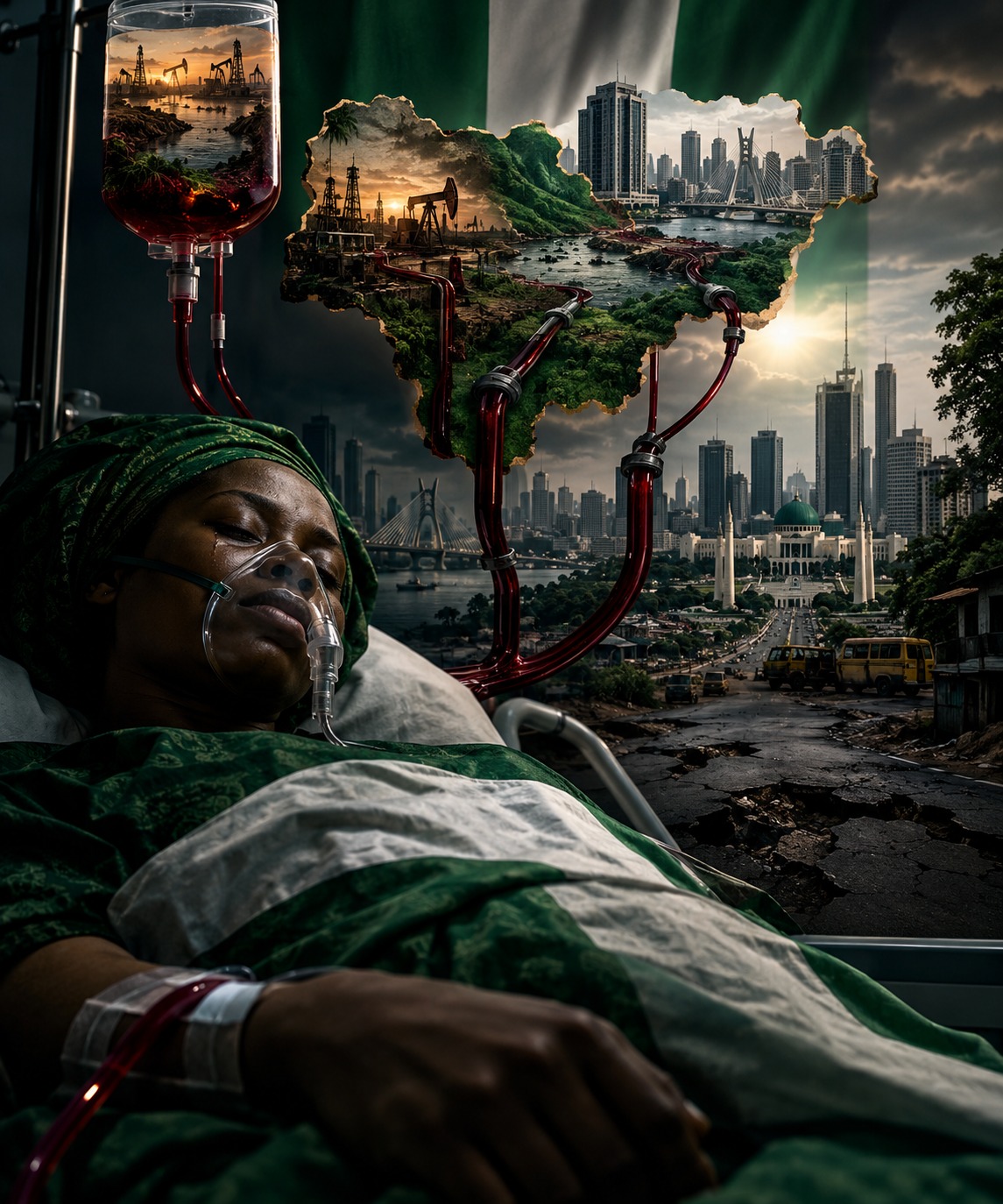
Of late I have found myself studying Nigerians the way a physician studies a patient who insists he is fine. I watch us in queues and in church pews, at weddings and at filling stations, in WhatsApp groups and town union meetings. I watch the country too, in its budgets and its broken promises, its panels of inquiry and its ceremonial outrage. What I see is a people and a state locked in a strange dance: two steps forward, two steps back, a twirl, a bow, and the band plays on. It was said of the restored Bourbon kings of France that they had learnt nothing and forgotten nothing. We seem to have managed something more remarkable still. We have learnt nothing and forgotten everything.
The usual explanations are familiar enough to recite in our sleep. Bad leadership. Corruption. Ethnicity. Religion. Colonial borders. Oil. I dismiss none of them; each carries some truth. But they have been repeated for so long that they have hardened into a kind of liturgy, words we say in order to feel that we have understood, when in fact they shield us from understanding. If the causes are so obvious, why does naming them change nothing? Why does a nation that can describe its illness in such fluent detail never seem to rise from the sickbed?
I have come to believe that the real question is not what hurts us. We know what hurts us. The real question is why the hurt never turns into anything. In a living society, pain is information. It travels from the body to the brain, it gathers urgency, and it compels the hand to pull away from the fire. Collective pain works the same way. Hunger becomes protest, protest becomes politics, politics becomes reform. That is how other nations, neither wiser nor holier than ours, eventually forced their states to behave.
In Nigeria the signal is intercepted. Somewhere between the wound and the will, something absorbs the pain, softens it, and gives it a place to go that is not the public square. We are not a nation that feels nothing. We are a nation under anaesthesia, and the anaesthetic, I am now convinced, is largely of our own making. Nobody designed it. No cabal meets in Abuja to administer it. It grew, dose by dose, out of the very survival skills we are proudest of, and that is exactly why it has been so hard to see.
Let me try to name the drugs.
The Sound of a Thousand Generators
Go back to that generator. Every family above the poverty line in this country now runs a private government. We generate our own electricity, sink our own boreholes, employ our own security, pay for our own schooling and settle our own hospital bills through the extended family’s emergency fund. We tar the stretch of road in front of the estate and mount the gate at its entrance. We have a private answer for every public failure, and we wear our self-sufficiency like a medal.
But consider what a generator really is. It is a vote of no confidence that is never cast. Each one stands for a household that has quietly concluded the state will not supply power, and has therefore stopped asking. Multiply that by millions and you have an entire social class that has resigned from citizenship without ever writing a letter of resignation.
This matters because of who that class is. In most societies that managed to tame their states, the pressure came from the middle: the shopkeepers, professionals, civil servants and small manufacturers who had enough to lose and enough voice to be heard. Our middle class has been bought off, and the strangest part of the story is that it paid for its own bribe. It does not demand electricity. It budgets for diesel. Its grievance has been converted from a cause into a cost line, and nobody marches over a cost line. The poor, meanwhile, who cannot afford the private state, lack the weight to make their suffering politically expensive. So those with voice have no reason to use it, and those with reason have no voice.
Money That Arrives Before the Anger
Every month, somewhere between a remittance counter in Peckham and a banking app in Houston, a young Nigerian sends money home. Taken together, those transfers come to close to twenty billion dollars a year. They pay school fees in Nsukka and rent in Ibadan, buy a father’s blood pressure tablets in Zaria and keep a mother’s provision shop alive in Warri.
I honour every naira of it. Yet I cannot avoid seeing what it does at the level of the nation. It places a cushion beneath the floor below which hunger would turn into unrest. Families that ought to be crying out are steadied, just enough, by a cousin in Toronto. The state is relieved of its most elementary duty by people it failed so thoroughly that they had to leave.
The economist Albert Hirschman once observed that people dissatisfied with an institution have two broad choices: they can leave, or they can stay and speak up. Exit or voice. The tragedy of the japa years is that those most capable of voice are the ones choosing exit. The young, the trained, the articulate, the impatient, those who in another era would have filled the lecture halls with argument and the streets with placards, are filling the departure lounges instead. Then, with a cruel kind of loyalty, they send back the money that makes it easier for those left behind to keep enduring. The valve releases the pressure twice: once when the restless leave, and again when their remittances soothe those who stay.
Separate Ledgers, Separate Wounds
A nation feels pain as one only when its people believe the pain is shared. Here, suffering is sorted at the door. There is a Northern account and a South-East account, a Christian account and a Muslim account, a Middle Belt account, a Niger Delta account, a minorities account. Each group keeps meticulous books on what was done to it, by whom and when, and each set of books is brought out mainly to discount everybody else’s.
I call it grievance accounting, and I think it is the deepest fracture we carry. A collapsed general hospital in Kano and a collapsed general hospital in Enugu are the same failure, produced by the same budget process, the same procurement rot and the same indifference. Yet they are almost never told as one injury. They are told as rival stories, each region insisting that its own neglect is the real neglect and that the other’s complaint is either exaggerated or deserved.
Pain that cannot be added up cannot be turned against the system that causes it. And here is the uncomfortable part. Those who profit from the system no longer need to divide us. We keep the books ourselves, with great diligence, and they simply collect the dividends. Every time we are invited to compare our wounds instead of comparing notes, the machine survives another season.
We Trust Upward, Never Across
It is fashionable to say that Nigerians cannot organise. Nothing could be further from the truth. Sit in any Igbo town union meeting on a Sunday afternoon and watch men and women raise money for a village road with the discipline of a central bank. Watch a church move a million worshippers to a camp ground along the Lagos-Ibadan Expressway and feed them. Watch market women in Onitsha or Kano enforce rules that no government officer could make stick. Age grades, alumni associations, transport unions, hometown progressive leagues: the muscle for collective action is everywhere.
What is missing is the direction in which trust flows. Ours travels upward, toward the patron, the pastor, the chief, the oga, the big man who can “help”. It almost never travels across, toward the stranger in another state who shares nothing with us except a passport and a problem. We have woven a dense web of loyalty that is vertical and tribal, and a thin, fraying thread of trust that is horizontal and civic.
So the same diaspora union that tars the five kilometres leading to its village will not join hands with anyone to demand that the state tar the highway that leads to those five kilometres. The capacity to organise is real. It is simply fenced within identity, and so it never ripens into citizenship. We are experts at being members. We have not yet learnt to be citizens.
The Search for a Good Man
Ask ten Nigerians what is wrong with the country and nine will tell you, in one form or another, that the problem is bad people. Greedy politicians. Corrupt civil servants. Leaders without the fear of God. It sounds like moral seriousness, and in a sense it is. Structurally, though, it is a gift to the very order it condemns.
When failure is explained as a shortage of good men, the cure becomes a hunt for a good man. Every election turns into the search for a saint, a deliverer who will emerge from the right zone and the right faith and somehow make the machine behave. Then the saint arrives, the machine does what it was always going to do, and we conclude, with genuine sorrow, that we picked the wrong saint. We rarely suspect the machine.
This is the moralisation trap. A system that is never put on trial can never be reformed. We keep changing drivers and refusing to look under the bonnet, at the incentives that reward the appointee who steals and punish the one who refuses, at the unwritten rules that make an honest governor a lonely man within six months. Character matters. But a country that relies on character alone has agreed to be either lucky or doomed, and we have rarely been lucky.
Laughter, Prayer and the Long Sedation
No people on earth laugh at their misfortune with more brilliance than we do. Fuel scarcity in the morning becomes a skit by afternoon and a million shares by nightfall. The jokes are sharp, the timing exquisite, the talent beyond dispute. I laugh along. And yet I have begun to notice what the laughter does. It discharges anger before anger has had time to ripen into resolve. A fuel queue that has been turned into comedy has been processed, digested and filed away. Processed pain does not march.
Something similar happens with a certain kind of popular religiosity. I write as a man of faith, and nothing here is a quarrel with God. My quarrel is with the habit of moving every hope out of the polity and into the providential. Hardship is a test. Your breakthrough is coming. Your season will change.
It is well. Spoken in faith, such words can carry a person through the longest night. Spoken as a social reflex, they tell an entire population that the remedy lies somewhere other than in public duty and public demand. The Church’s own social teaching has never asked believers to sit still before injustice; it has asked them to labour for the common good. Yet “it is well” may have become the most effective political sedative this country has ever known, and no government had to budget for it.
The Cruel Compliment
We are told, and we tell ourselves, that Nigerians are the most resilient people in the world. We move. Naija no dey carry last. There is truth and real courage in it. But I have come to hear the compliment as a quiet insult.
In a failing system, resilience works as a subsidy. Every shock the citizen absorbs is a shock the state is excused from preventing. Every price rise survived without complaint becomes proof that the next one can be survived as well. A people who can endure anything will, sooner or later, be asked to endure everything. Our celebrated capacity to bend without breaking has been mistaken, by those who govern us and by ourselves, for evidence that nothing needs fixing. Strength that is never used to push back is not strength at all. It is patience being harvested.
A Country Without a Rear-View Mirror
We speak of national amnesia as though forgetting simply happened to us, like the harmattan. It did not. For the better part of a decade, history ceased to be taught as a subject in its own right in our basic schools, and a generation grew up without a shared account of how this country came to be what it is. The reports of panels and commissions of inquiry gather dust unpublished. Archives rot in damp rooms. Each scandal is buried by the next within a fortnight, and the news cycle does the rest.
A people without memory cannot recognise a pattern, and a people who cannot recognise patterns will greet the same disaster as a fresh surprise, over and over. That is why our national life swings like a yoyo; there is no memory to catch the string. The same promises return on new campaign posters, the same failures in new budget lines, and we receive them with the innocence of first acquaintance. A nation that does not remember cannot learn, and a nation that cannot learn is condemned not only to repeat its history but to be astonished by it every single time.
The Payroll of Dysfunction
The last drug is the one we least like to admit. Every broken process in this country has created a job. The passport agent at the gate of the immigration office. The fixer at the land registry. The clearing agent at the port who knows whose palm to warm. The “consultant” who can get your file moving at the ministry. The tout at the motor park, the middleman at the certificate office, the cousin who knows somebody. Millions of ordinary Nigerians, not villains, not the famous thieves of the headlines, earn their daily bread from the gap between how things are supposed to work and how they actually do.
This means that dysfunction has a constituency, and a very large one. Reform does not only threaten the powerful at the top. It threatens the livelihood of a great many people at the bottom and in the middle, and they sense it instinctively. When a process is digitised and the queue disappears, somebody’s income disappears with it. We should not be surprised, then, that every honest attempt at simplification meets a thousand small, invisible resistances. The broken system is not merely tolerated. It is employed.
Waking the Patient
So the soothing forces were never truly mysterious. They are the generator and the remittance, the separate ledgers of grievance and the town union that will not look beyond its own village, the endless hunt for a good man, the brilliant skit and the reflexive prayer of postponement, the cruel compliment of resilience, the empty archive and the fixer at the gate. Each one makes perfect sense to the individual who reaches for it. Taken together, they form a national painkiller strong enough to let a country bleed for six decades while insisting it is only tired.
If this reading is right, then the cure will not come the way we keep expecting it to. It will not arrive in the person of a new president, however good. It will begin when enough of us refuse the anaesthetic. When we start to describe our generators and boreholes not as ingenuity but as evidence, public failure that we insist on charging to the public account.
When we learn to pool our grievances instead of trading them, so that the dying hospital in Kano and the dying hospital in Enugu are finally seen as one wound with one cause. When the energy of our town unions, church societies and alumni groups is turned outward and sideways, toward the stranger who shares our problem. When we put the system on trial rather than the saint. When we laugh, and then act. When we pray, and then demand. When we remember, deliberately and stubbornly, as a civic duty.
There is an old belief that Nigeria will change only when things become unbearable. I no longer hold it. We have borne the unbearable for so long that the word has lost its meaning. The country will change, I suspect, when its pain becomes undeniable, shared and remembered, when the signal finally travels from the wound to the will. Until then, the generators will keep coughing awake on our streets each evening, and we will keep mistaking their noise for the sound of life going on.
Charles is a contrarian thinker writing from Lagos