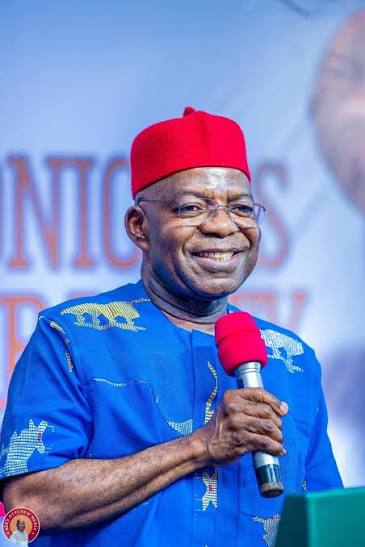
By Governor Alex C. Otti, OFR
The dreams and deeds of our ancestors gave us our unique identity as a community of courageous individuals. We have come thus far as a people, as Ndigbo, for the simple reason that our fathers and their fathers taught us to be brave, to take on life with an optimistic mindset but to also appreciate that success may not arrive at the first attempt.
We travel to the ends of the earth in seeming pursuit of riches but our journeys most times are driven by something more profound; the quest for meaning and the fulfilment that comes from giving life your all.
Our love for the oceans, roads and air is remarkable but what stands us out in the end is simply the fact that however far we travel, we do not forget the homeland; we do not abandon the culture that stirred our appetite for success — the philosophy that pushed us to seek the fullest expression of our potential.
Our ancestors made no claims to perfection but it is beyond dispute that they did the best they could to preserve and advance our civilisation; they passed onto us, the eternal torch of wisdom, ambition and an enduring appreciation of the superiority of the collective over the individual.
They taught us the principles of dialogue, the fine art of conversations, the science of building consensus and the courage to freely express ourselves without fear of being wrong or scorned.
It is therefore fitting that each year, a day is set aside to remember and honour the men and women who walked this earth before us; the parents and grandparents who in their striving, failing and rising, taught future generations of Ndigbo, enduring lessons in faith and resilience.
On this note, distinguished ladies and gentlemen, I would like to specially thank the leadership of Ohaneze Ndigbo through the years, for the consistency of the annual Igbo Day celebrations. It is fulfilling to observe that the interactions and debates that attend these celebrations are set up to reawaken us to the marvel of our identity, point us to the great exploits of our forebears and challenge us to rise beyond the limitations of the hour and instead, reach for the greatness that is our eternal heritage.
Long before the deception of political gamesmanship, classism and the distortion of religion for unwholesome agenda, we are one and the same people. Whatever we imagine to be our differences in cultural outlook and philosophies of life and success, we take collective pride in the exploits and wisdom of our common ancestors; they understood the importance of individual voices and introduced traditional platforms that gave every adult member of the community, the right to be heard, the freedom to hold an opinion and the aptitude to differ without malice.
Our republican philosophy of governance made stakeholders of men and women and assigned important roles to every adult in the combined pursuit of order, security and progress.
Beyond our age-old appreciation of the inalienable rights of individuals to define and follow their preferred trajectories within the boundaries of reason and law, our ancestors also achieved great feats in metallurgical sciences as established by ancient archaeological evidence in Opi, Lejja and Igbo Ukwu.
On a day like this, we owe a common duty to history and posterity to honour the giants who pushed themselves to achieve great things and braved impossible odds to write their names in the sands of time. It is especially fitting and symbolic that this year’s celebration is happening here in Umuahia, a city of immense significance in the grand chronicle of Igbo evolution and renaissance.
I would like to appreciate the President-General of Ohaneze Ndigbo, Distinguished Senator John Azuta-Mbata, and the body of decision-makers within the apex Igbo socio-cultural organisation for inviting Abia to host our dear brothers and sisters from different parts of the country.
On this note, may I now formally welcome you all to Umuahia, the capital of our dear State, for the 2026 World Igbo Day Celebration. May I also thank the participants from the various States for the grand cultural displays we have witnessed. Today’s event is proof that in addition to our intellectual and entrepreneurial exploits, our traditional systems of expression and hospitality are alive and well.
In a very special way, I would like to thank my brother Governors and the representatives of the participating States for their active involvement and support for the successful hosting of the 2026 World Igbo Day Celebration. Let me convey the apologies of my brother governors who were unable to join us and further state that they had requested that I represent them and I am so doing.
Great commendations are also due to my dear brother, Professor Kingsley Chiedu Moghalu, OON, for the brilliance of his keynote lecture yesterday which set the tone for today’s event. I want to particularly thank Professor Moghalu and other members of the team for developing the Igbo Charter for Strategic Engagement for National Development.
Considering the intellectual disposition of Professor Moghalu, his extensive understanding of the demands and dynamics of economic evolution and the composition of the committee that he headed, I am not surprised that they took time to painstakingly develop a framework that not only guarantees the attainment of clearly-defined political and economic outcomes; but recognises that the future will be shaped by the decisions and actions we consistently commit ourselves to, over the next few years.
I am glad that men and women of sound intellect and character are quietly stepping into the public arena to remind us a thing or two about our identity; especially in the light of the persistent attacks on the virtues of learning by a few misguided elements.
We are therefore invited to remain vigilant, constantly reminding ourselves that we come from a long line of ancestors who cherished knowledge over titles, a good name over riches and independence of thought over the appeal of playing to the gallery. Our progress will be stalled if we do not come together as a people united by a common heritage and driven by the hunger to leave a better community for our children.
I would again like to appreciate the leadership of Ohaneze Ndigbo for making this year’s event about building and strengthening the bond of unity. Njiko ka, the theme of this year’s event is very apt for a number of reasons; firstly, it serves an important reminder that republicanism and selfishness are not exactly synonymous.
Agreed that it is fair to allow individuals to decide how they want to function, there is, however, no gain in plotting to undermine others just because you disagree with them. Yes, we may actually not be on the same page on a number of issues, including political and economic concerns, but we have to appreciate that none of us will be here forever, we should therefore consistently think about our children when making decisions or committing ourselves to a course.
Unity, it must be made clear, invites regular sacrifices and discipline; a commitment to cutting our pride and donning the garb of humility, patience and understanding in our regular undertakings. May I also emphasise that unity does not mean unanimity of opinion on every issue but a consciousness that our individual desires cannot be superior to the aspirations of the majority.
The demand is for all of us to become more selfless and work more closely for the collective interest of our people. The era of disunity, discord and acrimony, by virtue of today’s celebration, must now give way to the age of peace, understanding and sincerity of intentions as we begin to engage more, interact and share ideas on common development programmes and projects that would benefit our people across generations.
The era of Ikeotuonye has now been replaced with the era of Njikoka. Let me conclude by pointing us to 3 noteworthy practices that capture how our people interact with and prepare for the future. The first is the old tradition of omugwo through which mothers build interminable bonds of affection with their grandchildren, the second is the apprenticeship system which encourages the transfer of trade knowledge and skills across generations and the third is the common appetite for the education of our children and it does not matter one’s economic status, our people, whether rich or poor, would trade anything to give their children and wards the headstart that sound education guarantees.
The message here is that our success as a people would be determined in the main by how we continue to deliberately prepare the next generation of Ndigbo for the opportunities of the new global economic order. As parents and leaders, we are invited to make a firm commitment to education. Education is the key to unlocking the promises that tomorrow holds, so there can be no compromises.
The more significant demand is to create systems that enable the seamless transfer of our knowledge and body of advantages in our various fields of expression to those coming after us. Our people have achieved remarkable feats in different areas of human endeavours, the onus is now on us to pass on to our children, the values and philosophies that enabled our distinction through generations.
Violence, crime, intolerance, dishonesty and destructive dispositions must have no place in our land; it is of great priority that we confront headlong, the rising menace of substance abuse amongst our young people because the signals are troubling.
I am, however, confident that we have it in us to rise to the challenges of the day, confront them frontally and return our young ones to the values of moderation, patience and excellence.