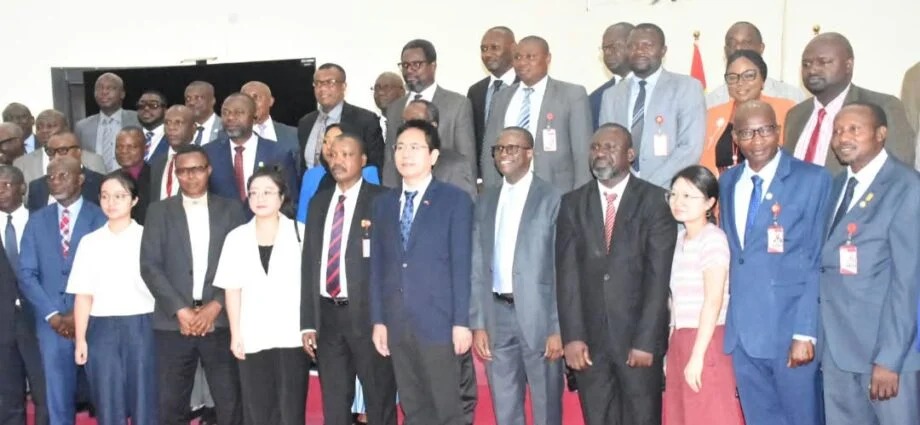
The Independent Corrupt Practices and Other Related Offences Commission (ICPC) has called for stronger collaboration with China to strengthen Nigeria’s anti-corruption framework.
The Chairman of ICPC, Dr Musa Aliyu, SAN, made the call on Monday at the third edition of the International Diplomatic Dialogue held at the ICPC Headquarters in Abuja.
Aliyu said that Nigeria had a lot to learn from Beijing’s institutional and legal reforms.
The dialogue had the theme: “Experience Sharing in Anti-Corruption Policies and Strategies: The Chinese Perspective.”
The Chinese Ambassador to Nigeria, Amb. Yu Dunhai, who was represented by the Chinese Cultural Counsellor in Nigeria, Mr Yang Jiangxing, was the guest speaker.
The ICPC chairman said the event was timely, given the devastating effects of corruption on the political, socio-economic and developmental strides of nations that allowed it to thrive unchecked.
He noted that Nigeria and China established diplomatic relations in 1971, and that the relationship had grown to cover economic, strategic, trade and infrastructure cooperation.
The ICPC chairman said Nigeria was particularly interested in the work of China’s anti-corruption institutions, including the National Supervisory Commission (NSC) and the Central Commission for Discipline Inspection (CCDI).
“We believe that China has made significant efforts through its anti-corruption bodies. The Commission will be glad to share from the strategies, policies and enforcement actions adopted by the Chinese Government to fight corruption,” he said.
Aliyu stated that learning from comparative experiences and best practices was critical as Nigeria deepened its anti-corruption efforts and adapted innovative approaches to local realities.
He said the dialogue aligned with the ICPC and its training arm, the Anti-Corruption Academy of Nigeria (ACAN) on fostering international cooperation and promoting evidence-based approaches to corruption prevention.
The chairman recalled that the commission had earlier hosted similar dialogues with the Kenyan High Commissioner in June and the Indonesian Ambassador in August, as part of efforts to broaden knowledge exchange.
He commended the Provost of ACAN, Prof. Sheriff Ibrahim, and his team for organising the initiative, and urged participants to engage actively to build stronger partnerships.
“Corruption remains one of the greatest threats to development, but together, through collective action and unwavering commitment, we can build institutions where transparency and accountability thrive,” Aliyu said.
The Chinese Ambassador to Nigeria, Amb. Yu Dunhai, remarked that Nigeria and China could deepen anti-corruption cooperation by exchanging experiences on prevention and values education, rather than focusing only on punishment.
The envoy said corruption was a global governance challenge, and that every country must think about how to prevent abuse of public power and protect public resources.
He traced China’s approach to integrity to Confucian’s teachings, noting that over 2,500 years later, principles such as benevolence, justice, self-discipline and responsibility still shaped public conduct in China.
“Confucius taught that good governance did not begin with government institutions alone. It began with people. More specifically, it began with the character of those who exercised responsibility and authority,” Dunhai said.
He highlighted five Confucian teachings relevant today: “ren” or benevolence; the Golden Rule of empathy; “xin” or trustworthiness; the principle that means matter in pursuit of wealth; and learning from both good and bad examples.
According to him, public power is not personal property but a responsibility, and corruption is ultimately about misuse of power, not just money.
“Integrity creates trust. Trust creates stability and stability creates the foundation for development. So integrity is not simply a moral virtue. It is also an economic and institutional asset,” he said.
The Provost of ACAN, Prof. Sheriff Ibrahim said that Nigeria could achieve transformative development by adapting China’s blend of Confucian ethics, political will and technology-driven enforcement to fight corruption.
Ibrahim lauded the ICPC chairman for providing leadership that yielded measurable results.
He said under Aliyu’s leadership, in 2025, ICPC recovered ₦37.44 billion and $2.35 million through asset seizures and forfeitures, investigated 263 cases, and filed 61 cases in court with a 55.74 per cent conviction rate.
He added that the commission secured a five-year prison sentence for Prof. Cyril Ndifon of the University of Calabar for abuse of office and cyberbullying, and won the SAEMA Award for Diligent Investigation for the second time.
For the first half of 2026, the Provost said ICPC had recovered over ₦5.8 billion in proceeds of crime and restrained billions in cash and assets as part of national accountability efforts.
He noted that the commission had also commenced the 7th phase of constituency and executive projects tracking, monitoring 1,500 schemes valued at ₦610 billion across 21 states and the FCT.
Turning to China, Ibrahim said the country in the 1970s was among the poorest nations on earth, with 88 per cent of its population living in absolute poverty on less than one dollar a day and a per capita income of roughly 155 dollars.
He said major thoroughfares were dominated by bicycles, electricity was scarce in rural areas and more than 75 per cent of the workforce labored manually in agriculture before reforms began in 1978.
Contrasting that with China of today, he said the country’s nominal Gross Domestic Product reached 15.1 trillion dollars in 2020 and over 19 trillion dollars by mid-2020s, with manufacturing share rising to about 35 per cent of global output.
He said China lifted over 800 million people out of extreme poverty by 2020, urbanisation rose from 20 per cent to over 60 per cent and life expectancy increased from 60 years in the 1970s to over 77 years.
On how China achieved the turnaround, Ibrahim attributed it to political will since 2013 under President Xi Jinping, coupled with technological applications in anti-corruption enforcement.