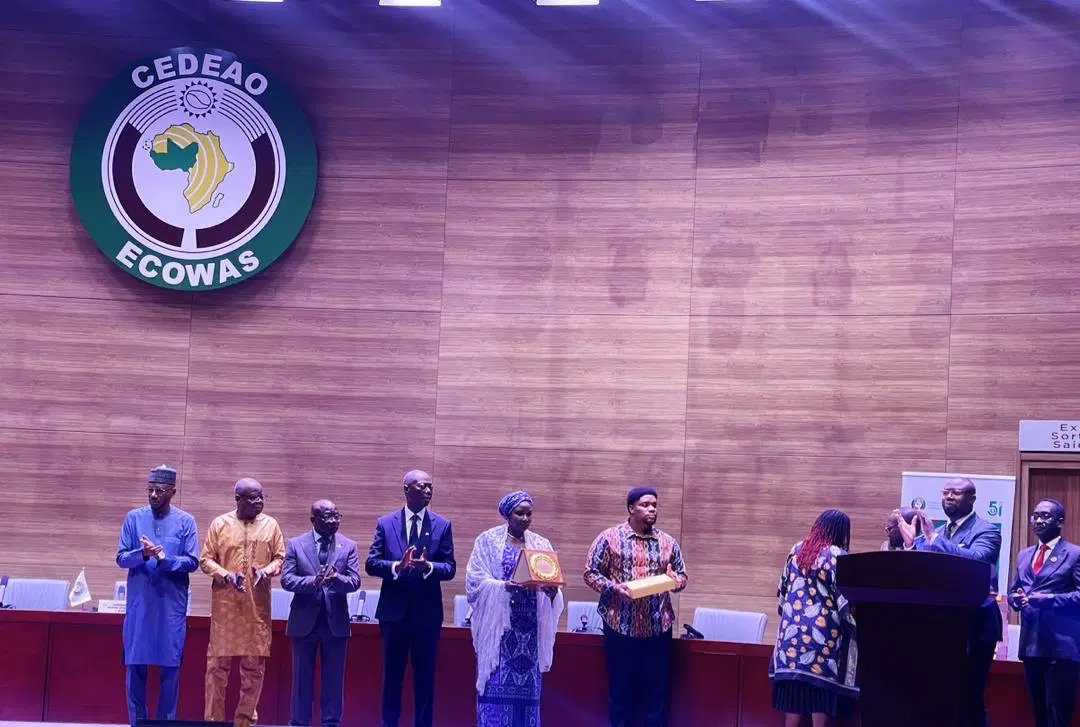
Decades after peace was restored to war-torn Liberia, Sierra Leone, and Guinea-Bissau, a diplomatic push to rewrite West Africa’s conflict history unfolded on Thursday, August 27, 2026, at the new headquarters of the ECOWAS Commission in Abuja.
Speaking at the official book launch of Fighting Bushfires: ECOWAS and Peacemaking in West Africa The Experience and Learning Curves, regional leaders and military veterans issued a sharp rebuke against Western narratives that attribute the restoration of peace in the sub-region primarily to foreign powers.
The event held to unveil a series of definitive publications capturing ECOWAS’s 50-year legacy of peacebuilding, doubled as a solemn commemoration. Former commanders of the ECOWAS Monitoring Group (ECOMOG) and journalists were awarded the Symbolic Peace of the Rose Award for their frontline sacrifices.
Delivering the keynote remarks, Nigeria’s Minister of Defence, General Christopher Musa, rejected online accounts and international publications that minimize the decisive role played by African troops.
”If you go to the internet, you see their story that they were the ones that liberated Sierra Leone and Liberia,” Musa told the audience. “And so when I watched that video, I asked, ‘Where did you write it?’ You don’t have an analytical reference. Nobody ever imagined ECOWAS was going to succeed… But even without the experience, we went in, fought through, and came out successfully.”
General Musa emphasized the heavy personal price paid by West African armed forces, revealing that ten of his course mates from the Nigerian Defence Academy died during the Liberian conflict. He urged African nations to maintain unity to ensure those sacrifices were not in vain.
Dr. Babatunde Afolabi, Director of Political Affairs at the ECOWAS Commission, echoed the Minister’s stance, emphasizing that West Africa must actively control its own history.
”This is about giving West Africa greater ownership of its history, ensuring that the region’s experiences are accurately recorded, and using those experiences to shape future approaches to peace and security,” Afolabi stated, warning against misconceptions surrounding the bloc’s interventions.
The ceremony paid tribute to key commanders who led ECOMOG missions through the 1990s, including Lt. Gen. Arnold Quainoo, Maj. Gen. Joshua Dogonyaro, Maj. Gen. Tunji Olurin, and Maj. Gen. Victor Malu.
The commission also honored journalists who covered the conflicts, notably Nigerian reporters Krees Imodibie of The Guardian and Tayo Awotusin of Champion Newspaper, who were killed in Liberia by forces loyal to Charles Taylor, alongside veteran reporters Lindsay Barrett and Ben Asante.
As ECOWAS prepares to celebrate its 50th anniversary, officials stressed that the lessons of ECOMOG’s conventional warfare interventions remain vital today as the sub-region confronts modern asymmetric threats and political instability across the Sahel.