By Victor Anazonwu
No. 1 Bishop Anyaogu Street was the last building on the street—the point where the road seemed to come to an abrupt end. Just a few metres beyond the edge of the building, a railway track drew a literal line across the landscape, as though saying: no crossing beyond this point.
This was before a road was constructed across the railway line to link Uwani directly with Ogui New Layout, Enugu.
Beyond the tracks, at that time, lay overgrown, dusty bushes, with tall grasses poking their noses into the sky beneath the hazy Harmattan. There was also endless litter, including the ubiquitous spent bullet casings left behind by a war that had only recently ended.
The railway came alive several times a day, usually with ample warning. First came the long blast of a train horn from somewhere in the distance. Minutes later, after two or three more blasts—each seemingly louder than the last—the train arrived in a noisy clatter and a cloud of thick smoke.
Gbagam-gbagam, gbagam-gbagam, gbagam-gbagam…
That was the unmistakable sound of the great iron wheels rolling over the joints in the thin iron tracks. The metallic orchestra rose to a crescendo as the train finally came into view and glided past the edge of our apartment building like some enormous iron snake.
For a minute or two, the ground—and sometimes the entire building—seemed to tremble.
Then, just as suddenly, the noise began to recede. The horn sounded increasingly faint until, eventually, there was nothing left but silence.
It was in these surroundings that I first met Uncle Pal Akalonu in the early 1970s.
He lived in Flat 6 of a long, single-storey, eight-flat apartment block owned by a wealthy contractor known as Franco Builders. My family lived in Flat 8, making Uncle Pal our next-door neighbour on the ground floor. Both families also shared the same backyard, which opened through a small gate onto a walkway, some bushes, a block-moulding factory and, farther away, the boisterous Kenyatta Market.
Everyone called him Uncle Pal or Ndaa Pal.
“Ndaa” is an affectionate form of address used by younger people for older relatives and respected elders, particularly in parts of Owerri, present-day Imo State. Yet here we were in Enugu, and everyone—including people much older than he was—used the expression in addressing him. I would later realise that this man whom we addressed with such deference was actually only in his mid thirties at the time.
He was the first and only person I know who bore that name Pal. Paul was a more familiar name. Did Uncle Pal remove the “u” in Paul to make his name more stylish? I would never know, and never asked.
Uncle Pal was a handsome, fair-complexioned man who walked with a slight swagger. He was invariably well turned out, usually in a neatly pressed English suit or blazer, often with a striped shirt underneath.
He shaved every morning without fail.
As a little boy, I found the ritual fascinating. He would stand before a mirror wearing nothing but a large yellow towel wrapped around his waist, his moustache area, jaw and neck covered in white shaving lather. To my childish eyes, he looked rather like Father Christmas making a daily morning appearance.
Then he would emerge, freshly groomed and smartly dressed, carrying his briefcase and hurrying off to work.
He wore a distinctive cologne—or perhaps it was aftershave; I could never have known the difference then—that lingered in the air long after he had left.
When Ndaa Pal returned from work in the evenings, the atmosphere changed.
You could hear him exchanging pleasantries with neighbours as he strolled into the compound. He smiled easily and had a trademark laugh that seemed to roll out of his deep, resonant voice.
As children, we usually ran out to greet him.
He was remarkably attentive. He knew our names, called us by them and often patted our little heads affectionately. On our lucky days, he handed us biscuits or sweets.
That was the highlight of our day.
Then came the familiar metallic jingle of his large bunch of keys as he opened the door to his flat. After that, silence until the next morning.
You knew Uncle Pal was home for the weekend when the record changer—the music box of that era—came alive.
He played a lot of folk and highlife music, particularly music in the Owerri tradition. Occasionally there was Fela or O-s-i-b-i-s-a. He loved singing along with the records, and his voice would sometimes drift through the walls and into our flat.
I suspect that my own early taste for Owerri highlife music was acquired partly by eavesdropping on Ndaa Pal’s remarkable record collection.
Then came the day Uncle Pal married Aunty Beatrice, whom we called Ndaa Beaty.
The entire neighbourhood seemed to go into celebration.
Our compound and street became something of a Mecca, with a seemingly endless stream of guests and well-wishers arriving for days. Relatives from “home” descended on the place and camped in his flat for even longer.
Uncle Pal was, quite simply, a people’s man.
My father, with whom he had developed a close friendship, was his best man at the wedding.
“Danny Boy!”
That was the affectionate name Uncle Pal gave my father.
Dad, in return, called him “Ndaa Pal”, just as everyone else did.
Many years later, I stumbled upon a photograph of the wedding in one of my father’s old photo albums. There was Uncle Pal, signing the marriage register, with his beautiful bride beside him and my father standing behind them.
The photograph was remarkably well preserved.
They were two dashing young men in their prime.
Now both have gone the way of all flesh.
Such is life.
I gradually discovered that Uncle Pal was more than just the smart, friendly man who lived next door.
He began appearing on television, presenting a weekly live musical programme on NTA. He would walk onto the stage before a live studio audience, introduce the artiste or band of the day with a flourish, and yield the floor.
He also interviewed band leaders and musical maestros—many of whom he seemed to know personally.
Suddenly, we were the little kids living next door to a television celebrity.
We felt like celebrities by association.
Around this period came Sweet Breeze, a musical group of four or five young men who performed under Uncle Pal’s tutelage. They sometimes rehearsed in our building.
We children would stand on our toes, crane our necks and peer through the windows to watch them practise.
We could never quite understand how anyone could manipulate those guitar strings and coax such beautiful sounds from them.
We only knew that we wanted to do it too.
One of the prominent members of Sweet Breeze was Ndaa Basil, Uncle Pal’s younger brother, who lived with him for a while.
For some years, Sweet Breeze was a musical sensation. In later years, Uncle Pal was also closely associated with Christy Essien Igbokwe who went from teenage prodigy to national and international musical icon.
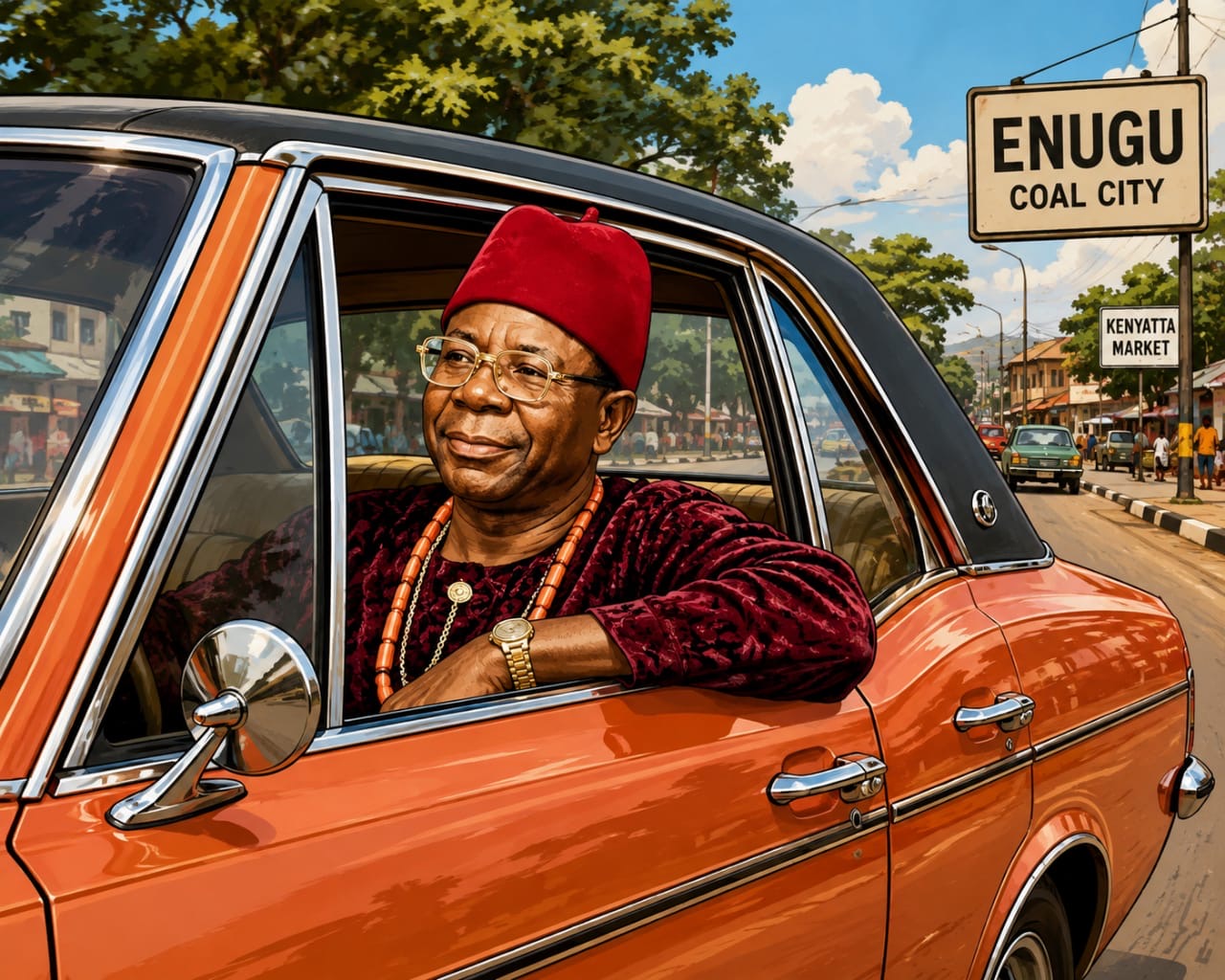
Then Uncle Pal bought a brand-new Ford car. I think it was a Cortina.
That car changed the complexion of our little parking lot.
It was a dark-orange beauty with a black top that, to my childish eyes, looked almost feminine.
Until then, most of the cars in the compound were ageing survivors that had somehow made it through the war. My father had an ancient Hillman. The Ogbogus in the next block of flats had a blue Peugeot 403 that seemed to compete with Dad’s Hillman over which one could be more stubborn about starting in the morning.
The Oparas upstairs had an aged Volkswagen Beetle that had once been white.
Uncle Pal changed all that.
We took particular pleasure in admiring his Cortina every morning on our way to school.
Perhaps he also challenged the other men in the block and down the street, because before long, newer cars began appearing in the parking lot—including my father’s white Opel Rekord.
Years later, I learnt that this sudden transformation in the fortunes of ordinary civil servants was part of the story of the famous Udoji Awards, when the Federal Government increased the salaries and allowances of public servants and paid arrears.
For children like us, however, economics was the last thing on our minds.
We simply knew that Uncle Pal had a beautiful new car.
My family eventually moved out of No. 1 Bishop Anyaogu Street in late 1974 to another part of town.
And with that move, Uncle Pal slowly faded from the immediate landscape of my childhood.
The baritone voice.
The infectious laughter.
The lingering perfume.
The music from the record changer.
The biscuits and sweets.
The shiny yellow Ford Cortina.
All became fragments of a distant childhood.
But Uncle Pal remained a presence on television and later served as General Manager of NTA Aba. He was widely regarded as an important figure in the development of highlife music in Eastern Nigeria.
A Punch newspaper obituary summed up his professional legacy this way:
“Akalonu… was a songwriter, producer, promoter, director, mentor and cultural custodian whose contributions to the development of highlife music in Eastern Nigeria spanned generations.”
That is the larger story.
But for me, Uncle Pal was something more personal.
He was the kind, gentle, handsome man who lived next door.
The man who smiled at everybody.
The man whose laughter could be heard across the compound.
The man who knew the names of little children and sometimes rewarded them with biscuits and sweets.
The man whose music introduced a little boy to the sounds of Owerri highlife.
The man whose life, from my childhood vantage point, seemed to be one long celebration of music, friendship and good humour.
And so I have chosen not to mourn Uncle Pal with this tribute.
I prefer to celebrate him.
He was a joyful soul.
A jolly good fellow.
He loved a good laugh. He loved music. He loved people.
He lived the highlife—literally.
He passed away in 2026 at the ripe old age of 91.
If he could, I imagine he would have called one of the numerous bands he mentored to celebrate his own passing. He would have put the music on his turntable and let the sounds of the Oriental Brothers, the Peacocks or some other great highlife ensemble fill the night.
He would have popped a drink, raised his glass and called for a toast.
Perhaps he would even have laughed that big, warm, unmistakable laugh of his.
For he was, and will always remain in my childhood memory, a jolly good fellow.
Fare-thee-well, Uncle Pal.
Say me well to your old friend, Danny Boy.
Victor Anazonwu is a member of The Renaissance Online Magazine editorial board.