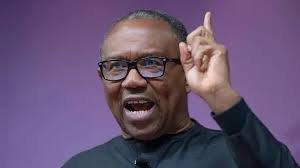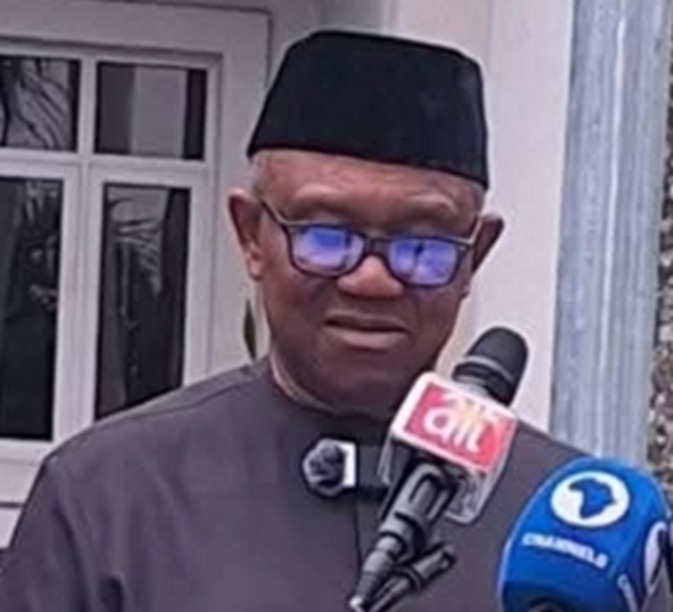
The presidential candidate of the Nigeria Democratic Congress (NDC), Peter Obi, has unveiled his agenda to reset Nigeria, promising to prioritise security, job creation, human capital development, and inclusive economic growth if elected in the 2027 presidential election.
Obi spoke during a press conference in Onitsha, Anambra State, on Friday, August 21, 2026, to mark the commencement of the 2027 Presidential and National Assembly campaigns.
The campaigns officially kicked-off on Wednesday, August 19, 2026.
He stated that the commencement of the campaign period offered Nigerians an opportunity to assess the records, ideas and plans of candidates seeking their mandate at a time the country was facing serious economic, security, and social challenges.
Obi lamented that Nigeria is at a defining moment, with millions of citizens grappling with poverty, insecurity, unemployment, weak infrastructure, unreliable electricity, and the high cost of doing business.
Citing data from the International Monetary Fund (IMF), Obi noted that 63 per cent, or more than 140 million Nigerians, live at or below the national poverty line, while humanitarian agencies estimate that about 35 million people will require food assistance during the 2026 lean season.
He added that about 3.6 million Nigerians remained internally displaced, largely as a result of conflict and insecurity, while millions of young people enter the labour market each year without adequate productive opportunities.
“These are more than statistics. They reflect the daily realities of Nigerian families, farmers, workers, students, and businesses,” he said.
Obi, however, expressed optimism that the country could overcome its challenges, arguing that Nigeria had the people, resources, market, talent and enterprise required to build a more prosperous nation.
“I enter this contest with one firm conviction: Nigeria can work, and Nigeria must work,” he said.
Security, Jobs, Economic Growth
The former Anambra State governor stated that his administration would focus on transforming the economy from one driven largely by consumption to one centred on production, investment, enterprise, and human capital.
Obi promised to improve agricultural productivity by securing farming communities, expanding irrigation, improving rural roads and storage facilities, and connecting farmers to finance and markets.
He also pledged to strengthen manufacturing and agro-processing to enable Nigeria to produce more finished goods, create jobs, and capture greater value from its resources.
According to him, government would create a business environment that allows entrepreneurs to invest, employ workers, and expand without unnecessary regulatory and infrastructure barriers.
“Every naira should have a clear purpose, and major public investments should have measurable outcomes,” Obi said.
He explained that the objective would not simply be economic growth but an economy capable of producing more, employing more people, creating wealth and improving living standards.
On insecurity, Obi asserted that no nation could prosper when its citizens could not safely live, farm, travel or conduct businesses.
He promised to strengthen intelligence gathering and coordination among security agencies, improve policing and border management, and deploy technology more effectively in combating insecurity.
He also advocated the decentralisation of security management, with strong coordination among the different levels of government.
Obi pointed out that security policy must also address the socio-economic conditions that make vulnerable young people susceptible to criminal recruitment, stressing that farmers could not produce food if they could not safely access their farms.
Investment in Young Nigerians
The NDC candidate described Nigeria’s youthful population as an opportunity rather than a burden, saying government must equip young people with the skills required to participate productively in the economy.
He promised to improve basic education, strengthen universities, and expand technical and vocational training.
Obi emphasised that Nigeria needs professionals such as doctors, engineers, scientists and lawyers, as well as technicians, mechanics, builders, nurses, farmers, programmers, manufacturers, artisans, and entrepreneurs.
“Our goal is to secure a high demographic dividend from our youth bulge,” he remarked.
Obi also identified healthcare as a critical component of human capital development, pledging to strengthen primary healthcare, improve maternal and child health, expand access to essential medicines and equip healthcare workers to deliver effective services.
Regional Development
The former Anambra State governor said that every part of the country must become productive and benefit from Nigeria’s economic transformation.
He identified agriculture, livestock, irrigation, agro-processing and manufacturing as key areas for development in the North-West, while advocating reconstruction, agriculture, education, enterprise and regional trade in the North-East.
For the North-Central, he proposed greater food production and processing alongside responsible development of mineral resources.
Obi noted that the South-West could build on its strengths in manufacturing, technology, finance, trade and the creative economy, while the South-East could expand its entrepreneurial and industrial base through improved infrastructure, connectivity, and access to investment.
He also proposed greater value creation from oil and gas in the South-South, alongside the development of maritime services, fisheries and agriculture, with stronger environmental protection.
Governance and Public Accountability
Obi assured that his administration would pursue fiscal discipline while protecting investments in education, healthcare, security and infrastructure.
He equally pledged to reduce wasteful spending, improve public revenue without stifling businesses and establish institutions capable of sustaining development beyond individual administrations.
Referring to his experience as governor of Anambra State, he mentioned that public office should be treated as a responsibility rather than a reward.
“Government must manage resources responsibly, set clear priorities, and measure the outcomes of its decisions. Public office is not a reward; it is a responsibility to the people.”
Obi also highlighted the governing experience of his running mate, Senator Rabiu Musa Kwankwaso, particularly his focus on education, technical training, scholarships, infrastructure and human-capital development during his tenure as governor of Kano State.
While acknowledging that their experiences differed, he affirmed that they had reached a common conclusion that Nigeria must invest in its people and manage public resources with discipline.
Rejects Ethnic, Religious Politics
Obi called on Nigerians to scrutinise the records and proposals of all presidential candidates and demand evidence behind their promises.
He urged politicians and their supporters to debate ideas without hatred, compete without violence and disagree without undermining national unity.
He also rejected campaigns based on ethnicity and religion, saying the 2027 election should be guided by capacity, competence, compassion, character and commitment.
“Our campaign will focus on the urgent concerns of Nigerians and not on ethnicity or religion,” he said.
Obi further challenged presidential candidates to personally engage Nigerians rather than rely on proxies and surrogates during the campaign.
He reiterated that candidates seeking the presidency must be prepared to travel across the country, meet citizens, answer their questions, defend their records, and subject their plans to public scrutiny.
“True leadership requires presence and empathy. No one can lead from the front without standing with communities across Nigeria devastated by banditry, criminality, terrorism, and flooding,” he stated.
Obi pledged that he and his running mate would take their campaign directly to Nigerians, listen to their concerns, and openly present their plans for the country.
He maintained that the ultimate objective of their campaign was to unite Nigeria, secure the country, place it on the path of economic and inclusive growth, and move it from consumption to production.
“Nigeria’s challenges are real, but so are its opportunities. We have the people, resources, enterprise, and creativity to build a safer, more productive country. Our task is to turn these possibilities into results,” he added.