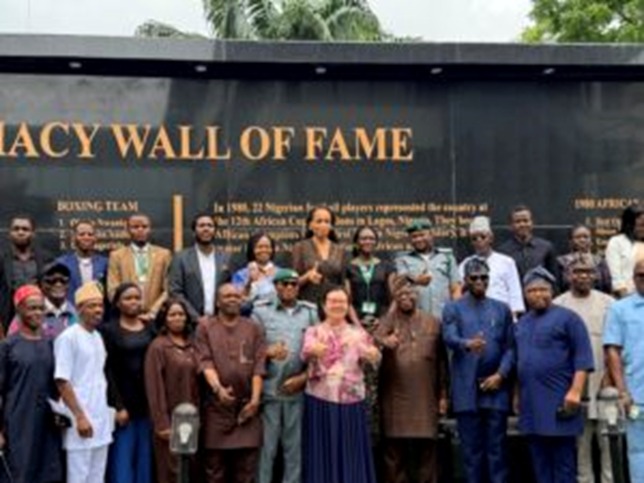
Ms Yan Yuqing, Consul General of the People’s Republic of China, on Wednesday said her country’s zero-tariff treatment for African countries is already expanding exports to the Chinese market.
She said this at a seminar organised by the Centre for China Studies (CCS) in conjunction with the Embassy of the People’s Republic of China and Nigerian Institute of International Affairs (NIIA) in Lagos.
The seminar had the theme, “China’s Zero-Tariff Treatment for African Countries and its Implications for Structural Economic Transformation in Africa”.
Yan noted that barely three months after the zero-tariff policy took effect, China’s imports from Africa had begun to rise, with imports in May and June reaching RMB193.8 billion.
She said Nigeria’s performance had been especially striking, noting that bilateral trade reached 18 billion dollars, up 35 per cent, while Chinese imports from Nigeria rose by 80 per cent to $2.3 billion.
“The policy is designed to further open up the Chinese market and accelerate Africa’s economic development,” she said.
The envoy said tariff eliminations between three per cent and 10 per cent had also resulted in significant daubing for Nigerian exporters of products including sesame, cattle bone granules and liquified propane.
“Every 100 tons of sesame exported saves 11,000 dollars in costs, Nigeria’s annual export of 7,000 tons of cattle bone granules saves nearly 450,000 dollars.
‘’Also, on day one of the policy, a single shipment of 23,000 tons of Nigerian liquefied propane saves 300,000 dollars in tax, bringing fresh opportunities for broader bilateral economic and trade cooperation,” she said.
She added that China would strengthen supporting measures through green channels for African exports, commodity exhibition platforms and cross-border e-commerce to reduce trade costs and facilitate market access.
Yan, however, said Nigeria must translate improved market access into concrete export and investment gains by helping businesses meet China’s inspection and certification standards.
Also, the Director-General of the NIIA, Prof. Eghosa Osaghae, said the policy had come at a time of growing global debates over tariffs and protectionism.
He said Africa must, however, critically interrogate the policy and examine how it could secure equitable and sustainable benefits.
“The question will be: Can this incentivise industrialisation in Africa?” Osaghae said.
Osaghae called for an empirical assessment of the impact of earlier zero-tariff arrangements involving African countries, saying the continent must learn from previous experiences and avoid repeating mistakes.
Also, the Director, CCS, Mr Charles Onunaiju, said that the policy was an opportunity that required deliberate institutional and economic responses.
“Zero tariff is not a finish line; it is only a starting point and how it pans out essentially depends on how we respond,” he said.
Onunaiju also advocated converting Nigeria’s geopolitical zones into geo-economic zones that would compete on production and contribution to national wealth.
He urged governments to support industries and improve logistics, access to concessional facilities, customs procedures and institutional capacity.
According to him, Africa risks losing the opportunity, if it continues to sporting raw materials without building the capacity to process and add value to its products.
On his part, a Senior Fello, NIIA, Prof. Femi Otubanjo, said Nigeria must diversify its economy, industrialise and become more competitive to derive maximum benefits from the policy.
“We remain a dumping ground, if all we are doing is selling raw materials and unrefined minerals,” he said.
Dr Gambo Aliyu, Asst. Comptroller-General of the Nigeria Customs Service (Zone A) Zonal Headquarters, said African exporters would benefit from the zero-tariff opportunity.
Aliyu said that customs must create a system in which legitimate exports could move with minimal delays, while it continued to generate revenue and protect national security.
‘’Nigeria should look at the Chinese market, not only as a destination for commodities, but as a market for Nigerian-made products.
‘’This requires investment in processing, manufacturing, packaging, standard skill acquisition, and technology transfer, ‘’ he said.
He also raised concerned about high costs of production, noting that if this persisted, Nigerian products might still struggle to compete at the international stage.
“Tariff opportunity must be accompanied by reforms that reduce the cost of production and the movement of goods.
“These reforms matter because of the volume and complexity of international trade as it increases the dynamics of trade,” Aliyu said.