By Etim Etim
When we were in secondary school, Prof. Chike Edozien Obi was a renowned mathematician, reputed to be the first Nigerian to hold a doctorate in mathematics. Awarded Ph.D in 1950 by the University of Cambridge for his thesis titled ‘’Periodic Solutions of Non-Linear Differential Equations of Second Order’’, he had earlier obtained his first and second degrees from University of London as external student through correspondence courses.
Obi’s story fascinated my classmates and I in those days so much so that any one of us who was good in maths was nicknamed after Chike Obo. Dr. Obi died in 2008 at the age of 87. I am not sure if Nigeria has ever honoured him with a national award or named a street after him.
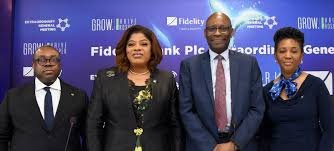
It’s been 18 years since the old man passed away, and his first son, Mustafa Chike-Obi, former chairman of Fidelity Bank, has come up with a new hypothesis of his own – not in science nor mathematics – but in economy and business. And unlike his father’s discovery, Mustafa’s proposition is set to create some controversies.
Speaking in a podcast ‘’Policy Without Politics’’ which he co-hosts with Ken Ikpe last week, Mustafa Chike-Obi said Eko Atlantic City could eventually contribute more to Nigeria’s GDP than Dangote Petroleum Refinery & Petrochemicals FZE (DPRP). He argued that although the refinery has transformed the nation’s downstream oil sector, Eko Atlantic’s long-term contributions to the economy would be broader because of its capacity to attract businesses, institutions and residents.
He said: ‘’Ten years from now, Eko Atlantic will employ more people than the refinery can employ in 10 years… by the time Eko Atlantic is a well thought-out, developed city, the impact on the Nigerian economy and GDP will, in my opinion, dwarf that of the refinery.’’ He then suggested that the federal government should adopt ‘’even-handed approach’’ to supporting landmark private-sector investments.
According him, although both the City and the refinery are both located in free trade zones, the City appears to depend less on government than the refinery. ‘’If government is going to invest in something as big, important and successful as the refinery, they should consider an investment in Eko Atlantic in some way’’, Chike-Obi said.
Chike-Obi’s argument is disputable and flawed in many ways, and it’s quite tempting to question his motives. By every parameter that measures an organization’s contributions to GDP, DPRP is and will remain a bigger contributor to GDP than Atlantic City.
A business contributes to a nation’s GDP primarily by producing goods and services, investing capital in the business to expand and engaging in international trade to earn foreign exchange and improve earnings. Specifically, any business that produces goods and services; buys new machinery, equipment, technology or construct new buildings, etc, trade with foreign partners creates jobs and pay taxes, are contributing to GDP of the country. To that extent, while DPRP is already making a direct contribution to our GDP, Eko Atlantic would be making indirect contribution through the businesses that would be operating from there.
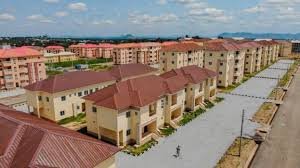
For readers who do not live in Lagos and might not be aware of what Eko Atlantic is, it is a new city near Victoria Island that is being developed on a 10-square kilometer parcel of land which was reclaimed from the Atlantic Ocean. Designed as a sustainable, self-sufficient smart city, it will accommodate about 250,000 residents and feature 10 distinct commercial and residential districts. It is roughly five times the size of Monaco, another haven for the rich, located near France.
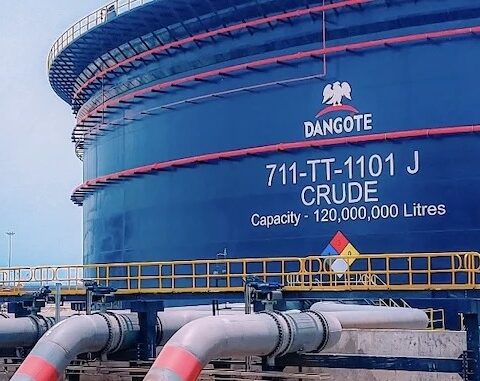
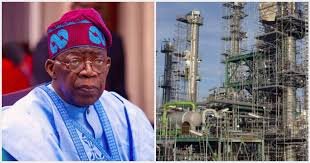
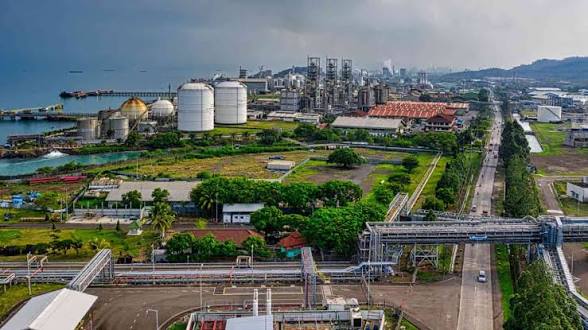
DPRP occupies a 25-square kilometer land size and has initial refining capacity of 640,000 barrels of crude oil per day which has recently been ramped up to 700,000 bpd. The complex also produces fertilizer and petrochemical products which are used as raw materials in pharmaceutical industry. DPRP and its integrated complexes (fertilizer and petrochemicals) currently employ over 15,000 people – direct and indirect – mostly Nigerians.
Eko Atlantic is still being built and a few businesses have already moved in there. United States has announced plans to build its biggest diplomatic mission in Africa in the Atlantic City. By the time it is fully occupied – say in the next 10 years – Eko Atlantic City will only accommodate service firms like the telecommunications; banks; IT and shopping malls. A big shopping mall has already been built. However, there is no room for manufacturing business in the new City.
DPRP is undergoing massive expansion to double current output in the next few years. Regarded as the world’s largest single-train refinery, DPRP is making significant impact on the life of every Nigerian, having solved Nigeria’s perennial problem of product shortages. It also earns foreign exchange. And contribute to recent increases in our foreign reserves from $3 billion in 2023 to $50 billion as at June. The Refinery has recently replaced the United States as the biggest fuel exporter to Europe.
On the other hand, Atlantic City is yet to be fully occupied. Further expansion of the city would be hampered by the United Nations Law of the Sea. The developers cannot dredge the Ocean beyond Nigeria’s continental shelf.
Without the capacity to expand, a business cannot grow and may suffer a decline in the long run. In terms of revenue, Eko Atlantic earns FX from sale of land spaces and the service charges residents and businesses pay. Even then, these do not add up to near DPRP’s FX and Naira incomes which come from both exports and in-country sales.
By 2030, DPRP is projected to earn N100 billion in a year, according to briefings the company recently gave to a visiting team from Goldman Sachs. This is double Nigeria’s total export income from crude oil. While the refinery impacts every household in the country, Eko Atlantic is meant for the wealthiest cream of the Nigerian elite who can afford a place there. It is barely known beyond Lagos!
DPRP is expected to push Nigeria’s GDP growth rate from 4.15% to 6.12%, amounting to a yearly contribution of $6 billion to the GDP. The refinery is an important part of the federal government’s $1 trillion economy vision. Upon full completion, Eko Atlantic is expected to contribute at least $1 billion to the Nigerian economy through sales of commercial space, premium on real estate and tourism income.
Thus, Chike-Obi’s theory that in 2036, the total combined output of all the businesses domiciled in Eko Atlantic City would be greater than the total output of DPRP, and so, the federal government should extend some incentives to the City, is therefore a misleading fallacy. You do not contribute more to GDP just because you are elitist.
Chike-Obi has the right to ask for incentives for anybody, but he should be reminded that the Chagoury group, of which the Atlantic City is a prominent member, has benefitted from generous incentives, favours and waivers from the government over the years.
Another member of the group, HiTech Engineering & Construction, got the N700 billion Lagos-Calabar Highway contract without bidding for it. It also got the Lekki expressway contract in 2008 and tolled the road until the protests of 2020 when the tolling facilities were dismantled. There are reports that the reason Wale Edun was asked to leave the cabinet some months ago was because he was reluctant to make payments to the Chagourys for jobs done, preferring instead to pay other local contractors.
Mr. Gilbert Chagoury, the Lebanese-Nigerian owner of the business group, is a good friend of the President’s. Last year, Chief Chagoury received GCON, the nation’s second highest national honour, from the President in Paris where he lives. Yes. President Tinubu took the laurel to him in Paris! Nobody knows the terms under which the Chagoury group acquired the rights to reclaim the land from the Atlantic Ocean, but in 2024, Aliko Dangote told reporters who visited his refinery that he paid $100 million to acquire the land on which the complex is built.
What more does Atlantic City want?