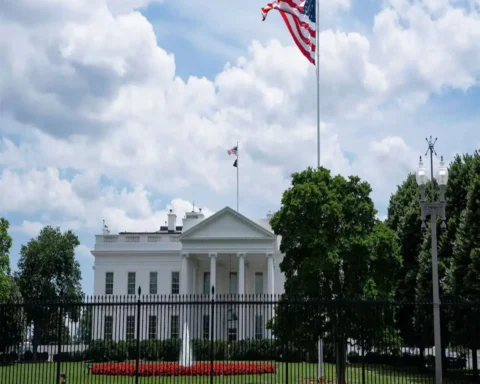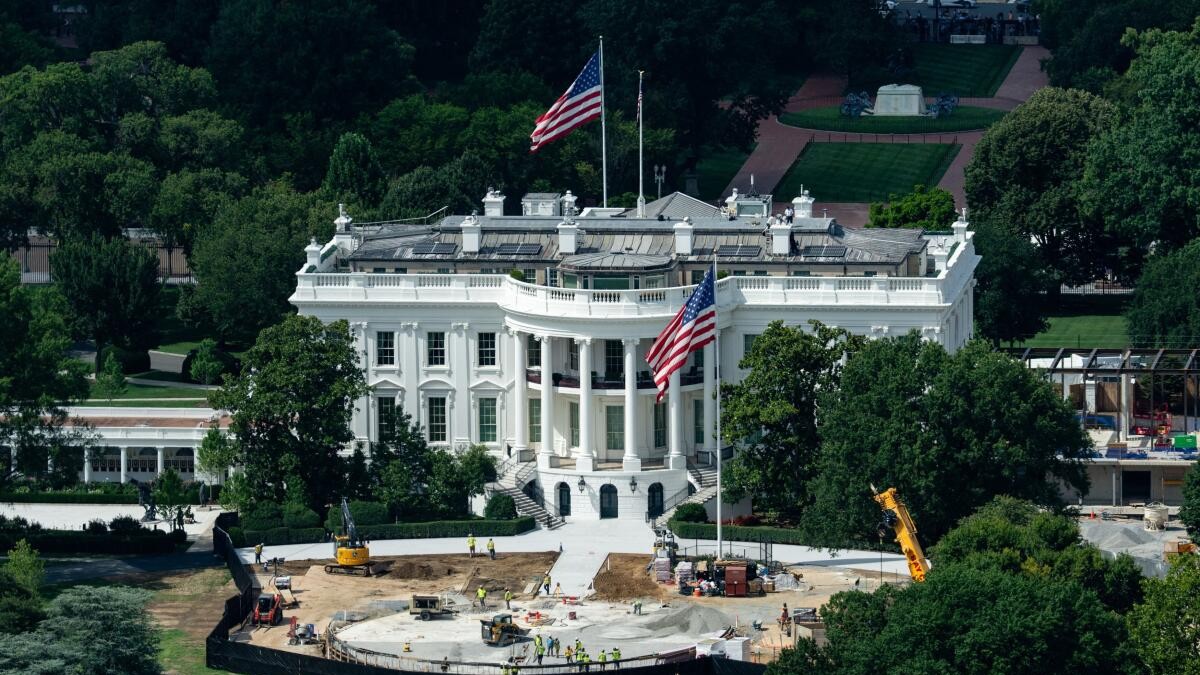
A federal appeals court on Friday ordered President Donald Trump’s administration to halt construction on a $400 million ballroom at the site of the White House’s demolished East Wing, dealing the Republican leader a major legal setback over the boundaries of executive authority.
In a 2-1 decision issued on August 7, 2026, the U.S. Court of Appeals for the District of Columbia Circuit upheld a preliminary injunction halting above-ground construction on the 90,000-square-foot redevelopment.
The court placed its order on hold for two weeks to give the administration time to file an emergency appeal with the U.S. Supreme Court. The majority ruled that major structural changes to the presidential residence require explicit authorization from Capitol Hill.
The ruling stems from a lawsuit filed late last year by the National Trust for Historic Preservation after the administration demolished the historic East Wing, originally built in 1902 to clear space for a massive new venue capable of seating up to 1,000 guests.
Writing for the majority, Circuit Judges Patricia Millett and Brad Garcia emphasized that the executive branch cannot unilaterally redesign the landmark:
“Whether or not a massive ballroom should be constructed is for Congress to decide and is not a matter for Executive self-help,” the majority wrote. “Congress has not ceded unfettered authority to the Executive Branch to dramatically redesign, reshape, and reconstruct the White House, the People’s House, to fit a particular President’s desires.”
The decision affirms a prior ruling by U.S. District Judge Richard Leon, who twice blocked above-ground construction while permitting limited underground work to continue. In dissent, Trump-appointed Circuit Judge Neomi Rao called the injunction a “blatant abuse of discretion,” arguing the judiciary overstepped its role regarding White House security and property improvements.
During oral arguments in Washington, government attorneys framed the project, which has faced cost increases from $200 million to $400 million, as a vital security and operational upgrade.
Justice Department Counsel Yaakov Roth argued that the project is privately funded and that the judiciary should not intervene: “The courts have no role… architectural preference should not take precedence over national security concerns”.
National Trust Attorney Thaddeus Heuer countered that the administration bypassed standard constitutional procedure: “They just don’t want to go to Congress.”
Responding on Friday evening via Truth Social, President Trump sharply criticized the ruling and confirmed an immediate push to the Supreme Court:
“This decision, made after much of the work has been done and paid for, is a National Security Threat at the highest level. It is also a National Disgrace,” Trump posted, defending the expanding project as “magnificent, safe, and secure.”
Unless the Supreme Court intervenes before the 14-day stay expires, all above-ground construction at the White House site must come to a complete halt.