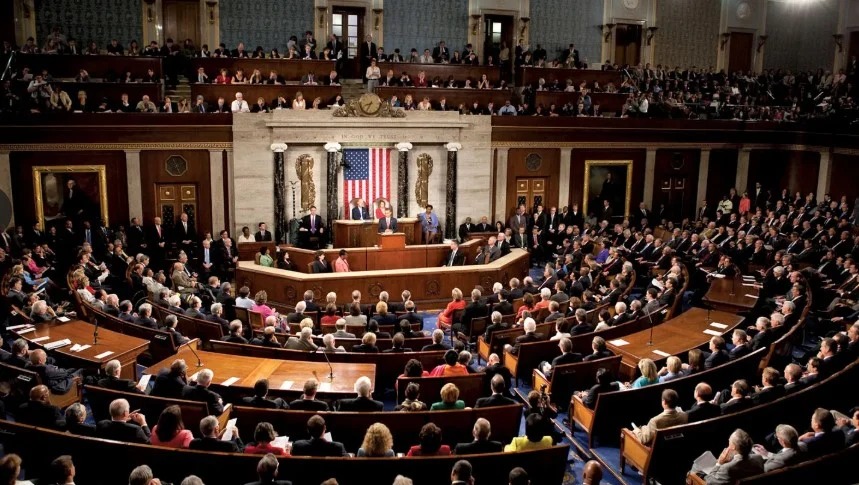
The United States House of Representatives passed a major spending bill on Wednesday that would freeze half of America’s foreign assistance to Nigeria unless the West African nation demonstrates measurable efforts to protect its Christian populations from sectarian and religiously motivated violence.
The provision, embedded within H.R. 8595: The National Security, Department of State, and Related Programs Appropriations Act, 2027, passed the House floor in a tight 217–209 vote. If signed into law, the legislation marks a stark pivot in Washington-Abuja relations, tying hundreds of millions of dollars in bilateral aid directly to human rights benchmarks.
Introduced into the broader package by Congressman Riley M. Moore (R-WV) alongside House Appropriations subcommittee chairman Mario Diaz-Balart (R-FL), the specific provision restricts 50% of U.S. foreign aid allocations to Nigeria’s central government. Release of the restricted funds would require the U.S. State Department to formally certify that the Nigerian government is taking tangible steps to halt escalating attacks against Christian farmers, churches, and schools.
The bill requires Nigeria to show measurable progress in combating threats posed by Fulani militant groups and other insurgent factions.
Abuja must actively facilitate the safe return of thousands of internally displaced persons (IDPs) to their ancestral lands, particularly in the highly targeted Middle Belt region.
The State Department is directed to submit a comprehensive compliance report detailing whether current U.S. security assistance inadvertently enables or exacerbates religious persecution in the region.
”This bill sends a clear message that the United States will continue to stand with persecuted Christians across the globe, especially in Nigeria,” Rep. Moore said in a statement following the vote. “For years, communities have faced unspeakable violence while the global community looked away. The U.S. is finally holding foreign governments accountable.”
The legislative push builds on executive momentum in Washington. In late 2025, the White House officially redesignated Nigeria as a “Country of Particular Concern” (CPC) under international religious freedom laws, a status that opens the door to potential sanctions and aid restrictions.
While lawmakers in Washington frame the measure as an essential defense of global religious liberty, the bill is expected to face heavy pushback. Critics and diplomats warn that slashing aid could weaken Nigeria’s broader counter-terrorism capabilities against groups like Boko Haram, potentially destabilizing the region further.
The spending package now moves to the U.S. Senate, where it faces an uncertain path amid a deeply divided legislature. Officials in Abuja have previously defended their security record, attributing regional violence primarily to climate-driven land disputes and resource scarcity rather than purely religious friction. However, if the Senate adopts the House’s stringent conditioning, the Nigerian government will face unprecedented economic pressure to overhaul its domestic security strategy.