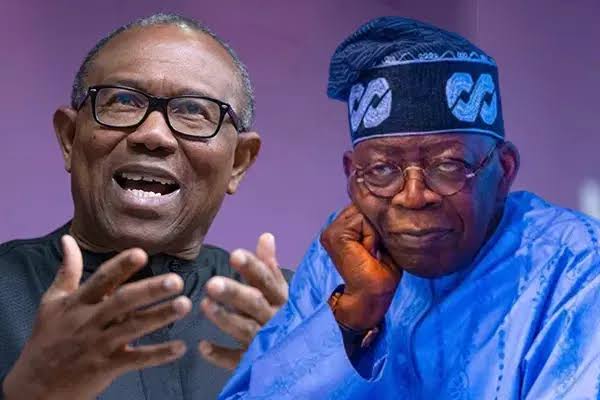
Former Anambra State Governor and Nigeria Democratic Congress presidential candidate, Peter Obi, has claimed that many Nigerians who supported President Bola Tinubu in the 2023 presidential election have suffered severe economic setbacks under the current administration, with some allegedly losing their businesses and falling into hardship.
Obi argued that the worsening economic situation has forced many business owners who once believed in the administration’s promises to rethink their political choices after experiencing the realities of governance.
The former presidential candidate made the remarks during an interview with media entrepreneur Chude Jideonwo, which was published on Wednesday.
Responding to questions on whether the popular movement that rallied behind his 2023 presidential ambition had diminished over time, Obi insisted that his support base had not only remained intact but had continued to grow as more Nigerians assessed the performance of the present administration.
According to him, many citizens who voted for President Tinubu based on his previous public record and perceived experience have become disappointed by the country’s current economic realities.
Obi maintained that the hardships facing Nigerians had led many former supporters of the President to reconsider their positions after witnessing rising inflation, increasing living costs and the struggles confronting businesses across the country.
He claimed that individuals who owned thriving businesses before the current administration took office had watched their investments collapse and were now battling to survive.
Questioning the economic fortunes of such Nigerians, Obi asked whether those who once operated successful businesses had now become petty traders selling kuli-kuli just to make ends meet.
According to him, the country’s economic conditions have become too difficult for the government to persuade Nigerians that meaningful progress is being made.
“Those who jumped into, in quotes, some experiential thing, ‘Oh, this man did this, this man did this’, I was going to create the future. I’ve seen that the whole thing was a mess,” Obi said during the interview.
He argued that the hardships experienced by ordinary Nigerians have become evident across different sectors of the economy, making it increasingly difficult for citizens to accept official claims that the country is on the path to recovery.
Obi maintained that the challenges confronting households and businesses have strengthened public demand for what he described as competent, people-focused leadership capable of addressing Nigeria’s economic and social problems.
The former governor further insisted that the movement that supported his presidential ambition during the 2023 elections has continued to expand, rather than decline.
According to him, more Nigerians are joining the movement because they have become dissatisfied with the country’s direction and are seeking an alternative approach to governance.
He argued that public opinion has shifted as citizens compare campaign promises with current realities, especially in relation to inflation, unemployment, business survival and the cost of living.
Nigeria has faced significant economic challenges in recent months, including rising food prices, high transportation costs, exchange rate volatility and inflation, which have placed considerable pressure on households and businesses.
Many small and medium-scale enterprises have also complained about rising operational costs driven by increases in electricity tariffs, fuel prices and the cost of imported raw materials.
The Federal Government has consistently maintained that many of the economic reforms introduced by the Tinubu administration,
including the removal of fuel subsidy and the unification of the foreign exchange market, were necessary to stabilise the economy and lay the foundation for long-term growth.
Government officials have argued that while the reforms have resulted in temporary hardships, they are expected to attract investment, strengthen public finances and improve economic productivity over time.
However, opposition figures, including Obi, have repeatedly criticised the pace and implementation of the reforms, arguing that insufficient measures were put in place to cushion their impact on ordinary Nigerians.
Obi has consistently called for policies that prioritise production, investment in critical sectors, improved governance and targeted interventions to support vulnerable citizens and struggling businesses.
His latest comments add to the ongoing national debate over the state of Nigeria’s economy and the effectiveness of the current administration’s policies, as political leaders continue to present differing assessments of the country’s progress and the welfare of its citizens.