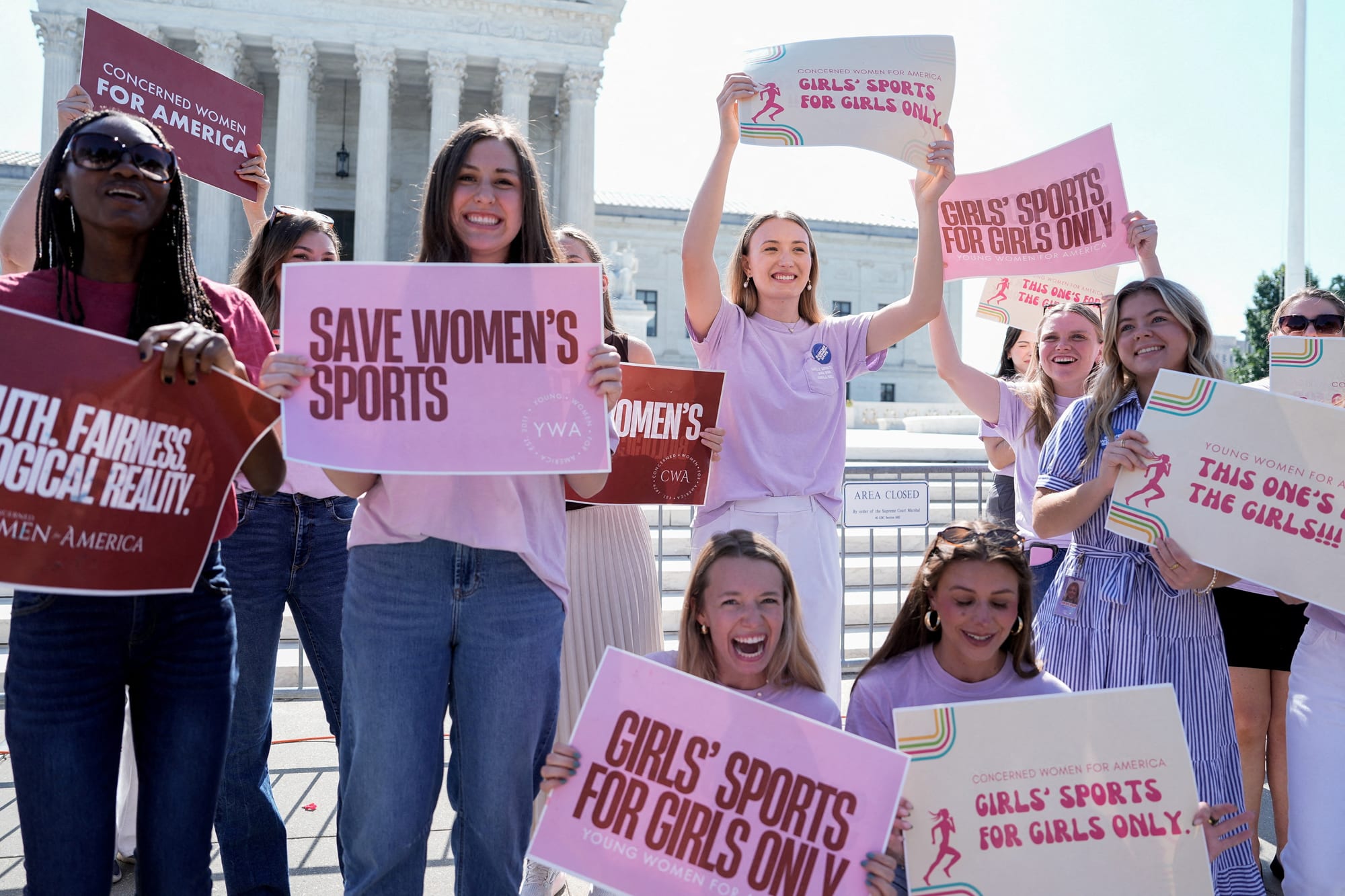
US President Donald Trump on Tuesday celebrated what he described as a “big win” after the US Supreme Court upheld state laws that bar transgender athletes from competing in girls’ and women’s school sports, a landmark decision that is expected to shape sports participation policies across much of the United States.
Reacting shortly after the ruling, Trump took to his social media platform, Truth Social, to applaud the decision, describing it as a significant victory for fairness in women’s athletics and one of the most important legal outcomes in the ongoing national debate over transgender participation in competitive sports.
“The United States Supreme Court just ruled against men playing in women’s sports. Wow! That takes that ridiculous situation off the table!!!” Trump wrote in his post, expressing satisfaction with the court’s judgment.
The Supreme Court’s decision represents one of the most consequential rulings in the country’s ongoing culture wars, where issues surrounding gender identity, education, and sports have increasingly become central topics in political campaigns and legislative debates.
In a 6-3 ruling that split the justices largely along ideological lines, the court held that the US Constitution does not prohibit states from enforcing laws restricting transgender athletes from participating in girls’ and women’s school sports.
The decision effectively allows states that have enacted such measures to continue implementing them and is expected to reinforce similar legislation already adopted across much of the country.
However, while the court reached a clear conclusion on the constitutional question, the justices remained divided over a separate issue concerning whether such restrictions violate federal law, leaving room for future legal disputes.
The constitutional ruling is expected to strengthen the legal standing of laws already in place in at least 27 states, including West Virginia and Idaho, where lawmakers have argued that limiting participation based on biological sex is necessary to preserve fairness, competitive balance, and safety in girls’ sports.
Supporters of the legislation have long maintained that biological differences can create competitive advantages in certain athletic events and that female athletes deserve protections to ensure equal opportunities in school sports.
Opponents, however, argue that the bans unfairly target transgender students, discriminate against a vulnerable minority, and deny them equal opportunities to participate in educational activities alongside their peers.
Writing for the court’s majority, Brett Kavanaugh said decisions regarding eligibility policies for school athletics are best made by elected state legislatures and educational institutions rather than by federal courts.
According to the majority opinion, states possess broad authority to establish rules governing school sports in pursuit of legitimate policy objectives, including maintaining what lawmakers view as fairness in athletic competition.
The ruling marks another significant legal victory for conservative policymakers, many of whom have made transgender participation in sports a major political issue over the past several years.
Across the United States, Republican-led state legislatures have increasingly introduced laws regulating transgender participation in athletics, access to gender-affirming healthcare for minors, and policies concerning gender identity in schools.
The sports issue, in particular, has generated intense public debate, with supporters of the restrictions emphasizing the protection of women’s athletics, while civil rights advocates argue the measures contribute to the exclusion and stigmatization of transgender youth.
Trump has consistently campaigned on promises to restrict transgender participation in women’s sports, making the issue a recurring theme during political rallies and policy announcements.
Since returning to office, his administration has continued to support legal and legislative efforts aimed at defining participation in school sports according to biological sex assigned at birth.
Tuesday’s Supreme Court ruling is therefore viewed as reinforcing one of the administration’s key policy priorities and is likely to energize conservative supporters who have advocated for similar measures nationwide.
Legal experts say the judgment will provide stronger constitutional backing for existing state laws while potentially encouraging additional states to adopt comparable legislation.
Nevertheless, the unresolved questions regarding federal anti-discrimination laws suggest that litigation over transgender rights in education and athletics is far from over.
Civil rights organizations are expected to continue challenging restrictions under federal statutes, including laws prohibiting discrimination in educational institutions, meaning future cases could once again reach the nation’s highest court.
The decision also highlights the Supreme Court’s growing influence in resolving politically sensitive disputes that have divided lawmakers, advocacy groups, educators, parents, and athletes across the country.
For supporters of the ruling, the judgment affirms the authority of states to establish policies designed to protect women’s sports.
For critics, however, it raises fresh concerns about the legal protections available to transgender students and the broader implications for LGBTQ+ rights in the United States.
As reactions continue to pour in from political leaders, advocacy organizations, and educational institutions, the ruling is expected to remain a defining moment in the evolving national conversation over gender identity, civil rights, and the future of school athletics in America.