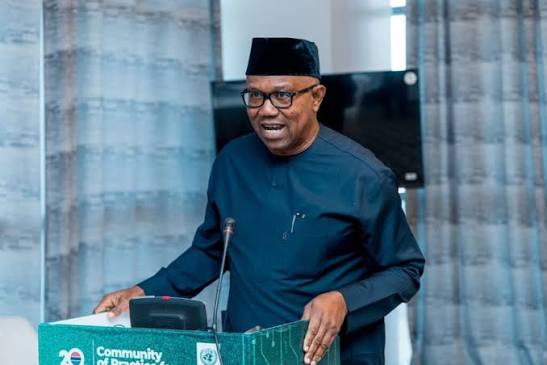
The presidential candidate of the Nigeria Democratic Congress, Peter Obi, has attributed the persistent problem of electoral manipulation in Nigeria to the failure of citizens to actively participate in and protect the democratic process.
Obi made the remarks during a recent visit to Washington, D.C., where he spoke on the state of Nigeria’s democracy, electoral accountability, and the responsibility of citizens in ensuring that elections reflect the true will of the people. His comments, contained in a video that began trending on Saturday, have since sparked widespread debate across political and civic circles.
The former governor of Anambra State argued that politicians alone cannot guarantee credible elections if voters are unwilling to remain engaged beyond merely casting their ballots. According to him, the power to secure free, fair, and transparent elections ultimately rests with the electorate. “Elections are rigged in Nigeria because Nigerians want it to be rigged.
It’s as simple as ABC. I will do whatever is possible to protect the votes, but unless Nigerians decide that their votes will count, it will not count,” Obi stated. His comments came against the backdrop of ongoing national conversations about electoral reforms, voter participation, and public confidence in democratic institutions.
Nigeria has witnessed repeated allegations of vote manipulation, voter intimidation, ballot snatching, and irregularities during elections, issues that have often generated legal disputes and political tensions. Obi stressed that citizens must recognize their critical role in safeguarding democracy and ensuring that electoral outcomes are not determined by a handful of political actors.
He argued that democracy cannot thrive when voters abandon the process immediately after voting, leaving room for manipulation during the counting and collation stages. According to him, one of the most effective ways to strengthen electoral integrity is for voters to remain at their polling units after casting their ballots and observe the counting process until results are officially recorded.
“If you vote and you stay in your polling booth and say that the votes must be counted here, it will be counted,” he said. The former presidential candidate lamented what he described as the transactional nature of Nigerian politics, where immediate personal benefits often take precedence over long-term national interests.
He argued that many citizens have yet to fully understand the relationship between governance outcomes and their daily living conditions. “Because our politics is transactional, the average Nigerian doesn’t know who is his problem,” Obi added.
He noted that many voters continue to exchange their electoral power for short-term gains, a situation he believes weakens democratic institutions and enables politicians to evade accountability. According to him, when citizens prioritize temporary rewards over competence, transparency, and effective leadership, the quality of governance inevitably suffers.
Obi further emphasized that meaningful democratic change cannot be achieved solely through political leaders or electoral bodies. Rather, he said, it requires a collective commitment by citizens to demand transparency and insist that every vote counts.
The former governor also highlighted the importance of civic education, arguing that many Nigerians remain unaware of the influence they can wield through active participation in the democratic process. He encouraged citizens, particularly young people, to become more involved in elections, monitor proceedings, and hold elected officials accountable after they assume office.
His remarks resonated with ongoing discussions surrounding voter turnout and civic engagement in Nigeria. Analysts have often pointed to declining voter participation as a major challenge facing the country’s democracy, warning that low turnout can weaken the legitimacy of electoral outcomes and reduce public trust in governance.
Obi’s comments come at a time when Nigerians are reflecting on the state of democracy in the country following recent Democracy Day commemorations and protests in various parts of the nation. Civil society groups, political activists, and community organizations have repeatedly called for reforms aimed at improving transparency, accountability, and public confidence in the electoral system.
Supporters of Obi have interpreted his remarks as a call for greater citizen participation and vigilance, while critics argue that responsibility for electoral integrity should not rest solely on voters but also on institutions charged with conducting elections and enforcing electoral laws. Nevertheless, the former governor maintained that citizens possess enormous power to influence political outcomes if they are willing to exercise their rights responsibly and consistently.
He reiterated that democracy is not a one-day event confined to election day but a continuous process that requires active involvement from the electorate. According to him, Nigerians must move beyond merely voting and embrace a culture of monitoring, accountability, and civic responsibility.
As discussions generated by the viral video continue across social media and political platforms, Obi’s message has once again placed the spotlight on the role of citizens in shaping Nigeria’s democratic future. For many observers, his remarks underscore a broader challenge confronting the nation: how to transform voter participation from a periodic exercise into a sustained commitment to democratic governance.
With preparations for future elections already beginning to attract attention, Obi’s call serves as a reminder that the strength of any democracy depends not only on its institutions but also on the willingness of its citizens to defend and protect the electoral process from manipulation.