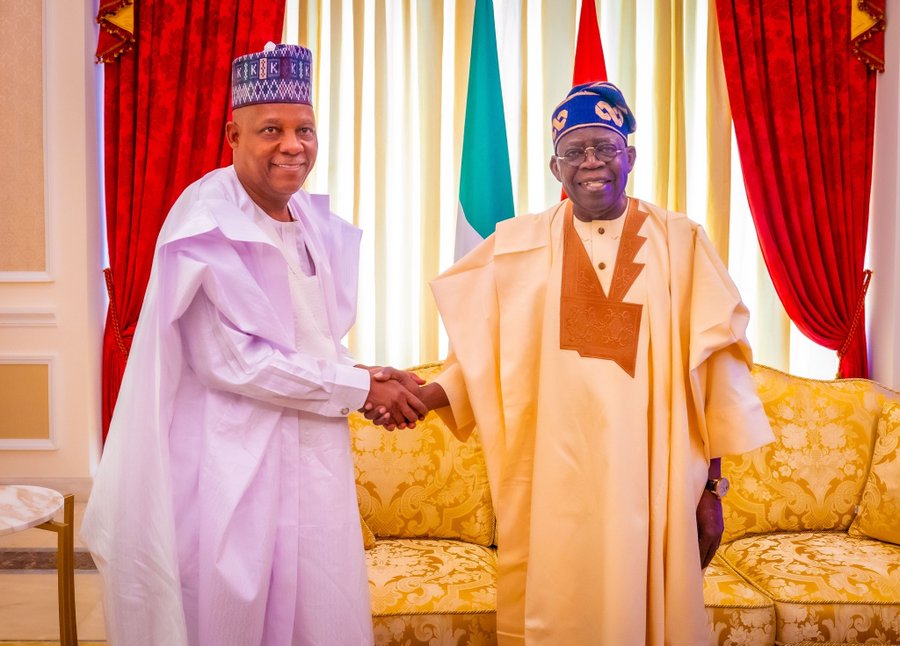
Vice President Kashim Shettima on Tuesday recounted how President Bola Ahmed Tinubu dismissed claims by some individuals who alleged that traditional attire gifted to him during the 2023 presidential campaign had been spiritually manipulated to harm him.
Shettima revealed that barely three months after Tinubu assumed office, a group of people from Borno State visited the President and warned him against wearing the garments, alleging that the clothing had been charmed and could lead to his death.
According to the Vice President, Tinubu refused to entertain the allegation and instead reacted in a manner that publicly rejected the claims and what he described as the growing culture of suspicion in society.
Rather than avoid the attire, Shettima said the President deliberately wore the traditional garments continuously for one week to demonstrate his disbelief in the accusation and to send a message against superstition and mistrust.
The Vice President made the disclosure during his remarks at the public presentation of the autobiography of former Nigerian Head of State, Yakubu Gowon, titled “My Life of Duty and Allegiance,” held in Abuja on Tuesday.
Shettima, who represented President Tinubu at the event, used the story to highlight what he described as the dangerous rise of suspicion, distrust and conspiracy thinking in Nigerian public life.
He explained that modern Nigerian society has increasingly become characterised by doubt and fear, where even acts of goodwill and friendship are often viewed through the lens of suspicion.
According to him, the incident involving the traditional attire reflected how deeply mistrust has penetrated social and political relationships in the country.
The Vice President said the individuals who visited the President genuinely believed their claims and urged Tinubu to distance himself from the garments immediately.
However, Shettima noted that the President found the allegation irrational and inconsistent with the spirit in which the attire had originally been presented during the campaign period.
“He said the story did not add up,” the Vice President recalled while narrating Tinubu’s response to the warning.
To further illustrate his point about the erosion of trust in modern society, Shettima referenced remarks made earlier by the Muhammadu Sa’ad Abubakar during the book presentation.
According to Shettima, the Sultan had narrated how former Head of State Yakubu Gowon used to receive gallons of fura from the Sultan’s family in Sokoto while serving as Nigeria’s leader at Dodan Barracks in Lagos.
The Vice President said Gowon accepted the gesture wholeheartedly and without suspicion, describing it as evidence of a period when relationships among Nigerians were built more on trust, mutual respect and goodwill.
He lamented that such openness and confidence among citizens have gradually diminished over time, replaced by fear, rumours and deepening distrust.
Shettima argued that one of the greatest challenges facing Nigeria today is not only insecurity or economic hardship but also the weakening of social trust among citizens and political actors.
He stressed that rebuilding trust would be essential to achieving national unity, peaceful coexistence and sustainable development.
The Vice President praised Gowon for embodying values of integrity, sacrifice and national loyalty, noting that the autobiography being presented serves as an important historical account for younger generations.
He said the life and leadership style of the former Head of State remain valuable lessons in patriotism, tolerance and nation-building.
The event attracted prominent political leaders, traditional rulers, diplomats, military officers and senior government officials from across the country.
Many speakers at the occasion reflected on Gowon’s contributions to Nigeria’s unity and stability, particularly during some of the country’s most difficult historical periods.
Observers noted that Shettima’s remarks stood out because they touched on broader social issues beyond politics, particularly the increasing atmosphere of suspicion and conspiracy theories that often shape public conversations in the country.
Analysts say the Vice President’s comments may also be interpreted as an appeal for Nigerians to promote tolerance, understanding and trust across ethnic, regional and political divides.
The story of Tinubu’s response to the allegation quickly generated discussions among attendees, with many viewing it as a symbolic rejection of fear-driven narratives and divisive assumptions.
For Shettima, the incident represented more than a personal experience involving the President. It served as a reflection of how far society has drifted from the culture of openness and trust that once characterised relationships among Nigerians.
He concluded by urging Nigerians to learn from leaders like Gowon, whose life, according to him, demonstrated that mutual trust and national loyalty remain essential ingredients for building a stronger and more united country.