By Prof. Brown Imasuen
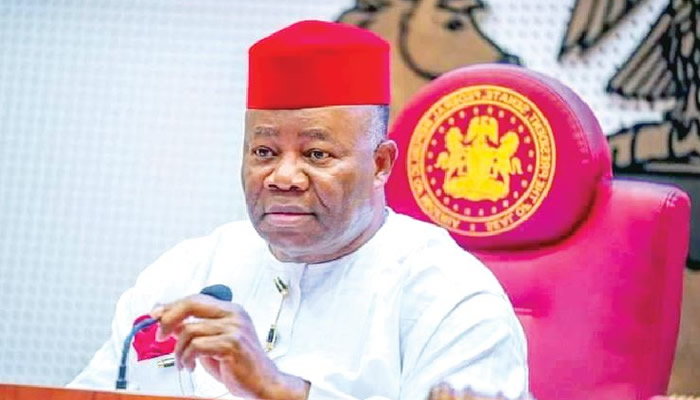
In the putrid chambers of the Nigerian Senate, where honour is a forgotten costume and public service a euphemism for plunder, Godswill Akpabio, Nigeria’s 10th Senate president, has delivered yet another masterclass in institutional subversion.
On May 6, 2026, Akpabio, presiding over his chamber like a feudal lord, warning a vocal Adams Oshiomhole of removal from the Senate, like he did Abdul Ningi and Natasha Akpoti-Uduaghan in the past, rammed through amendments to the Senate Standing Rules that restrict eligibility for presiding and principal leadership positions to senators who have served at least two consecutive terms. That is, eight unbroken years of warming those red seats.
Many senators were left in awe because they knew that it was neither about reform nor about taking advantage of their experience. They knew it for what it was, a naked, shameless gerrymandering of power, a calculated entrenchment of a cabal of recycled political buccaneers against the wider interest of 200 million Nigerians gasping for accountable governance.
Akpabio’s manoeuvre, adopted through a contemptuous voice vote after a closed-door session, is pure legislative sorcery designed to anoint the current crop of “ranking” senators, which includes himself and his allies, as the only legitimate contenders for Senate President, Deputy Senate President, and other principal offices in the 11th National Assembly after the 2027 elections. With that, Akpabio barred ‘fresh bloods’ or returning senators who dared to sit out a term or enter from gubernatorial mansions.
In one nasty alteration, Akpabio excluded them and cleared the way for himself. In other words, talented, visionary lawmakers who will be elected on merit in 2027 are now told, by Akpabio, to sit at the back of the bus while the old boys’ club feasts eternally. This is not about legislative competence. It is about insulating mediocrity, shielding incompetence, and guaranteeing that the Senate remains a closed shop for the same faces who have presided over Nigeria’s tragic descent. One cannot overstate Akpabio’s audacity on Infamy Street.
Here is a Senate President who climbed to power through the very fluidity of Senate politics, now slamming the door behind him with iron bars forged in the preservation of self-interest. The man who once embodied the “godswill” of zoning and alliances now rewrites the rules mid-game to ensure that only those who have inhaled the toxic air of the 9th and 10th Senates long enough can aspire to lead. Senator Oshiomhole’s public clash with Akpabio the following day laid bare the personal stakes because with Akpabio’s new rule, a first-term senator of considerable national stature and importance, is suddenly rendered ineligible, and reduced to a spectator in the very chamber where his voice once thundered.
The message Akpabio sends to Nigerians is that your mandate ends at the election booth. It says that once inside those hallowed chambers, power belongs to those who have mastered the art of survival, not service. This alteration of rules is, openly, the quintessential manifestation of Nigeria’s most basic affliction; that is, the corrupt manipulation of institutional processes by a parasitic elite. Akpabio’s Senate, constitutionally the heart of legislative oversight, has been reduced to a rubber stamp for executive excess and a marketplace for the highest bidder.
By rigging the leadership ladder, Akpabio and his cohort have effectively neutered the democratic essence of the legislature. Leadership positions in the Senate are not mere ceremonial perches; they determine committee chairmanships, legislative priorities, budgetary allocations, and the vigour of oversight. When these positions are pre-ordained for a select clique, many of whom, like Akpabio, have accumulated more scandals than achievements, the entire legislative machinery becomes an extension of personal empires rather than a servant of the people. Now, consider the consequences.
Nigeria’s developmental policies have failed not because ideas were lacking, but because those entrusted with lawmaking and oversight are themselves products and perpetrators of systemic corruption. For instance, when budgets are padded with constituency projects that never materialise, bills are killed or birthed at the altar of godfatherism, and executive recklessness goes unchecked because Senate leadership owes allegiance not to the Constitution but to the cabal that installed and now protects it, then democracy collapses.
Akpabio’s rule change is the institutionalisation of this. It ensures that in 2027, the Senate will once again be led by men whose primary loyalty is to the preservation of a status quo that has delivered a youth population that is radicalised by hopelessness. For those who clap, they must realise that the country’s stunted growth finds its deepest roots in the legislature’s betrayal of its sacred mandate. A Senate leadership drawn perpetually from the same pond breeds intellectual incest.
Fresh perspectives on security, economic diversification, electoral reform, and federal restructuring are suffocated before they draw breath. The result is a legislature that excels at appropriating jumbo salaries and estacodes while the nation bleeds from insecurity, poverty, and underdevelopment. Nigeria does not suffer from a shortage of competent citizens.
It suffers from a deliberate architecture that elevates the connected, the compromised, and the cunning over the capable. What Akpabio did is simply the advancement of the gathering of political vampires extending their lease on the nation’s jugular. Akpabio, the “Uncommon Transformer” of Akwa Ibom lore, now transforms the Senate into a retirement home for political has-beens and a launchpad for perpetual relevance.
The two-term requirement is sold as promoting “experience,” but experience in what? Experience in padding budgets? Experience in turning a blind eye to monumental corruption? Experience in the dark arts of political survival while ordinary Nigerians queue for rice and noodles? True legislative experience should be measured by the impact of bills passed that transformed lives, oversight that recovered looted funds, debates that elevated national discourse, not by how many years one has perfected the art of looking away.
This self-perpetuating oligarchy mocks the very federalism that Nigeria claims to practise. States send senators to represent diverse interests, yet leadership is now hostage to a narrow clique whose fortunes are tied to Akpabio’s patronage networks. Ambitious governors eyeing the Senate, reformers from civil society backgrounds, and technocrats drafted into politics, all are disenfranchised by a rule change that reeks of pre-emptive rigging.
What happens when zoning demands a leader from a region lacking such “qualified” two-term senators? The rules will bend again, of course, but only in service of the powerful. The Nigerian people, as always, are mere spectators in this macabre drama. When legislative leadership is corrupted at inception through rule manipulation, every downstream policy bears the DNA of that original sin. Economic blueprints are gathering dust because lawmakers are too busy positioning for the next leadership contest.
We must know that Nigeria’s stunted growth, which is evident in its ranking among the world’s most miserable nations despite abundant resources, is not an act of God or colonial curse alone. It is the direct progeny of institutions like this Senate, where men like Akpabio treat rules as playthings and power as an inheritance. True legislative independence would see the Senate opening its leadership to competition, rewarding competence, and subjecting itself to transparent processes that Nigerians can trust.
Instead, we witness this cowardly entrenchment, this fear of fresh air, this allergic reaction to accountability. Akpabio’s gambit exposes the rot at Nigeria’s democratic core. A legislature that cannot even manage its own succession without descending into self-serving chicanery has no moral authority to lecture the executive or the judiciary. It becomes complicit in the national failure. The developmental paralysis indicated by youth unemployment, brain drain, crumbling education and health systems, and pervasive insecurity stems fundamentally from this elite consensus that public office is a private estate, rules are malleable, and the people are expendable.
Nigerians must rise against this normalisation of impunity. Civil society, the media, and the electorate in 2027 must reject any Senate leadership born from such fraudulent rules. The amendment must be challenged in courts and in the court of public opinion as an assault on democratic choice. Until the legislature purges itself of such base manipulation, Nigeria’s policies will remain stillborn, its federation fractured, and its promise perpetually deferred. Godswill Akpabio has not strengthened the Senate; he has embalmed it.
He has not honoured experience but canonised entitlement. In doing so, he and his enablers stand as living monuments to why Nigeria limps while lesser nations sprint. The Senate of the Federal Republic has become the Senate of Self-Perpetuation, a chamber where ambition is throttled, merit is murdered, and the Nigerian people are, once again, the ultimate victims. This is not leadership. This is larceny dressed in senatorial robes. And history will record it as such, with Akpabio as its unrepentant architect.
Prof. Imasuen wrote from Ohio, USA