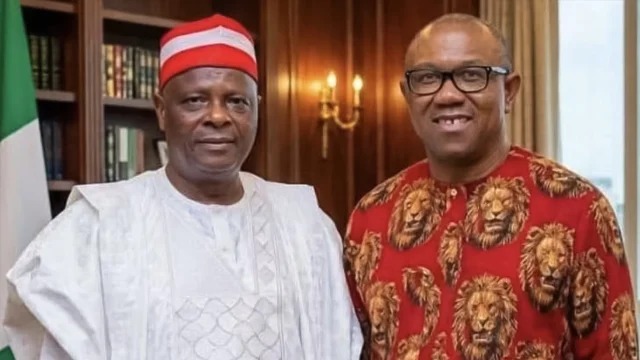
Without doubt, Peter Obi and Musa Kwankwaso have suddenly become the true face of opposition in the wake of the forthcoming 2027 general elections. This has not come as a surprise. Nigerians are looking for reliable, honest and trustworthy men and women they could entrust with leadership in 2027, to change the current oppressive government that has left Nigerians in quandary. The duo of Obi and Kwankwaso come closest to this national cry and expectation.
It is, therefore, not surprising that Obi-Kwankwaso have become the centre of attraction. Wherever they go the crowd follows them. When Obi left the Peoples Democratic Party (PDP), to join the hitherto dead Labour Party (LP), the crowd followed him leading to the revival of the party and formation of the Obidient Movement.
From the Labour Party, Obi joined the African Democratic Party (ADC), with other political heavyweights like Atiku and Amaechi and the crowd joined with him. That was where he linked up with Kwankwaso and the Obidient and Kwankwasiyya Movements joined forces to form the OK Movement, now making waves.
Right now, OBI-Kwankwaso have switched over to the Nigeria Democratic Party (NDC), in a determined effort to realize their dream in 2027, As expected, the OK Movement along with the same crowd have followed them.
It is pertinent to ask, at this juncture, why Obi appears to be on the move all the time. The answer is simple. Obi is under constant attacks by the enemies of Nigeria who want to frustrate him, which is normal. People throw stick at a ripe pear by the road side not because they don’t like it but to partake in some of the fruits. ///The enemies of Nigeria don’t want Nigeria to make headway. The solution to the anomie in Nigeria is good leadership, which Obi-Kwankwaso want to proc
The “battle against opposition parties” in Nigeria isn’t one single fight-it’s a mix of power, money, institutions, and history. Here’s what’s driving it right now in 2026.
There is the winner-takes-all political system. Nigeria runs a presidential system where the ruling party controls federal resources, appointments, security agencies, and budget allocations. If you’re not in power, you’re largely shut out of patronage. That creates zero-sum incentives: ruling parties fight hard to stay in power, and opposition fights hard to displace them.
Opposition parties routinely accuse the ruling party of using state institutions like security agencies-Police, DSS, EFCC for arrests, investigations, or intimidation of opposition figures.
Allegations of voter suppression, ballot box snatching, manipulation of INEC, and court rulings that favor incumbents. Defection incent – opposition lawmakers/governors are often pressured to defect to the ruling party with promises of projects, appointments, or dropped investigations. This isn’t new. It happened under PDP 1999-2015, and it’s happening now under APC.
Party fragmentation-Nigeria’s opposition is often divided. PDP, Labour Party, NNPP all compete against each other instead of presenting a united front. The ruling APC actively courts defections to weaken opposition. In 2025-2026 there have been high-profile defections of governors and senators to APC.
Money and godfather politic – elections are expensive. Ruling parties have access to federal funds and contracts to finance campaigns. Opposition parties rely more on private donors and state-level governors. “Godfathers” who bankroll candidates often demand loyalty over party ideology, making opposition coalitions unstable.
Security, ethnic/regional tensions – opposition is often strongest in regions different from the ruling party’s base. Ruling parties frame opposition as “regional” or “ethnic” to delegitimize them. Opposition parties accuse the ruling party of selective enforcement of security against their strongholds.
Historical pattern – since 1999, every ruling party has been accused of trying to create a one-party state. During PDP era: Obasanjo’s 3rd term bid, allegations of rigging 2003/2007. APC era: 2019 and 2023 elections saw disputes over results, and opposition leaders face arrests or EFCC cases.
Why it’s escalating now in 2026? Labour Party and PDP are still contesting the 2023 presidential result in public opinion, even after court rulings. That keeps tensions high. As for the 2027 jostling, parties are already maneuvering for 2027. Ruling party is consolidating, opposition is trying to form a coalition but struggling with ego clashes.
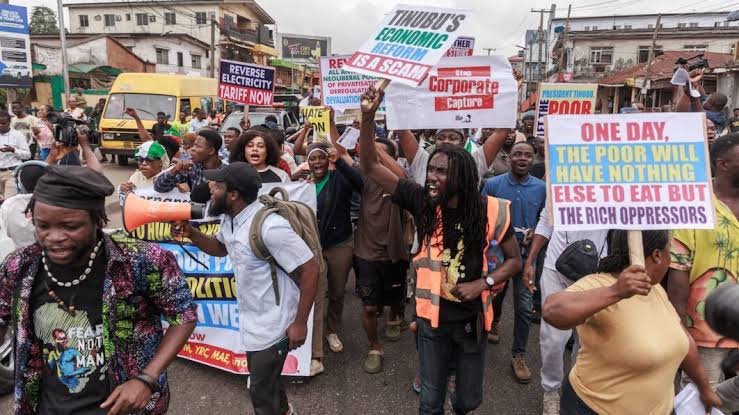
Economic hardship: Inflation, fuel subsidy removal, and insecurity give opposition more ammunition – so ruling party responds more aggressively.
All this battle weakens democracy. It reduces policy debate, fuels voter apathy, and makes governance reactive rather than proactive. It also feeds public distrust – only 27 percent of Nigerians viewed SA positively in 2017, partly because they see similar elite power struggles at home.
Bottom line: It’s less about ideology and more about access to state power and resources. Until Nigeria moves toward issue-based politics and independent institutions, the cycle continues.
Peter Obi’s defection to NDC party has made headlines. In July 2025, Obi joined the African Democratic Congress (ADC) coalition alongside Atiku Abubakar, Rotimi Amaechi and others to challenge President Tinubu in 2027. He formally became an ADC member on January 1, 2026.
By May 3, 2026, Obi announced his resignation from ADC, citing “deepening internal crises and a hostile political environment”. May 3, 2026, Obi and former Kano governor Rabiu Musa Kwankwaso were formally received into the NDC at its Abuja secretariat by National Chairman Cleopas Moses Zuwoghe. 308117b6f78a
Why he left ADC, Obi said the ADC was facing the same problems that pushed him out of the Labour Party – internal crises, litigations – ongoing court cases and leadership tussles after a Supreme Court ruling left the ADC’s structure “uncertain”.
– External interference – he alleged “the same Nigerian state and its agents” that destabilized LP are now infiltrating ADC
Toxic environment: He described Nigerian politics as “increasingly toxic, marked by intimidation, insecurity, and persistent scrutiny”. That confirms what the legendary Nelson Mandela said the election in Nigeria is war. He stressed that it wasn’t personal grievance with ADC leaders like David Mark or Atiku.
Why opt for NDC”? Obi said the move was driven by “the condition of our nation and the urgent need to rescue Nigeria”. Kwankwaso said it was based on “shared ideology and common vision for Nigeria”. The NDC’s National Leader is former Bayelsa governor Seriake Dickson.
Obi urged NDC members to avoid litigation: “We are not lawyers. We want to build a party…We are pleading with the judiciary. Please end cases in party so we can face the job of building a new Nigeria”. eac7
This is happening right before INEC’s May 10, 2026 deadline for parties to submit membership registers for 2027. Political realignment is happening fast.
The ADC coalition is saying they’re “unfazed”, but analysts say Obi’s exit fractures the opposition again — similar to 2023 when split votes gave Tinubu advantage.
The Nigeria NDC is branding itself as a “Noah’s Ark” for dissatisfied politicians from both ruling and opposition camps. Bottom line, Obi left ADC over instability and joined NDC with Kwankwaso to build what he calls a more cohesive opposition platform ahead of 2027.
Peter Obi’s jump from ADC to NDC scrambles the 2027 election math in 3 big ways: It fractures the opposition vote again/ This is the same dynamic that gave Tinubu advantage in 2023. Then, Tinubu won with *37 percent* because Obi and Atiku split the anti-APC vote.
In July 2025, Obi, Atiku, Kwankwaso, and Amaechi had agreed to use ADC as a single coalition platform for 2027.
That was meant to consolidate the opposition vote behind one candidate. Now with Obi in NDC and Atiku still in ADC, you’ve got at least 3 major opposition blocs again.
If they don’t reunite, Tinubu only needs 35-40 percent to win in a crowded field. That’s the “vote-cannibalization” analysts are talking about.
In 2023, Obi got 6.1 million votes, mostly from the South-East, South-South, and urban youths nationwide. That bloc is personality-driven, not party-driven. Where Obi goes, those votes follow.
Obi’s name with Kwankwaso’s Kano base gives NDC instant national relevance it didn’t have before. ADC loses its most popular figure and its youth appeal.
Timing makes it worse for opposition. INEC’s deadline is May 10, 2026 for parties to submit membership registers. Primaries must finish by May 30, 2026, with campaigns starting August 2026.
Obi’s exit came right as the coalition was supposed to coalesce around a single candidate. Instead of unity talks, parties are now in a “realignment rat race”. The window to negotiate a merger is shrinking fast.
This is a tactical win for Tinubu in the short term. The opposition looks chaotic and divided just as the formal selection process begins. APC can focus on consolidation instead of fighting a united front.
But there’s a risk: If NDC and ADC eventually merge before primaries, Tinubu faces a stronger united opposition.
The defection also signals that even Obi, who ran as “different” in 2023 – doesn’t trust existing opposition structures, which could boost voter cynicism overall.
For the opposition to beat APC in 2027, NDC and ADC need to merge or agree on a single candidate before May 30. That means Obi, Atiku, and Kwankwaso have to swallow ego and pick one flag bearer. That is the right thing to do.
If they don’t: Tinubu may win with a plurality, not majority. If they do, you get a genuine three-horse race where the opposition has a real shot.
Is the internal cries within opposition induced by the ruling APC? There’ is no public smoking gun, but the pattern and incentives strongly suggest APC involvement, even if they are not directly in the room.
Peter Obi himself said it in his May 3, 2026 resignation letter from ADC, “the same Nigerian state and its agents” that destabilized Labour Party are now infiltrating ADC. He didn’t name APC directly, but “Nigerian state” in this context is read as the ruling party apparatus.
This matches what happened to LP in 2023-2025 factional leadership disputes, court cases, and parallel executives that paralyzed the party.
A divided opposition gave Tinubu advantage with 35-40 percent votes, like in 2023. That’s a clear incentive for the ruling party to keep opponents fighting each other instead of fighting APC.
This isn’t unique to APC. PDP did the same thing when it was in power 1999-2015. What’s different now? The timing is suspicious. All these crises — ADC leadership tussles, LP factionalism, PDP instability — are peaking right before INEC’s May 10, 2026 membership register deadline and May 30 primary deadline. That’s when opposition needs to be most united.
Also, APC officials have openly mocked the opposition splits. The Presidency called Obi “a political nomad” after his ADC exit. That’s not proof of orchestration, but it shows they see it as advantageous.
Some opposition figures created these problems themselves. Party structures in Nigeria are weak, ideology is thin, and godfather politics means personal ambition often trumps party loyalty. You don’t always need external help for a party to implode.
Atiku’s aide Paul Ibe said ADC is “still on course” despite Obi’s exit and that more people are joining ADC. That suggests the coalition thinks it can survive without Obi.
In Nigerian politics this is called “divide and rule” — and every ruling party since 1999 has used it. APC has both the motive and the resources to do it now.
What matters for 2027? Whether opposition leaders believe it’s induced and act to close ranks, or keep blaming each other while APC consolidates.
Dr. Onyekakeyah, former member of The Guardian Editorial Board, is a public affairs commentator and a Daily Query columnist.