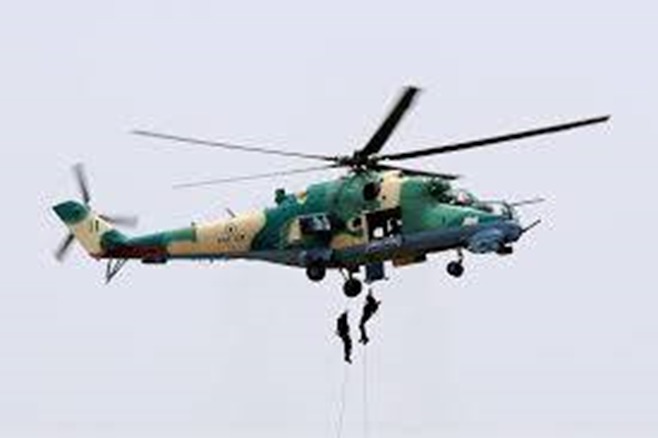
High above the rugged ridges of the Mandara Mountains, the silence of dawn was broken by the distant hum of military aircraft, an unmistakable signal that a decisive operation was underway. In a region long troubled by insurgent, the skies themselves had become a theatre of precision and resolve.
The Nigerian Air Force (NAF) had launched a series of sustained counter-terrorism airstrikes, targeting entrenched terrorist enclaves hidden deep within the mountainous terrain. These enclaves, concealed among rocky outcrops and dense vegetation, had for years served as operational bases, supply depots, and safe havens for armed groups responsible for attacks on nearby communities.
According to a statement issued on Tuesday by Air Commodore Ehimen Ejodame, the operation was the result of carefully coordinated intelligence efforts. Acting on credible reports and confirmatory Intelligence, Surveillance, and Reconnaissance (ISR) missions, NAF air assets identified multiple high-value targets, structures and logistics hubs actively sustaining insurgent campaigns in the region.
For weeks leading up to the strike, surveillance drones and reconnaissance teams had monitored movements across the Mandara corridor. Patterns began to emerge: clusters of activity at unusual hours, supply routes weaving through narrow mountain passes, and fortified hideouts that blended into the terrain. Each detail added to a growing picture of a network that had to be dismantled.
Then came the moment of action.
With calculated precision, NAF platforms moved into position, executing a coordinated assault designed to neutralise the threat while minimising collateral damage. The strikes were swift and deliberate. One by one, identified structures were engaged, logistics depots erupted in controlled blasts, communication points were silenced, and fortified camps were reduced to smouldering remnants.
Ejodame emphasised that the operation adhered strictly to established rules of engagement, with particular attention given to the protection of civilian lives and the surrounding environment. “Employing precision targeting,” he noted, “NAF platforms engaged and neutralised hostile elements and their infrastructure with lethal accuracy.”
For residents of nearby settlements, the impact of the operation was both immediate and profound. For months, many had lived under the shadow of uncertainty, threatened by raids, displacement, and the constant fear of violence spilling into their homes. The degradation of these terrorist strongholds, local sources suggested, could mark a turning point in restoring a measure of security to the region.
Military analysts have also pointed to the strategic importance of the Mandara Mountains. Straddling the border between Nigeria and Cameroon, the area’s difficult terrain has long provided cover for insurgents seeking to evade ground operations. By targeting logistics hubs and infrastructure, the NAF has not only disrupted immediate threats but also weakened the broader operational capacity of these groups.
“This is not just about eliminating fighters,” one security expert observed. “It’s about dismantling the systems that sustain them, their supply chains, their communication networks, and their ability to regroup.”
Indeed, Ejodame underscored that the sustained nature of the air campaign has significantly reduced the terrorists’ ability to carry out attacks against civilians. Each successful strike compounds the pressure on insurgent networks, limiting their mobility and eroding their confidence.
Yet, even as the smoke clears over the Mandara peaks, the operation represents part of a larger, ongoing effort. Counter-terrorism in such complex environments is rarely concluded in a single engagement. It demands persistence, intelligence coordination, and the continued cooperation of local communities.
For now, however, the skies over the Mandara Mountains tell a story of momentum, a story of a military pushing deeper into previously inaccessible strongholds, and of a region inching closer to stability.
As the aircraft returned to base and the echoes of the strikes faded into the morning air, one thing remained clear: the balance had shifted, and the enclaves that once thrived in secrecy had been brought into the open, and struck with decisive force.