By
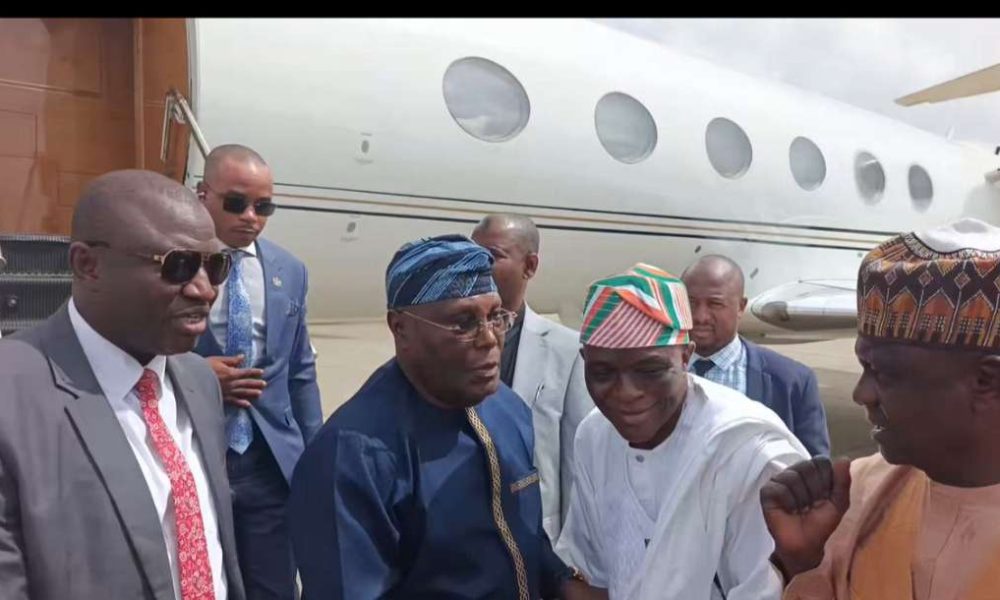
Nigeria’s opposition heavyweights on Saturday converged in Ibadan for a major political summit aimed at forging a united front ahead of future elections, with former President Olusegun Obasanjo presiding over discussions that could shape the next phase of the country’s political realignment
The meeting, held at the Banquet Hall of the Oyo State Government House in Ibadan, brought together leaders from the Peoples Democratic Party, African Democratic Congress, New Nigeria Peoples Party, and other political actors under a shared agenda of opposition coordination and national reform.
Tagged “That We May Work Together for a United Opposition to Sustain Our Democracy,” the summit was framed by organisers as a response to Nigeria’s worsening economic pressures, insecurity concerns, and growing calls for stronger political accountability.
Among the early arrivals were former Vice President Atiku Abubakar, who confirmed his presence via social media, Peter Obi, former Anambra State governor and former Kano State governor Rabiu Kwankwaso, who described the engagement as an opportunity for “meaningful national dialogue.”
The event is being hosted by Oyo State Governor Seyi Makinde, with other notable attendees including former Sokoto State governor Aminu Tambuwal and Labour Party’s 2023 Lagos governorship candidate Gbadebo Rhodes-Vivour.
According to organisers, the summit is expected to serve as a platform for rebuilding trust among opposition blocs and developing a coordinated strategy ahead of upcoming electoral cycles. Discussions are also expected to centre on governance failures, electoral reforms, and economic recovery strategies.
A lineup of speakers has been assembled to deepen policy discussions. These include human rights advocate Chidi Odinkalu and political analyst Usman Bugaje, both of whom are expected to address democratic consolidation and institutional reforms.
Former Independent National Electoral Commission (INEC) official Mike Igini will focus on electoral credibility, while economist Pat Utomi is expected to present proposals on rebuilding Nigeria’s productive economy. Security expert Kabir Adamu will examine the country’s escalating insecurity challenges.
Political tensions shadow summit
Despite the atmosphere of unity being projected, the summit has been overshadowed by allegations from the opposition camp that the ruling All Progressives Congress attempted to frustrate the gathering.
“They say they are not scared, but they are behaving like people who are terrified,” the statement read, insisting that the opposition remained determined to proceed with its agenda.
As of press time, the APC had not issued any official response to the allegation. Efforts to reach its spokesperson, Felix Morka, were unsuccessful.
Beyond the formal speeches and discussions, attention has also focused on behind-the-scenes alignments among key political actors
The ADC pointed to the presence of former Minister of Transportation Rotimi Amaechi, alongside former Kano State deputy governor Nasiru Gawuna and figures associated with the Kwankwasiyya Movement, describing it as evidence of shifting alliances within the opposition space.
Analysts say such interactions reflect a broader recalibration within Nigeria’s opposition politics, as parties and political blocs explore possible mergers or strategic cooperation ahead of the next electoral cycle.
Political observers view the Ibadan summit as one of the most significant opposition gatherings in recent years, not only for its symbolism but also for the personalities involved and the strategic questions it raises.
While no formal coalition agreement has been announced, the meeting is widely seen as an attempt to lay the groundwork for future collaboration among fragmented opposition forces.
Organisers insist the ultimate goal is to present a credible and united alternative capable of challenging the ruling party’s dominance in future elections, even as internal differences and external pressures continue to test the durability of such ambitions.