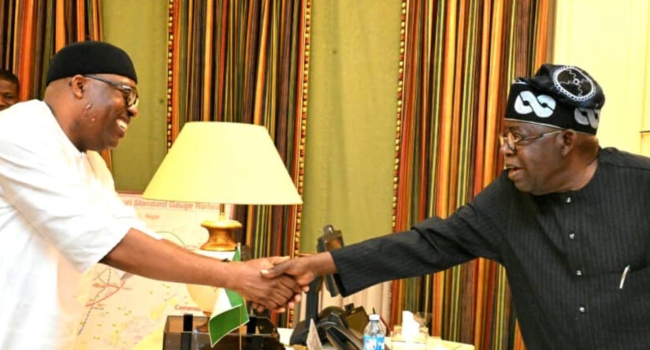
Rivers State Governor, Siminalayi Fubara, on Thursday threw his weight behind the re-election of President Bola Ahmed Tinubu, declaring that Nigeria is firmly in capable hands under the current administration and urging stakeholders across the country to support continuity in leadership.
Fubara made the remarks while formally declaring open the high-level meeting of the Southern Traditional Rulers Council in Port Harcourt, the Rivers State capital, where monarchs from the 17 southern states converged to deliberate on pressing regional and national issues, including unity, security, and economic development.
Addressing the royal fathers, the governor emphasized that the country is undergoing a critical phase of transformation, noting that the reforms being implemented by Tinubu’s administration require time, consistency, and collective support to yield their full benefits. According to him, granting the President a second term would ensure that ongoing policies and developmental initiatives are not disrupted.
He said, “At a time like this in our national journey, continuity is essential. The reforms being carried out are not quick fixes but long-term strategies aimed at repositioning Nigeria for sustainable growth. It is important that we allow these efforts to mature.”
Fubara pointed to what he described as measurable progress in key sectors of the economy, highlighting improvements in infrastructure development, fiscal reforms, and efforts to stabilize the macroeconomic environment. He particularly commended the administration’s commitment to large-scale infrastructure projects, including the ambitious coastal road initiatives expected to boost connectivity and economic activities along Nigeria’s shoreline.
“These projects are not just about roads; they are about opening up economic corridors, creating jobs, and strengthening national integration. Despite the obvious challenges, we are beginning to see signs of recovery and forward movement,” he added.
The governor also stressed the importance of unity among leaders, especially traditional rulers, whose influence at the grassroots level remains vital in maintaining peace and fostering cooperation among communities. He urged them to continue playing their roles as custodians of culture and stability while supporting government efforts to address insecurity and social unrest.
The gathering of traditional rulers drew prominent monarchs from across the South-East, South-West, and South-South regions, reflecting a shared commitment to strengthening regional collaboration. Discussions at the meeting were expected to center on strategies for tackling insecurity, promoting economic integration, and preserving cultural heritage in the face of rapid modernization.
Fubara used the opportunity to call for stronger synergy between government institutions and traditional leadership structures, noting that sustainable development can only be achieved when all stakeholders work in harmony.
“Our traditional rulers are critical partners in governance. Their wisdom, experience, and closeness to the people make them indispensable in our quest for peace and development,” he said.
Observers at the event noted that Fubara’s endorsement of Tinubu carries political significance, particularly within the complex landscape of Rivers State politics and the broader southern region. His stance is seen as a signal of alignment with the federal government and a call for political stability ahead of future electoral cycles.
As deliberations continued behind closed doors, participants expressed optimism that the resolutions from the council would contribute to shaping policies and strengthening cooperation among southern states, while also reinforcing national unity.
The meeting is expected to produce a communiqué outlining key recommendations on security, economic growth, and intergovernmental collaboration, issues considered central to Nigeria’s long-term stability and prosperity.