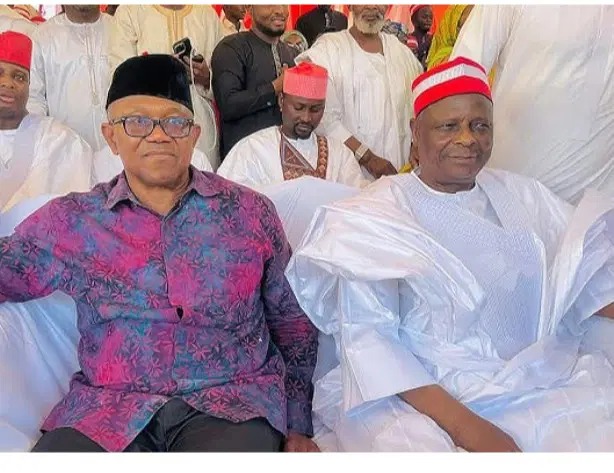
The reported emerging alliance between Peter Obi and Musa Kwankwaso represents a strategic move that could change the 2027 political landscape in favour of the opposition. Carried forward, the ruling APC must be in panic mode, even as the Obedient and Kwankwasya movements are forging a united front in Abuja as the race towards the 2027 general elections begins to gather momentum.
The other day, supporters of Peter Obi and Rabiu Kwankwaso came together to unveil what they call the Obi–Kwankwaso (OK) Movement, a pressure group aimed at shaping the opposition politics in Nigeria.
The announcement, made in the nation’s capital Abuja, did not come as a surprise to many observers. In recent months, there have been growing discussions within the African Democratic Congress (ADC) over who should fly the party’s presidential flag in 2027.
Inside the ADC, several big names have already shown interest. These include former Vice President Atiku Abubakar, former Rivers State governor Rotimi Amaechi, as well as Obi and Kwankwaso. Amid this uncertainty, the OK Movement says it is stepping in with a clear purpose.
Speaking to newsmen, the group’s National Publicity Secretary, Justin Ijeh, explained that the movement is not starting from the scratch. According to him, it has already built structures across all 36 states and the Federal Capital Territory, with coordinators appointed to drive its plans at both state and zonal levels.
He described the movement as a coming together of different political families — the Obedient Movement, the Kwankwasiyya group, members of the New Nigeria People’s Party, and the ADC. Many supporters present at the launch saw the moment as the beginning of something bigger.
They spoke about the influence of the Obedient Movement, especially its strong youth base, which played a major role in changing Nigeria’s political conversation during the 2023 elections. By joining forces with Kwankwaso’s loyal base, the organizers believe they can build a stronger and more united front.
Ijeh, in his statement, said Nigeria is at a critical point, with many citizens facing hardship, rising living costs, and insecurity. He explained that the OK Movement hopes to bring together like-minded groups to offer a new direction.
“There is a need for unity and a clear vision at this time,” he said, noting that the movement is drawing strength from its grassroots support.
When contacted, the National Coordinator of the Obedient Movement, Dr Yunusa Tanko, confirmed that the new group is working closely with existing Obi support networks.
He dismissed any talk of division, saying the entire groups involved share the same goal- to work towards a joint presidential ticket under the ADC ahead of 2027.
As political alignments continue to shift, the emergence of the OK Movement adds a fresh twist to the unfolding battle for the opposition ticket, setting the stage for what could be a keenly contested race in the coming months.
The Peter Obi and Musa Kwankwaso alliance is widely being discussed as a strategic move for the 2027 elections- and here’s why: The movement combines strong regional bases. Obi has a strong support base in the South, especially the South-East, and among youth/urban voters via the “Obidient” movement.
Kwankwaso commands the “Kwankwasiyya” movement with formidable support in the North, particularly Kano. Together, they could create a North-South coalition that “could potentially shake up the political landscape”.
It addresses 2023’s split opposition: In 2023, Obi (Labour Party), Kwankwaso (NNPP), and Atiku (PDP) ran separately, which split opposition votes and gave the APC advantage. The alliance aims to avoid that.
As it gains momentum, talks of a joint ticket under the ADC are “gaining momentum” with opposition stakeholders, power brokers, and even retired military officers involved
Kwankwaso resigned from NNPP citing “strategic realignment” and the need for a platform to “effectively change the nation”. His support group has openly endorsed an Obi-Kwankwaso alliance as a strong challenge to APC.
Kwankwaso said he’s “ready to work with Peter Obi” and other opposition figures for 2027. He previously said he wouldn’t mind being Obi’s running mate if certain conditions were met.
With regards to Ttrust and ambition issues, APC thinks that the alliance will fail due to “lack of trust” and neither willing to concede presidential ambition. This was a factor that collapsed talks in 2023. But things have changed.
Politically, the alliance is strategic because it merges two of the most potent opposition structures from the North and South. Opposition figures believe it offers the “strongest chance of unseating the ruling APC”.
However, success depends on whether they can resolve who leads the ticket, manage egos, and maintain unity-the same trust issues that derailed it before 2023.
If Peter Obi and Rabiu Kwankwaso form a joint ticket for 2027, here’s what each would bring based on their political strengths:
Peter Obi goes with regional strength, strong base in the South-East and South-South. In 2023, he won Lagos, Abuja, and most South-East states.
Demographic appeal: Massive support among youths, urban voters, and the middle class through the “Obedient” movement, seen as representing change and accountability.
Political brand: Frugal governance image, private sector background, and reputation for fiscal prudence. Appeals to voters frustrated with corruption and waste. Christian/Southern balance: Helps balance a ticket geographically and religiously if paired with a Northern Muslim candidate.
Similarly, Rabiu Kwankwaso is coming with regional strength: Controls the “Kwankwasiyya” movement with a dominant base in Kano and strong influence across North-West. NNPP won Kano governorship in 2023.
Grassroots structure: Deep political machinery at ward and LGA levels in the North. Known for mobilizing large crowds and loyal supporters. Experience: Former governor of Kano State twice, former Defence Minister, and former senator. Brings executive and federal-level experience, Northern/Muslim balance. Delivers Northern votes and appeals to traditional political blocs that Obi alone struggles to reach.
Together, the ticket would aim for North-South coverage: Kwankwaso’s North-West plus Obi’s South-East/South-South plus youth votes nationwide.
Structure plus Momentum: Kwankwaso’s grassroots machinery plus Obi’s volunteer-driven “Obedient” energy.
Ethno-religious balance: Muslim-Christian, North-South pairing-a formula that historically wins Nigerian presidential elections. Opposition unity: Avoids the 2023 problem where split opposition votes gave APC advantage.
The main hurdle of who leads has been crossed with Kwankwaso saying he wouldn’t mind being Obi’s running mate if certain conditions were met. Labour Party said it could work if Kwankwaso would be humble enough to work with Obi.
For an Obi-Kwankwaso ticket, there are 2 main combos being discussed, and each plays differently across Nigeria’s regions: With Obi as President / Kwankwaso VP, there will be continuous momentum. Obi came 3rd in 2023 with 6.1M+ votes and won 11 states + FCT. He has stronger national “brand” post-2023.
Kwankwaso formally resigned from the New Nigeria People’s Party (NNPP), citing the need for “strategic realignment” and a platform to “effectively change the nation”. This is widely seen as clearing the path for him to join the African Democratic Congress (ADC).
He is expected to declare for ADC and be received by its National Chairman David Mark and Secretary Rauf Aregbesola. Peter Obi has also been linked to ADC in coalition talks.
NNPP’s National Publicity Secretary said if Obi and Kwankwaso agree to work together, “there is bound to be a movement, either to the ADC, NNPP or somewhere else”.
If Kwankwaso runs on another platform, NNPP’s NWC would meet and likely align with him, and “he will be moving there along with the full support of the Kwankwasiyya Movement”.
LP’s National Secretary said a merger could work “if Kwankwaso would be humble enough to work with Obi”. There are talks of collapsing the structures of the two movements.
They haven’t collapsed structures yet. Both are gravitating toward ADC as a coalition platform, and a joint ticket is under discussion with Obasanjo’s backing. The structures would only truly “collapse” if one party dissolves into another or both formally fuse under ADC.
Dr. Onyekakeyah, a former member of The Guardian Editorial Board, is a public affairs commentator and a Daily Query columnist.