The Indictment: A Preliminary Statement
I am not a prosecutor. I do not sit in the Ministry of Justice, and I do not command the EFCC.
But if I did, this would be a criminal case.
Let me be clear from the outset: I believe Bola Ahmed Tinubu is a criminal. Not as a matter of opinion or political rivalry, but as a conclusion drawn from patterns of conduct, financial anomalies, and institutional control that align with violations of Nigerian law. If I had the constitutional authority to issue a warrant today, it would be grounded not in sentiment, but in the Constitution of the Federal Republic of Nigeria (1999) and the Criminal Code Act.
Section 308 may shield the office for now. But immunity is not innocence.
It is delay.
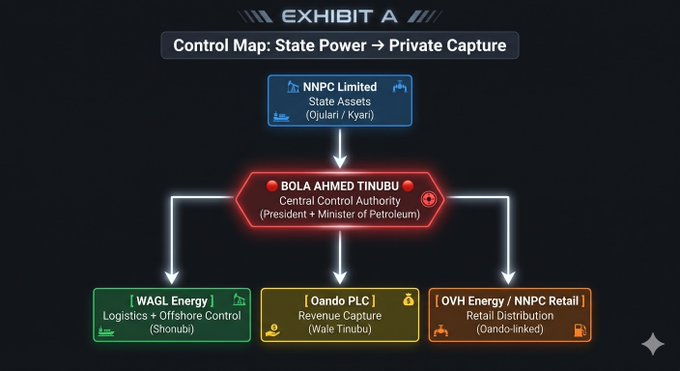
Before you follow the movement of oil, you map the movement of control.
This is not governance. This is private capture.
What follows is not rhetoric. It is a prosecutorial framework. Based on the available evidence, these are the charges that would form the foundation of a criminal indictment against Bola Tinubu, the President of the Federal Republic of Nigeria and his accomplices.
Registry of the Accused: The Syndicate Personnel
Bola Ahmed Tinubu (The Principal): President of Nigeria and Minister of Petroleum Resources. The architect of the institutional restructuring designed to enable sovereign wealth diversion.
Adewale “Wale” Tinubu (The Commercial Lead): CEO of Oando PLC. The primary commercial beneficiary, coordinating the acquisition of state assets (Agip, OVH) and the logistics of the offshore network.
Temitope Shonubi (The Logistics Coordinator): Chairman of WAGL Energy and Sahara Group. The midstream architect managing the MT Iyaloja Lagos and the offshore “FOR ORDER” transfer zones.
Bashir Bayo Ojulari (The Successor Enabler): Current Group CEO of NNPC Limited (appointed April 2, 2025). As the successor to Mele Kyari, Ojulari is the current custodian of the “performance-based” system that maintains the Malta-Nigeria corridor and the “reverse takeover” of retail assets.
Mele Kyari (The Legacy Architect): Former Group CEO of NNPC Limited (2019–2025). Designed and implemented the administrative framework for the syndicate’s operations before his removal.
Huub Stokman (The Managerial Proxy): MD of NNPC Retail (formerly CEO of OVH Energy). The operational node ensuring private management control over state retail assets.
Corporate Entities: NNPC Limited, WAGL Energy, Oando PLC, and OVH Energy Marketing.
Count 1: Abuse of Office
Statutory Basis: Criminal Code Act, Chapter 12, Section 104
The Charge:
That Bola Ahmed Tinubu, while serving as President of the Federal Republic of Nigeria and Minister of Petroleum Resources, did knowingly and willfully use the authority of his office to restructure state institutions and deploy public assets for the direct and indirect benefit of a private, family-linked commercial network.
The Evidence:
- The alignment and integration of NNPC-controlled assets with WAGL Energy structures
- The leadership role of Temitope Shonubi within WAGL
- The parallel control of Oando PLC under Wale Tinubu
- The consolidation of executive oversight across regulatory, commercial, and logistical layers
Together, these elements establish a vertically integrated system in which public authority and private commercial benefit operate as a single coordinated structure.
The Penalty:
Under Section 104 of the Criminal Code Act, abuse of office is punishable by up to three years imprisonment. Where the conduct amounts to official corruption under Section 98, the offense carries a penalty of up to seven years imprisonment.
The Prosecutorial Recommendation:
The prosecution asserts that this conduct was systemic, deliberate, and foundational to the broader scheme of economic exploitation. Accordingly, the prosecution seeks:
For the Principal Actor (Bola Ahmed Tinubu): The maximum custodial sentence allowable under Sections 104 and 98, applied at the highest threshold permitted by law.
For Associated Actors: Full custodial penalties proportionate to their level of participation in the abuse of state authority.
This is not governance.
This is a system where public power and private profit move as one.
Count 2: Criminal Conspiracy
Statutory Basis: Criminal Code Act, Section 516
The Charge:
That Bola Ahmed Tinubu did conspire with close associates, including Wale Tinubu and Temitope Shonubi, to coordinate state policy, regulatory action, and asset deployment in a manner designed to secure private commercial advantage from public resources.
The Evidence:
- Coordinated restructuring of NNPC retail and downstream assets
- Transfer and management alignment involving OVH Energy
- Policy decisions that enabled consolidation under interconnected entities
- The synchronization of public institutional actions with private commercial outcomes
These actions demonstrate a sustained agreement to use state power as an instrument for private gain.
The Penalty:
Under Section 516 of the Criminal Code Act, any person convicted of conspiracy to commit a felony is liable to imprisonment for up to seven years.
The Prosecutorial Recommendation:
The prosecution asserts that this conspiracy represents the operational backbone of the broader scheme. Accordingly, the prosecution seeks:
For the Principal Actors (Bola Ahmed Tinubu, Wale Tinubu, Temitope Shonubi): The maximum term of imprisonment permissible under Section 516
For Co-Conspirators: Custodial sentences reflecting their role in facilitating and executing the conspiracy
This is not coordination.
This is conspiracy with structure.
Count 3: Money Laundering and Financial Opacity
Statutory Basis: Money Laundering (Prevention and Prohibition) Act, 2022
The Charge:
That state-linked energy assets and associated financial flows were deliberately structured through offshore jurisdictions and intermediary entities for the purpose of concealing beneficial ownership, obscuring the origin of funds, and converting sovereign assets into privately controlled proceeds.
The Evidence:
- Use of Marshall Islands flag registration to obscure beneficial ownership
- Deployment of Maltese fiduciary structures and offshore intermediaries
- Utilization of Mauritian holding companies as a financial conduit to route proceeds, obscure beneficial ownership, and shield revenue flows from Nigerian regulatory oversight
- A $2.08 billion Malta–Nigeria trade anomaly following years of zero activity
- Multi-layered financial routing across jurisdictions designed to limit transparency and break the chain of financial traceability
These elements establish a pattern consistent with the concealment and laundering of proceeds derived from sovereign resources.
The Penalty:
Under the Money Laundering (Prevention and Prohibition) Act, 2022:
- Individuals are liable to a minimum of four years imprisonment
- Financial penalties of not less than five times the value of the proceeds
- Corporate entities are subject to license revocation and equivalent financial sanctions
The Prosecutorial Recommendation:
The prosecution asserts that the financial architecture of this scheme was deliberately engineered to obscure ownership and legitimize illicit gains at scale. Accordingly, the prosecution seeks:
For the Principal Actors: The maximum custodial sentence allowable under the Act, alongside full financial penalties proportionate to the value of illicit proceeds
For Corporate Entities and Financial Intermediaries: Full financial sanctions, including penalties of no less than five times the value of the funds and revocation of all relevant operating licenses.
This is not global finance.
This is money laundering with jurisdictions.
Count 4: Economic Sabotage
Statutory Basis: Petroleum Production and Distribution (Anti-Sabotage) Act, Section 1
The Charge:
That petroleum resources intended for Nigerian distribution were deliberately diverted, reclassified, and reintroduced into the domestic market under conditions severely detrimental to the national economy, public health, and environmental safety.
The Evidence:
AIS tracking data showing persistent “FOR ORDER” loitering patterns
Offshore Ship-to-Ship (STS) transfer activity along the Benin axis
Documented importation of high-sulfur “African Spec” fuel exceeding regulatory thresholds
The Penalty:
Under Section 2 of the Anti-Sabotage Act, any person convicted of sabotage under this Act shall be liable on conviction to be sentenced to death.
The Prosecutorial Recommendation:
The prosecution asserts that the scale, intent, and systemic impact of this offense — involving the diversion of billions in sovereign resources and the direct harm inflicted on the economic and physical well-being of the Nigerian population — meets the highest threshold of criminal severity contemplated under the Act.
Accordingly, the prosecution seeks the imposition of the maximum penalty prescribed by law.
Sentencing Recommendation:
For the Principal Actors (Bola Ahmed Tinubu, Wale Tinubu, and Temitope Shonubi):The prosecution seeks that they be convicted and sentenced to death by firing squad, consistent with the highest form of capital punishment historically applied in Nigeria for offenses of this magnitude against the state.
For Institutional Accomplices (NNPC officials and regulatory enablers):The prosecution seeks life imprisonment.
The Opening Statement
This case is not built on speculation. It is built on observable patterns.
To understand the system, you watch how it operates.
At sea, movement is not hidden. It is recorded.
Every commercial vessel is required to broadcast its position, speed, and destination in real time through the Automatic Identification System (AIS).
That data is public. It shows behavior, not statements.
Ships don’t make statements. They follow instructions.
But movement alone is not enough.
You also have to follow the money.
Because when trade flows contradict physical reality, you are no longer looking at commerce.
You are looking at coordination.
This is not growth.
This is a discontinuity.
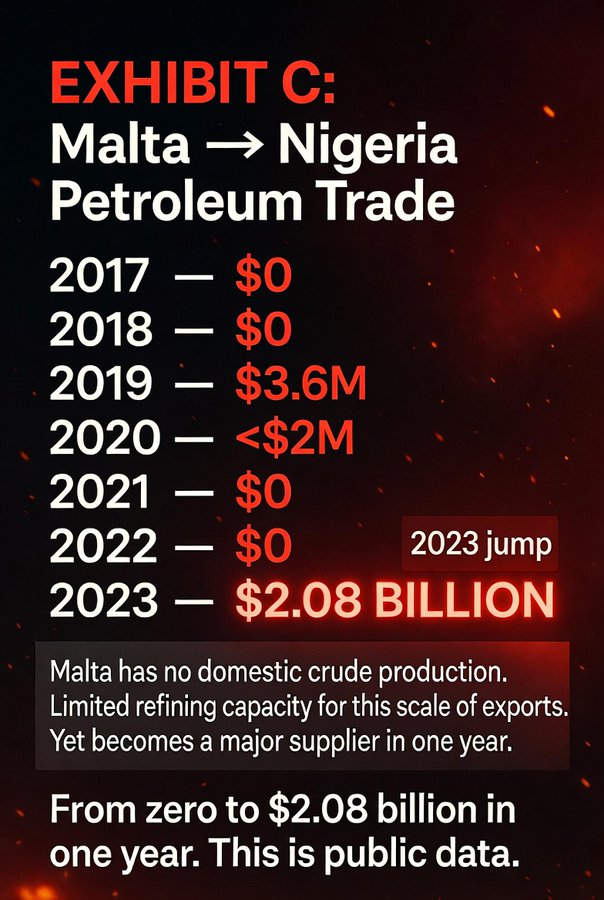
From 2017 to 2022, trade is effectively zero.
Then in one year, it jumps to $2.08 billion.
No discovery.
No refinery expansion.
No structural change in Malta’s energy capacity.
Just volume.
That is not how markets behave.
Markets scale.
They do not appear overnight.
But controlled systems do.
And when you see both movement and money align, you are no longer looking at coincidence.
You are looking at design.
In the following sections, the prosecution will present:
Exhibit A: Control Structure
Exhibit B: AIS Maritime Data (Behavior)
Exhibit C: Malta Trade Anomaly (Money)
Individually, each raises questions. Together, they form a system.
The evidence will show structure, coordination, and benefit.
This is not a story about governance.
It is a case about control.
And at the center of that control is a single office, a single network, and a system that converts public resources into private gain.
The prosecution rests its opening.
At this point, the system is clear.
Control.
Movement.
Money.
But there is one more layer.
The product.
This is where the system becomes visible.
The fuel is cheaper to produce.
Because it is not properly refined.
It is blended.
Diluted.
Reclassified.
The margin is not created through efficiency.
It is created through degradation.
Engines fail faster.
Air quality declines.
Public health absorbs the cost.
This is not just extraction.
It is proactive and willful transfer of harm on the people of Nigeria by the President of Nigeria, Bola Ahmed Tinubu for no reason other than personal profit.
Systems don’t operate in abstraction.
They require assets.
Ships.
Infrastructure.
Logistics.
And in this case, one asset stands at the center of it all.
The Naming Ceremony: A Mother’s Legacy or a Syndicate’s Flag?
In August 2025, a 40,000 cubic meter Liquefied Petroleum Gas (LPG) carrier entered the water in Ulsan, South Korea. The commissioning of the MT Iyaloja Lagos (IMO: 1026661) was presented as a milestone in Nigeria’s energy independence strategy. Named after the late Alhaja Abibatu Mogaji—the “mother” of President Bola Ahmed Tinubu—the vessel was draped in the sentiment of family legacy. Representing her father and the family, the ribbon was cut by Tinubu’s daughter, Folasade Tinubu-Ojo, the “Iyaloja-General” of Nigeria.
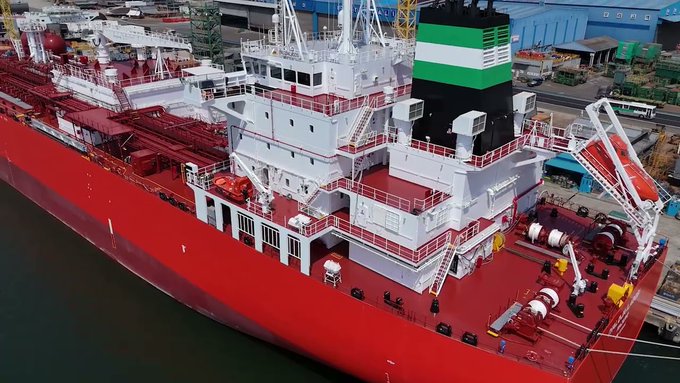
However, beneath the sentimental framing lies a more structured reality. When placed against the patterns already established, control, movement, and financial flow, the vessel’s role becomes more defined. Its ownership structure, routing behavior, and integration into offshore logistics corridors place it within a system that operates beyond conventional transparency.
The transit patterns associated with the vessel, particularly along the Benin offshore axis, align with known zones where cargo can be repositioned outside direct regulatory oversight. In these environments, origin, custody, and destination can shift without passing through standard port controls.
Within that framework, the MT Iyaloja Lagos is not simply a commissioned asset. It functions as part of a logistics chain linking access, movement, and distribution. Viewed in full, that chain narrows the distinction between state function and private control.
This becomes clearer when the vessel’s operational behavior is examined.
The Timeline: A Premeditated Asset
The development timeline of the MT Iyaloja Lagos provides important context for its role within the broader system. The order for the vessel was placed in 2023, shortly after the restructuring and prioritization of the WAGL Energy joint venture under the incoming Tinubu administration. The ship was commissioned in August 2025, consistent with standard construction timelines for a 40,000 CBM dual-fuel LPG carrier, which typically range from 18 to 24 months.
This sequence places the acquisition decision at the very beginning of the political transition. It indicates that the vessel was not an incidental addition, but part of an early-stage logistics expansion aligned with the growth of the WAGL fleet, which now represents approximately 202,000 CBM of capacity.
The progression can be summarized as follows. The order was placed in early to mid-2023 following the restructuring of the WAGL joint venture. Construction began later that year at HD Hyundai Heavy Industries in South Korea. The vessel was commissioned on August 18, 2025. By April 2026, it was actively operating within offshore corridors associated with “FOR ORDER” routing patterns.
The speed and alignment of these events establish that the vessel was integrated into a broader operational framework from inception. It was designed and commissioned to operate within a system that extends beyond conventional point-to-point logistics.this is
Ownership: The “Hide in Plain Sight” Strategy
The significance of the MT Iyaloja Lagos extends beyond its physical presence. Its connection to Bola Ahmed Tinubu is not obscured. It is publicly associated through naming, ceremony, and symbolism. By naming the vessel after his mother and having his daughter lead the commissioning, the relationship between the asset and the presidency is placed in plain view.
This visibility does not reduce concern. It reframes it. What is presented as personal tribute also signals proximity to control over a high-value asset linked to public resources.
The WAGL Front
On paper, the vessel is owned by WAGL Energy Limited, a joint venture between the Nigerian National Petroleum Company and private sector partners. This structure places the asset within a hybrid framework that combines public funding with commercial management.
Under this arrangement, the vessel operates with access to state-linked resources while benefiting from the operational flexibility of a private entity. Oversight is reduced without removing state involvement. Accountability becomes less direct while control remains intact.
The Double-Grip: Official Authority and Unofficial Control
The broader context becomes clearer when examining how authority is positioned across the oil value chain. Bola Ahmed Tinubu retained the role of Minister of Petroleum Resources, consolidating executive authority over licensing, approvals, and sector policy within the presidency.
At the same time, key commercial and logistical roles are occupied by closely aligned entities and individuals. This creates a system in which regulatory authority and operational execution function within overlapping networks.
In early 2026, Executive Order No. 9 further reshaped this structure by mandating that NNPC remit proceeds, including Royalty Oil, Tax Oil, and Profit Oil, directly into a Central Bank account under federal oversight. This shift moves control from internal institutional processes to a more centralized executive framework.
When viewed together, these elements reflect a high degree of integration across production, transport, and revenue management. The same authority that regulates the system also benefits from how the system operates.
This becomes observable through the vessel’s recorded movement data.
The operational behavior of the MT Iyaloja Lagos is not inferred. It is recorded. Every commercial vessel is required to broadcast its position, speed, and declared destination in real time through the Automatic Identification System. This data is public and independently verifiable across multiple maritime tracking platforms.
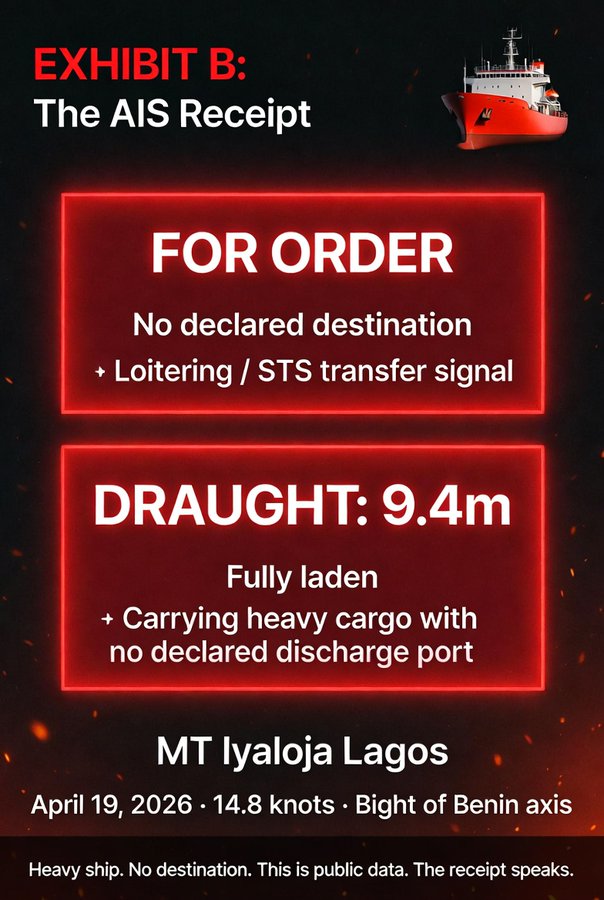
Recent AIS records show the vessel operating within the Bight of Benin corridor under a repeated “FOR ORDER” designation. In maritime practice, this indicates that a vessel has no fixed declared destination and is awaiting instruction. While not inherently unlawful, this pattern is commonly associated with offshore positioning in zones where ship-to-ship transfers occur outside standard port oversight.
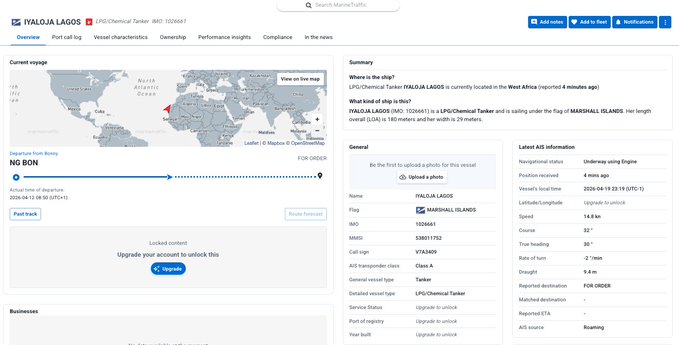
At the same time, the vessel reported a draught of approximately 9.4 meters. Draught reflects how deeply a vessel sits in the water and serves as a direct indicator of cargo weight. At this depth, the vessel is materially laden. In standard operations, a vessel carrying this level of cargo proceeds directly to a confirmed discharge terminal.
The combination of a fully laden vessel and the absence of a declared destination represents a deviation from conventional logistics flow. Within known offshore transfer corridors, particularly along the Benin axis, this pattern is consistent with positioning for ship-to-ship transfer activity, where cargo can change custody outside formal port systems. In that corridor, comparable movement patterns have been repeatedly linked to the diversion of petroleum outside regulated accounting systems, commonly classified as oil theft.
The Oando Integration: A Masterclass in Vertical Monopoly
The expansion of the WAGL fleet aligns with the growth of Oando PLC, reflecting a broader consolidation of control across Nigeria’s energy value chain. This is not simply expansion in scale. It represents the integration of upstream access, logistics capacity, and downstream distribution within a closely connected network.
In 2024, Oando completed the $783 million acquisition of Eni’s onshore Agip assets. This transaction occurred within a regulatory framework in which NNPC declined its right of first refusal, allowing the transfer of upstream oil and gas assets into Oando’s control. As the supervising authority over NNPC and the petroleum sector, the presidency oversaw the environment in which this decision was made. The outcome positioned Oando within the production layer of the value chain, shifting control of formerly state-linked assets into a closely aligned commercial structure operating within the same network of authority.
At the downstream level, NNPC acquired OVH Energy Marketing for approximately N140.5 billion in public funds. Subsequent restructuring placed the merged NNPC Retail network under management structures linked to Oando. This arrangement further aligned ownership and operational control across public and private entities within the same system.
When viewed alongside the logistics layer provided by WAGL-linked vessels, including the MT Iyaloja Lagos, the structure reflects a form of vertical integration. Production, transport, and distribution are no longer operating as separate, independently regulated functions. They are connected within a continuous chain.
Within such a system, oversight shifts from direct government supervision of individual transactions to reliance on the structure itself. The Nigerian state underwrites the risk through capital exposure, while operational control and profit capture remain concentrated within Bola Tinubu’s private network operating in alignment with the same authority that regulates the system.
The Marshall Islands Shield: Legal Distance and Operational Control
The decision to register the MT Iyaloja Lagos under the Marshall Islands flag introduces a critical structural layer. While the vessel is publicly presented as part of Nigeria’s energy strategy, its legal identity is anchored in an offshore registry. This creates a separation between national presentation and legal jurisdiction.
Historically, state-linked Nigerian vessels operated under national registry and were subject to Nigerian maritime laws, tax obligations, and labor standards. Vessels such as the MV Binta Yar’adua, which served under the Nigerian National Shipping Line, reflected this model of national registry and direct state oversight. By contrast, the Iyaloja Lagos operates under an open registry system that places it outside direct domestic oversight from inception.
The Marshall Islands registry is widely used in global shipping due to its permissive disclosure requirements and flexible regulatory framework. Unlike Nigerian-flagged vessels, it does not require full public transparency of beneficial ownership. This limits visibility into who ultimately controls the asset.
It also alters the regulatory environment in which the vessel operates. A ship flagged under a foreign registry is not subject to the same level of direct oversight from agencies such as the Nigerian Maritime Administration and Safety Agency. In practical terms, the vessel participates in Nigerian economic activity while remaining legally external to Nigerian maritime jurisdiction.
Taxation and labor obligations are similarly affected. Open registry systems often allow operators to structure tax exposure and employment requirements outside the stricter conditions imposed by domestic cabotage frameworks. This creates a further layer of separation between the asset and the national systems it serves.
The result is a dual structure. The vessel is presented as a national asset, but operates as a legally external one. Its economic function is tied to Nigerian resources, while its legal identity determines who can regulate it, audit it, or challenge its operation.
RECEIPT #1: The AIS Paper Trail and the Institutionalized Oil Bunkering Syndicate
The operational pattern of the MT Iyaloja Lagos is reflected in its Automatic Identification System (AIS) data. These broadcasts track position, movement, draught, and declared destination. They are independently logged and form a continuous public record of the vessel’s behavior.
From August 2025 through April 2026, that record reflects a consistent pattern. Port interaction is followed by offshore positioning under a repeated “FOR ORDER” designation.
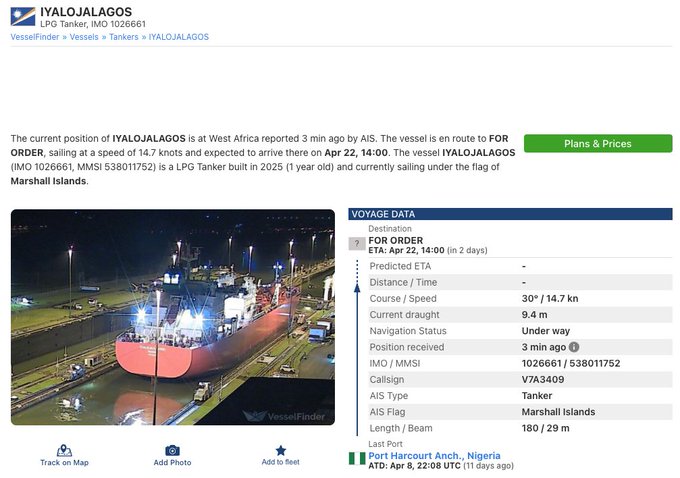
The sequence is not continuous, but it is clear.
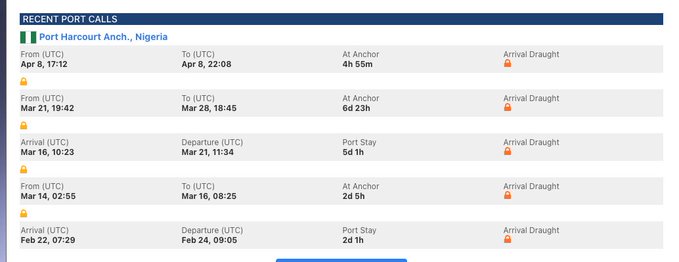
The vessel enters port for short durations. Two days. Five days. In late March, nearly seven days at anchor in Port Harcourt. Then it departs.
After each port interval, the pattern shifts offshore. Movement slows. Position stabilizes. The destination field remains unchanged. “FOR ORDER.”
On April 8, 2026, the vessel departs Port Harcourt Anchorage. By April 13, it is underway in West African waters, reporting a draught of 9.4 meters. It remains materially loaded. It does not declare a destination.
By April 19, it has been at sea for approximately eleven days under the same designation.
This is not a single deviation. It is a repeated cycle.
Port entry.
Short-duration activity.
Departure without declared discharge.
Extended offshore positioning.
The behavior is consistent across multiple intervals.
Within established offshore corridors in the Bight of Benin, this pattern aligns with positioning for ship-to-ship transfer activity, where cargo can change custody outside formal port systems.
The data does not interpret itself. It records movement, condition, and timing.
Taken together, those elements form a pattern.
The “FOR ORDER” Status: Oil Bunkering With Receipts
In April 2026, the MT Iyaloja Lagos engaged in a series of start and stop movements within the Bight of Benin, concentrated around the Cotonou anchorage corridor. Across multiple AIS intervals, the vessel maintained a “FOR ORDER” destination while remaining in a persistent offshore position.
In standard maritime commerce, a vessel proceeds directly to a declared discharge port where cargo is received, documented, and cleared through established regulatory systems. The destination field is the record of accountability. Here, that accountability does not resolve. The destination remains open.
This behavior carries operational implications. A vessel of this class, carrying a material draught and incurring significant daily costs in fuel, crew, and charter exposure, does not typically remain at sea without a defined discharge plan for extended periods. In a transparent commercial environment, time at sea without a destination represents cost without recovery.
An equivalent scenario would be a commercial transport system operating continuously without completing a defined trip. A ride-hailing vehicle remaining active without a passenger or a commercial aircraft remaining in flight without a scheduled landing represents a system in motion without a completed transaction. In each case, cost accrues without delivery.
The same principle applies here. The vessel remains underway for approximately eleven days under a “FOR ORDER” designation while materially laden, without a declared discharge point.
Movement slows. Position stabilizes. The destination field does not change.
Within established offshore corridors in the Bight of Benin, this pattern aligns with positioning for ship-to-ship transfer activity, where cargo may be transferred between vessels outside formal port infrastructure.
In regulated trade, destination is fixed. In this case, it remains unresolved.
A commercial vessel is not paid to do “aimless waka” in international waters. When it moves without a destination, day after day, the journey stops being transport and starts becoming something else.
The Benin Corridor: Control and Reclassification Risk
The vessel’s repeated positioning along the Benin axis is not random. It occurs within a corridor that sits outside direct Nigerian port control while remaining within active regional trading routes.
Once a vessel exits regulated port infrastructure and remains in offshore position under a “FOR ORDER” designation, the chain of custody becomes opaque. Movement continues, but accountability becomes indirect.
Within these offshore zones, cargo may be transferred between vessels through Ship-to-Ship (STS) operations conducted outside formal port systems. While STS transfers are a feature of global maritime trade, they also create conditions in which origin, custody, and documentation can be altered without passing through standard regulatory checkpoints.
The Point of Transition
In this context, the Benin corridor functions as a point of transition. Cargo that enters the zone under one declared structure can leave under another, depending on how it is received, transferred, or documented during offshore operations.
The implications are structural.
Traceability shifts. Once cargo moves through such a corridor without a fixed discharge point, its verification is no longer anchored to continuous physical oversight. It becomes dependent on documentation rather than direct observation.
Continuity breaks. In regulated trade, origin is preserved through declared routing and verified delivery. This environment operates so that continuity is interrupted.
This is where the AIS movement pattern and the downstream trade data begin to intersect. The same corridor that supports repeated offshore positioning also sits along the pathway through which reclassified product enters the global market.
The Load Indicator: The Smoking Gun
To the untrained eye, a ship at sea is just a ship. To a maritime investigator, the draught is a direct indicator of load. It reflects how deeply a vessel sits in the water and, by extension, how much weight it is carrying.
On April 13, 2026, the MT Iyaloja Lagos reported a draught of 9.4 meters. At this depth, the vessel is materially laden.
In standard commercial operations, a vessel carrying this level of load proceeds toward a confirmed discharge terminal. The journey resolves in delivery. The cargo moves, and it arrives.
Here, that resolution does not occur.
The vessel continues underway while reporting a material draught. The load remains. The endpoint does not.
This is not movement evidence. It is weight evidence.
The data is not interpretive. It is broadcast directly by the vessel through its Automatic Identification System and recorded across independent tracking platforms, including VesselFinder, MarineTraffic, and MyShipTracking. The same records show no corresponding scheduled arrival at a regulated discharge terminal during this interval.
The condition is clear. The vessel is carrying load. It remains in motion. It is not resolving into delivery.
When a ship sits this heavy without a destination, it is “waiting for a buyer” in the shadows. By facilitating this through a vessel named after his mother and controlled through his hand-picked NNPC and Oando leadership, Bola
Tinubu has moved oil bunkering from the creeks to the deep ocean. This is the wholesale hijacking of Nigeria’s oil production architecture. The ship is heavy with the stolen future of 200 million people, and the transponder data is the confession, the “ghost” who speaks.
The Technical Deception: How a “Gas Ship” Became a Crude Carrier
The MT Iyaloja Lagos is officially classified as an LPG or Medium Gas Carrier (MGC). That classification defines its intended cargo, not the full extent of its physical capability. The distinction is where the technical deception begins.
LPG is a demanding cargo. It must be stored under pressure or at extremely low temperatures to remain in liquid form. Crude oil, by contrast, is stable at ambient conditions. It does not require pressurization or cryogenic containment.
This asymmetry matters. A vessel engineered to safely contain pressurized or refrigerated gas is structurally capable of holding less demanding liquid cargo, subject to cleaning and handling constraints within its tank and piping systems.
This is not theoretical. The early development of LPG shipping relied on converted oil tankers. More broadly, vessel classifications such as multi-gas carriers and hybrid cargo designs reflect a long-standing reality: cargo designation does not strictly limit physical use.
The analysis, however, does not depend on theory. It depends on condition.
Draught reflects weight. It is a physical measurement of displacement, not a declared specification.
Liquefied gas is relatively low in density. A vessel carrying LPG will typically sit higher in the water than one carrying a dense liquid cargo of equivalent volume.
On April 13, 2026, the MT Iyaloja Lagos reported a draught of 9.4 meters while operating under a “FOR ORDER” designation. At this depth, the vessel is materially laden.
If the vessel were operating strictly within its declared LPG profile, it would be expected to sit higher in the water under comparable conditions. Instead, it remains deep, loaded, and without a resolved destination.
This is where classification and condition diverge.
The Trojan Horse Dynamic
A conventional crude tanker operates within a monitored framework. Its routes, cargo declarations, and discharge terminals are subject to higher scrutiny within global shipping and regulatory systems.
An LPG carrier, by contrast, operates under a different commercial and regulatory expectation. It is associated with “clean” energy logistics, with less emphasis on crude monitoring frameworks.
The distinction creates a structural advantage.
The question is not whether an LPG carrier is designed to carry crude. The question is whether it can move high-density cargo without triggering the same level of scrutiny as a dedicated crude tanker.
Within that framework, the use of an LPG-class vessel operating under a “FOR ORDER” designation while materially laden introduces a different kind of visibility. The ship moves. The load is present. The destination does not resolve.
The vessel does not need to declare a transformation. It only needs to move within a category that attracts less attention.
The data does not label the cargo. It reflects its weight, its movement, and its unresolved endpoint.
That is where the technical question becomes operational.
The Operational Takeaway: A Multi-Stage Heist
This is not a supply chain; it is a coordinated maritime racket that weaponizes state institutions to shield illegal gains flowing into Tinubu family pockets.
Stage 1: The Ghost Load (The Illegal Source)
The Constitutional Coup: Weaponizing the Office of the President
The syndicate operates with impunity because Bola Tinubu has consolidated the three most powerful levers of the Nigerian state into a single, unchecked hand.
The Minister-President Loop: Because Bola Tinubu serves as his own Minister of Petroleum Resources, he controls NNPC Ltd. without the “interference” of a middleman. He is the one who authorizes the release of the nation’s crude and gas allocations.
The Commander-in-Chief Shield: As Commander-in-Chief, the Nigerian Navy is constitutionally compelled to carry out his orders. Under the guise of “protecting vital national assets,” the Navy provides a secure perimeter for the Iyaloja Lagos—acting as armed escort for a private siphoning operation.
The Ghost Loading Maneuver: By loading the Iyaloja Lagos at offshore Single Buoy Moorings (SBMs) and deep-sea platforms—away from regulated land terminals—the syndicate ensures oil is “stolen” before it is even officially recorded as being produced. If it isn’t recorded at a dock, it doesn’t exist on the national balance sheet.
The Reality: The President provides the oil (as Minister), the President provides the protection (as Commander-in-Chief), and the President’s cronies manage the profit (as WAGL/Sahara). It is a vertical monopoly where the laws of the land are literally used to break the laws of the land.
Stage 2: The Grey Zone (Offshore Positioning & The Benin Safeguard)
The vessel moves to the “black hole” of the Cotonou–Lomé axis and declares FOR ORDER. WAGL Management (chaired by Tinubu associate Temitope Shonubi) issues navigational orders to loiter, while the Nigerian Navy—which has the satellite capability to track every vessel in the Gulf of Guinea—conspicuously fails to interrogate a fully laden ship (9.4m draught) drifting without a destination.
Strategic Context: Control of the Benin Corridor
The significance of the Benin corridor extends beyond vessel movement. It is a critical offshore zone through which unresolved cargo positioning occurs.
This context provides a framework for understanding the broader regional importance of maintaining stability within that corridor.
In December 2025, Nigeria intervened militarily during an attempted coup in Benin. While publicly framed as a defense of constitutional order, the timing aligns with the strategic importance of the Cotonou–Lomé axis as a key offshore transit zone.
A disruption in that corridor would introduce uncertainty into the same maritime environment in which vessels such as the Iyaloja Lagos operate under “FOR ORDER” positioning.
The relationship is structural. Control of territory extends to control of movement corridors. Control of movement corridors influences how and where offshore positioning can occur.
This becomes particularly relevant during offshore transfer conditions. At the point of transfer, vessels are stationary, exposed, and materially laden. A vessel reporting a draught of 9.4 meters while operating in this environment is not in transit. It is in position.
In such a state, the operation depends on stability. Any external intervention, whether regulatory or military, would introduce direct visibility into cargo condition and movement.
Within that context, the continuity of the corridor becomes operationally significant.
Stage 3: The “Receive and Pump” Maneuver (The Identity Wipe)
The Ship-to-Ship (STS) transfer in international waters is the core of the criminal alchemy. The Iyaloja Lagos does not just move oil; it “washes” it.
This vessel is not simply a transport ship; it is the physical point where “State Oil” is converted into “Private Oil.”
The “Receive and Pump” maneuver is essential to the entire operation because it provides the legal cover needed to break the chain of custody.
Why the “Receive and Pump” is Essential:
The Legal Receipt (Receiving): A foreign “dark tanker” cannot load directly at a Nigerian offshore platform without being flagged as a pirate or a thief. The Iyaloja Lagos, however, has the “legal” right to be there. It receives the oil officially under the guise of state utility. On the books, the oil has not been stolen; it is just being “stored” or “moved” by a state-linked vessel.
The Identity Wipe (Pumping): Once the Iyaloja Lagos loiters “FOR ORDER” in the Bight of Benin, it meets a dark tanker and pumps the crude over. This is the exact moment the “Chain of Custody” is broken. The crude is no longer traceable to a specific Nigerian well; it leaves the Iyaloja’s manifolds as “unlabeled feedstock.”
The oil is not just missing from a pipe in the creek; it has been systematically siphoned from the national grid through a ship named after the President’s mother, then legally laundered through a state-sanctioned transfer point before vanishing into the global black market.
Stage 4: The Laundering (The Malta Loop)
The stolen oil is re-classified as International Feedstock and shipped to hubs like Malta for blending into Maltese Blend petrol. The oil is sold back to Nigeria. The Tinubu-led Presidency then uses the Central Bank of Nigeria (CBN) to pay the syndicate subsidy payments for fuel that was stolen from the country to begin with.
Summary:
- Stage 1 Loading: No record of docking at a Nigerian port
- Stage 2 Transit: Using the Benin axis to escape NIMASA oversight
- Stage 3 Transfer: Moving state oil to dark tankers for laundering
- Stage 4 Payment: Using the CBN to buy back stolen oil from the family’s Maltese plants
Each stage is independently explainable, but together they form a closed operational loop.
Bola Tinubu has created a system where the Nigerian Navy protects the ship while it steals the oil, the NNPC provides the oil in secret offshore locations, and the Presidency pays the thieves to bring it back. This is not just bunkering; it is State Capture via the high seas.
RECEIPT #2: The Malta Connection – The Billion-Dollar Laundry
While the Iyaloja Lagos handles high-seas diversion, the Malta Loop serves as the industrial laundry where Nigeria’s stolen wealth is re-branded. These are not standard refineries; they are blending plants, facilities designed to mix diverted crude with chemical additives and low-grade European fuel to create substandard products for the Nigerian market.
The shift in trade between Malta and Nigeria is one of the most drastic anomalies in recent maritime history.
According to international trade databases (including Trade Map and the Observatory of Economic Complexity), for six consecutive years (2017–2022), petroleum imports from Malta to Nigeria recorded zero. Prior to the sudden multi-billion dollar surge starting in 2023 when Bola Tinubu assumed office, the trade relationship was negligible and characterized by erratic, low-value shipments.
Historical Oil Export Data (Malta to Nigeria):
- 2023: $2.08 Billion (Sudden Surge)
- 2022: $0 (No Trade Recorded)
- 2021: $0 (No Trade Recorded)
- 2020: $0 (No Trade Recorded)
- 2019: $3.62 Million (Minor Shipment)
- 2018: $0 (No Trade Recorded)
- 2017: $0 (No Trade Recorded) 2016: $13.32 Million (Minor Volume)
- 2015: $117.01 Million (Previous Peak)
- 2014: $59.98 Million (Minor Volume)
- 2013: $47.50 Million (Baseline)
The total absence of recorded oil trade during the six-year gap (2017–2022) is the primary receipt used by analysts to argue that the current infrastructure is a new, deliberate creation. During these years, Nigeria’s fuel needs were met through traditional hubs like Antwerp-Rotterdam-Amsterdam (ARA) or refineries in India and the Gulf. The minor spike in 2015 ($117M) represents less than 6% of the volume seen in the 2023–2024 period. Even at its previous “high,” Malta was not considered a strategic partner for Nigerian energy security.
The jump from $0 in 2022 to over $2 billion in 2023 represents a 4,300% increase in a single year. This timeline aligns perfectly with the commissioning of the Iyaloja Lagos and the restructuring of the NNPC under the current administration. The shift from “Zero” to “Billions” supports the theory of a “blending plant” strategy. Malta did not suddenly discover oil or build massive new refineries; it instead became a hub for “blending plants” where various petroleum products from Nigeria are mixed and re-labeled for export back into the Nigerian market.
Malta, a country with zero oil fields, is now a top-tier European source for Nigeria’s refined petroleum. It functions strictly as a midstream processing and storage hub, making it the perfect middleman for a system designed to obscure product origin. Within this structure, control over diversion, processing, and resale sits inside the same network—effectively placing supply flow and pricing power within a closed supply and demand loop aligned with Tinubu’s syndicate.
While Malta is a top global hub for refined products, its Crude Petroleum trade is relatively small and used as a “cover” for the much larger Refined Petroleum volumes that flow to Nigeria. Malta is not an oil producer. The reason its Crude Petroleum trade numbers look “small” and “balanced” is deliberate.
In 2024, Malta exported approximately $96.7 million in crude and imported $56.9 million, creating a net crude export of just $39.8 million. This minor surplus makes Malta look like a minor, legitimate player in the global oil market. But this is the illusion. This minor crude trade acts as a regulatory anchor, allowing Maltese entities to maintain active “Oil & Gas” licenses and trade permits. It is the “front office” that justifies the existence of massive offshore blending operations that moved $2.08 billion in refined products to Nigeria in 2023 alone—a figure that dwarfs Malta’s entire crude export capacity by a factor of 20.
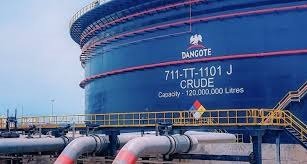
A refinery, like Dangote or Agip, is a massive, multi-billion dollar industrial complex that physically breaks down crude molecules. Malta does not have a major refinery. A blending plant is essentially a large-scale mixing station. They take “off-spec” or “diverted” crude, mix it with chemicals and additives, and re-label it as “Refined Product.” By labeling these exports as “Refined Petroleum” in trade data, the syndicate suggests that value was added through manufacturing. In reality, the “refinement” is often just a paperwork transformation to hide the origin of the oil.
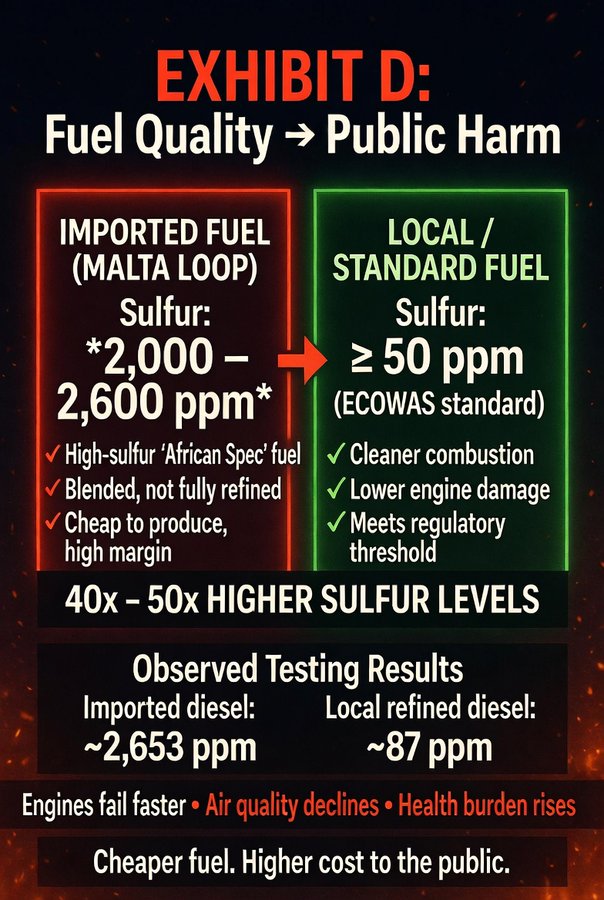
And this is where the health crime begins. There is a massive legal loophole in the oil trade. While the EU (including Malta) strictly enforces Euro 5 or Euro 6 standards (which limit sulfur to 10 ppm), they allow their blending plants to export what is colloquially called “African Spec.” In 2024 and 2025, reports indicated that fuel imported into Nigeria from Malta contained sulfur levels as high as 2,000 to 2,600 ppm. Technically, Nigeria adopted the ECOWAS standard of 50 ppm in 2020. However, regulators have been accused of “indiscriminately licensing” the import of this high-sulfur fuel, which is cheaper to produce and more profitable for the syndicate.
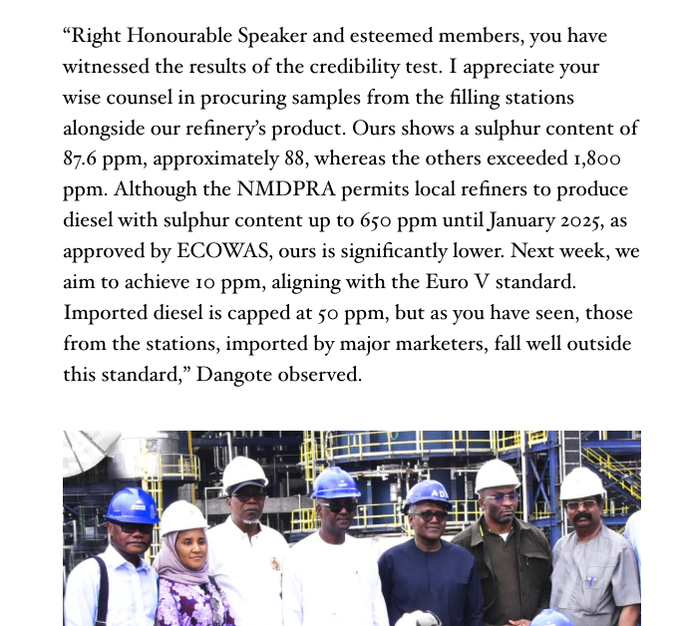
In late 2024 and early 2026, the Dangote Group went public with laboratory results that directly compared imported “Maltese” fuel with locally refined fuel. Imported diesel from specific terminals (linked to Matrix Energy and others) showed sulfur concentrations of 2,653 ppm. Locally refined diesel was tested at 87 ppm. This “dirty diesel” is a primary cause of engine failure, respiratory issues in urban areas, and the rapid degradation of modern vehicle catalytic converters.
The reason the fuel is “substandard” is not an accident; it is the business model. A refinery removes sulfur. A blending plant simply mixes different grades of oil to reach a “minimum” (and often illegal) threshold. Investigative reports suggest these blending plants use sanctioned Russian oil or diverted Nigerian crude as a “base,” which is then mixed with low-quality additives. This process allows “dirty” oil to be re-labeled as “Refined Product from Malta,” effectively laundering its origin and its chemical makeup.
The most damaging receipt is the silence of the NMDPRA (Nigerian Midstream and Downstream Petroleum Regulatory Authority). While the NMDPRA CEO claimed Dangote’s fuel was “inferior,” independent testing and AIS tracking of the Iyaloja Lagos suggest the regulator is actively clearing high-sulfur imports that would be illegal in any other market. By maintaining the “Minister of Petroleum” role in the presidency, the administration controls both the standards (what is allowed in) and the logistics (the Iyaloja Lagos bringing it in).
Between January and October 2025, Malta’s total exports in the “Mineral fuels and lubricants” category dropped by €190.3 million compared to 2024. Yet Nigeria remained the outlier recipient of massive volumes. Malta’s exports to the US and Europe are crashing. While the rest of Malta’s fuel trade is shrinking, the volumes going to Nigeria remain massive and consistent. This proves the Malta-Nigeria corridor is not a market-driven trade. If it were market-driven, Nigerian imports would fluctuate along with Malta’s global trade trends. Instead, it is a closed-loop logistics chain designed to move specific volumes regardless of global demand.
Aside from the multi-billion dollar corridor to Nigeria, Malta’s primary oil and refined product destinations for 2024–2026 tell the story of a tiny player: Spain received $62.3M in crude (Malta’s primary EU crude partner and often the source of Malta’s own base stock); Turkey registered the highest increase in Maltese exports in late 2025 but from a low base; Brazil received $28M in crude as a South American transshipment node; Qatar received $6.38M in crude as an emerging trade route; Greece received approximately $300M in refined products as a major EU entry point for blended fuel.
Nigeria’s $2.08 billion in imports from Malta in 2023 alone dwarfs Malta’s entire crude export capacity by a factor of 20. This mathematical impossibility confirms that the “Maltese” oil being sent to Nigeria is not coming from Malta’s legitimate refining operations. It is Nigerian crude that has been diverted, laundered through Maltese blending facilities, and sold back to the country it was stolen from.
The syndicate operates through a web of shell companies and leases that obscure Beneficial Owners. The Ras Ħanżir Terminal in Malta, owned by Maltese state-owned company Enemed, houses tanks used for blending. In July 2024, Aliko Dangote publicly alleged that some NNPC people and some traders have established blending operations off Malta. Ownership is often masked by Maltese law firms acting as fiduciary agents. While Oando PLC and Mele Kyari (before replacement with Bayo Ojulari) issued formal denials in 2024, investigative reports point to a network of fiduciary agents and Mauritian holding companies acting as proxies for the syndicate, specifically linking Wale
Tinubu’s interests to the logistics of these Maltese imports.
Think of it like adulterated alcohol—a high-quality spirit diluted and mixed with cheaper substances, then repackaged and sold as a finished product. The process changes classification, not origin. Diverted Nigerian crude is mixed with high-sulfur European waste. The resulting “dirty fuel” is often 650–700 parts per million (ppm) of sulfur, far more toxic than what is legally allowed in Europe (10 ppm), but approved for import by the NMDPRA. By importing this blend from their own plants, the Tinubu syndicate captures the full margin. They stole the crude, mixed it with cheap waste, and sold it at market price.
The round-tripping scam works in four steps: Crude is stolen or diverted via vessels like the Iyaloja Lagos to Malta. In Malta, oil is “re-certified” as Maltese refined product. Nigeria buys this “Maltese” fuel back at a premium. The Tinubu administration then pays “subsidy” or “cost recovery” payments to importers—effectively paying the criminal syndicate a second time for oil stolen from the country to begin with.
“Substandard” is not a quality control error—it is a profit margin. By blending diverted crude into 2,600 ppm “African Spec” fuel in Malta, the syndicate saves billions in refining costs while Nigerians pay the price at the pump, in their car engines, and with their lungs. The Iyaloja Lagos does not just carry stolen oil; it carries poison repackaged as progress.
The ELI/AKASO Racket: Tinubu’s Private Offshore Pipeline
The Energy Link Infrastructure (ELI) framework is the ultimate bypass. While the Iyaloja Lagos handles high-seas diversion, the ELI AKASO provides permanent offshore infrastructure needed for siphoning Nigeria’s oil before it ever touches a state-monitored pipe. This is deliberate, multi-billion dollar architecture designed to move national wealth directly into the President’s private Maltese coffers.
The FSO-ELI AKASO: The Hijacked Offshore Hub
The FSO-ELI AKASO (IMO: 9164847) isn’t just a ship; it is a floating, 2-million-barrel storage vault positioned in the Bonny offshore corridor.
The Receipt: As of April 17, 2026, tracking data shows the vessel stationary at 10.3 meters draught—sitting deep and heavy with 2 million barrels of crude—oil being loaded far away from the official Bonny Oil and Gas Terminal.
The Racket: By serving as an “Alternative Terminal,” it allows operators like Eroton (OML 18) to bypass the Trans-Niger Pipeline. If oil doesn’t flow through the state pipeline, the state can’t count it. This is oil bunkering at industrial level, sanctioned by the Commander-in-Chief.
The Maltese Financial Bridge
While oil is stolen in Nigerian waters, the money is captured in Malta. Energy Link Infrastructure Malta Limited is registered at 260 Triq San Albert, Gzira, Malta.
The Bypass: By routing ownership of the ACOES (Alternative Crude Oil Evacuation System) through a Maltese entity, “evacuation fees” and sales proceeds are captured in a European jurisdiction.
Direct to Tinubu: Through fiduciary agents and Mauritian shell companies, revenue from this 45km subsea pipeline—connecting the Cawthorne Channel directly to the AKASO—bypasses the Nigerian Federation Account entirely.
Why This is the Ultimate Racket:
Institutional Avoidance: Tinubu, as Minister of Petroleum, approves the “alternative” status of this terminal, effectively giving himself permission to bypass his own government’s monitoring systems
Military Protection: As Commander-in-Chief, he ensures the Nigerian Navy provides a “security cordon” around the AKASO, preventing independent inspectors from verifying how much oil is actually being loaded
Laundering the Future: The Maltese registration ensures this isn’t just “missing oil”; it is offshore capital that the Nigerian state can never audit. Control of infrastructure determines control of volume.
The ACOES and the ELI AKASO are the “private plumbing” of the Tinubu syndicate. They have built a second, invisible oil industry running parallel to the state’s, where the oil is Nigerian, the costs are public, but the 2 million barrels of profit belong exclusively to the criminal syndicate led by President Bola Ahmed Tinubu.
Forensic Timeline: The 2-Million-Barrel Racket
The 2 million barrels represents the static storage capacity of the ELI AKASO. To understand the daily, weekly, and yearly scale, you must look at throughput capacity—how fast the oil moves through the system.
The Daily Siphon:
The 47km subsea pipeline (ACOES) connected to the ELI AKASO has a targeted throughput capacity of 100,000 to 200,000 barrels per day. At just 100,000 barrels per day, this represents roughly 8% of Nigeria’s total daily production moving through a single offshore route.
The Cumulative Payout:
Daily: 100,000 barrels — approximately $8,000,000 at $80/barrel
Weekly: 700,000 barrels — approximately $56,000,000
Monthly: 3,000,000 barrels — approximately $240,000,000
Yearly: 36,500,000 barrels — approximately $2,920,000,000
At scale, throughput matters more than storage.
The 2 Million Barrel Reset:
The ELI AKASO acts as a buffer, operating in cycles:
Phase 1 (Accumulation): Over roughly 19 days, the vessel fills from the ACOES pipeline, storing crude offshore
Phase 2 (Transfer): Around day 20, a large tanker arrives and receives the full volume through ship-to-ship transfer.
This aligns with offshore transfer patterns observed with vessels like the Iyaloja Lagos operating under FOR ORDER positioning
Phase 3 (Movement): The receiving vessel departs into open-water routing corridors, while the AKASO remains at anchor, ready to repeat the cycle
The Ultimate Receipt: “Zero Production” vs. The Full Draught
The boldest lie of the Tinubu-led Petroleum Ministry is the claim that Nigeria’s oil wells are “dry” or “vandalized” while his private fleet sits heavy in the water.
As of April 2026:
Official NNPC reporting (overseen by the President himself) indicates that production in blocks like OML 18 has effectively ceased due to “technical issues”
AIS receipts tell a different story: the ELI AKASO is sitting at a draught of 10.3 meters—fully laden with 2 million barrels of crude
A ship at that depth isn’t “idling” or “waiting for repairs”; it is fully loaded. The “Zero Production” narrative is a tactical fabrication used to hide that the Tinubu cabal is siphoning the nation’s output into a private offshore vault before it can ever be taxed or accounted for. Reported output and observed storage do not reconcile.
The “Scuttling” Strategy: Liquidating the Evidence
The April 2026 auction of the ELI AKASO is the final stage of the racket. The syndicate isn’t just stealing the oil; they are “scuttling” the crime scene to bury the paper trail.
The Extraction: The Tinubu cabal siphoned 2 million barrels into the ELI AKASO while telling the Nigerian public the wells were dead. By claiming “zero production,” they avoided paying billions in royalties and taxes, keeping 100% of the value
The Legal Freeze: To prevent independent auditors or investigative journalists from boarding the ship and proving it is full of stolen oil, the cabal initiated winding-up petitions and court-ordered auctions, placing the vessel in a “legal no-man’s land” where the 2 million barrels inside are shielded from public view
The Fire Sale: The cabal is now conducting a “distressed” auction for a ship worth $40 million (carrying $160 million in stolen oil) with a reserve price of just $8 million. This is a pre-arranged “pass-back” to a presidential shell buyer, allowing the Tinubu inner circle to acquire the vessel, the oil, and the silence for pennies on the dollar. The sequence moves from extraction to insulation.
The Receipt Summary: The Tinubu Smoking Gun
The Physics of Theft: You cannot have a ship at 10.3-meter draught (Full) in an oil field that officially has “Zero Production” (Empty). The displacement of the water is the confession
The Architect: Bola Tinubu is the only person with dual authority to make this happen. As Minister of Petroleum, he oversaw the “Zero Production” lie. As Commander-in-Chief, he ordered the Nigerian Navy to protect the ELI AKASO while it was being filled with stolen crude
The Grand Total: At $80 per barrel, the 2 million barrels currently sitting in the ELI AKASO represent $160,000,000 (roughly ₦250 Billion)
This isn’t a “leakage” in the system; this is the President of Nigeria running a private, multi-billion dollar bunkering operation out of his own office.
The Fiduciary Shield: Invisible Ownership
The use of fiduciary agents and Mauritian holding companies is the legal camouflage that allows the syndicate to own multi-billion dollar assets without their names appearing on any public registry.
The Mechanism:
Instead of family members registering as owners of a blending plant or trading firm, fiduciary agents—typically Maltese law firms—are used to register the company on behalf of a client. These agents appear on official registries, while private agreements establish the true beneficial owners behind the scenes. This explains how public denials can be issued based on registry records, while beneficial ownership remains obscured.
The Mauritian Layer:
Mauritius serves as the gateway where oil-linked revenues are routed and structured before re-entry into the global financial system.
The Mauritius-Nigeria Double Tax Treaty: By routing profits through a Mauritian holding company, tax exposure across jurisdictions can be minimized
Zero Disclosure: Structures such as Global Business Licenses allow for limited transparency, creating gaps in publicly traceable ownership chains
The Oando Connection: Oando PLC has historically utilized Mauritian subsidiaries to manage complex asset and debt structures
The Three-Layer Structure:
- Mauritius — Financial routing and opacity
- Malta — Processing and reclassification
- Fiduciary Agents — Ownership masking
Receipt Summary: The Complete Paper Trail
Enemed (Malta) — Storage and blending facilities — Leased to private Nigerian traders and NNPC proxies
NNPC Officials — Facilitators — Alleged by Dangote to own the blending operations
Wale Tinubu / Oando — Logistics link — Management of the retail network that buys the Maltese blend
Central Bank of Nigeria — Paymaster — Remits billions in USD to Malta for fuel that was originally Nigerian crude
NNPC: The President’s Personal ATM
Under Tinubu, the NNPC has transitioned from a struggling state oil firm into a “black box” that facilitates executive-level theft. The recent declaration of “record profits” by the NNPC is viewed by analysts as a mathematical distraction designed to hide the massive “under-recovery” of diverted crude.
By appointing loyalists to key positions and maintaining direct control over Bayo Ojulari (NNPC GCEO), the presidency ensures every voyage of the Iyaloja Lagos serves the syndicate. When the NNPC claims it cannot account for 400,000 barrels of oil per day due to “theft by vandals,” the reality is often that oil is being loaded onto Tinubu-approved state-linked vessels and sent to the “Maltese laundry.”
The Oando-WAGL Nexus: A Family Empire
The Iyaloja Lagos is just one asset in a much larger fleet. The symbiotic relationship between WAGL Energy (the “public” face) and Oando PLC (the “family” face) ensures the Tinubu family maintains a stranglehold on the nation’s jugular.
Oando’s recent “management deal” for NNPC retail outlets—essentially handed over without a transparent competitive bidding process—completes the circle. The diverted oil, refined in Malta and shipped back in “family-branded” vessels, is sold to Nigerians at Oando stations. It is a closed loop of corruption where the Nigerian public provides the raw material, the infrastructure, and the final payment, while Tinubu and his family pocket the margin.
Conclusion: A Criminal Enterprise in Plain Sight
The MT Iyaloja Lagos is a beautiful ship, a technological marvel of dual-fuel engineering. But to the Nigerian citizen enduring record-high fuel prices and a devalued currency, it is a monument to their own exploitation.
Bola Tinubu has not built a legacy; he has built a syndicate. By utilizing the “WAGL” joint venture, the “Marshall Islands” flag, and the “Maltese” refinery loop, the current administration has created an airtight system where the state’s wealth is systematically drained. They didn’t steal the oil in the dark; they did it in the bright South Korean sun, with a ribbon-cutting ceremony and a prayer for a grandmother’s soul. These elements are observable independently and consistent when viewed together.
The receipts are undeniable:
- The AIS tracks showing “For Order” loitering in Benin
- The OEC data showing a $2 billion explosion in Maltese trade
- The corporate board interlocks between the presidency, NNPC, and Oando
- The 10.3-meter draught on a vessel in a “zero production” field
The Iyaloja Lagos is named after a mother, but it is feeding off the lifeblood of the nation. It is time to stop calling it “governance” and start calling it what it is: a coordinated maritime heist run from the highest office in the land.
Closing Argument: The Verdict of History
A President is a fiduciary—a trustee of the people’s resources. When that trustee uses his mother’s name to brand a vessel that flies a foreign flag, loiters in diversion zones, and carries “African Spec” poison back to his own citizens, he is no longer a leader. He is the head of a ruthless criminal syndicate preying on the very people he is supposed to lead.
The defense will speak of “market forces”, “due process” and “regulatory compliance” and gaslight us in many other ways. But market forces do not create $2 billion anomalies from zero in twelve months. Due process and Regulatory compliance do not permit 2,000 ppm sulfur in a 50 ppm world.
The immunity of Section 308 is a pause button, not an eraser. The data is permanent. The receipts are filed. In a nation where the law applies equally to all, the scale of this theft demands the ultimate penalty at some point.
Somebody has to speak up. Somebody has to speak for the millions of Nigerians who are paying for this syndicate with their health, their savings, and their futures. Somebody has to speak for the sovereignty that is being auctioned off in the Marshall Islands and laundered into Mauritian accounts through the ports of Malta. If we do not name the crime, we become accomplices to the heist.
The evidence is clear. The intent is obvious. The cost is our nation.
On behalf of the voiceless people of Nigeria, the prosecution rests.