By Lillian Okenwa
As the Nigerian Bar gathers again for its Annual General Conference, the story of Barnabas and Abigail Igwe returns us to a turbulent period in Anambra when vigilante power was rising, public institutions were under strain and a lawyer’s opposition to the prevailing order carried consequences.
Since Friday, lawyers from across Nigeria began to gather for another Annual General Conference of the Nigerian Bar Association (NBA).
For most of them, it will be a familiar ritual: The opening ceremonies, professional debates, meetings, elections, reunions and the arguments that have always accompanied the Bar’s biggest annual gathering.
For an older generation of lawyers, however, the conference also carries a memory that has never quite disappeared.
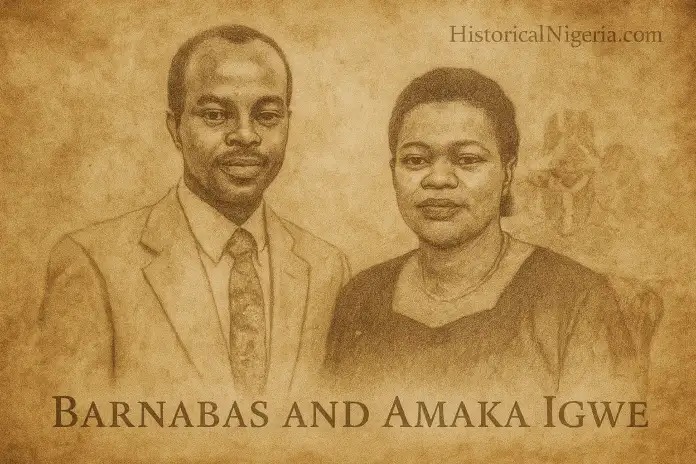
In 2002, Barnabas Igwe, chairman of the Nigerian Bar Association’s Onitsha Branch, attended the Association’s Annual General Conference in Ibadan with his wife, Abigail. They returned to Anambra but, they never returned to their lives.
The murders became one of the most painful episodes in the history of the Nigerian legal profession. But to understand the events surrounding their deaths, it is necessary to go back to the Anambra they returned to—a state experiencing a combination of political tension, insecurity, industrial unrest and a growing crisis of confidence in government institutions.
It was the period in which the Bakassi Boys emerged as one of the most powerful vigilante organisations in the South-East.
The group had acquired popular support by confronting armed robbers at a time when many residents had lost faith in the ability of the police to protect them. Its methods were swift and often violent. To some communities, the Bakassi Boys were a necessary response to a frightening security situation. To human rights organisations and civil liberties advocates, they represented the danger of allowing an armed group to operate beyond the ordinary restraints of the law.
The controversy grew as the organisation became increasingly associated with political authority.
In Anambra, the debate became especially bitter.
Governor Chinwoke Mbadinuju’s administration was facing mounting criticism. Workers went for months without salaries. Industrial action paralysed parts of the state. The courts and other public institutions were struggling with the consequences of the wider crisis.
The political atmosphere had become increasingly charged. The Onitsha Bar’s interventions were no longer routine professional statements. Igwe had become a visible critic in a state where political authority and vigilante power were increasingly difficult to separate.
The murders came against that background.
Anambra was then dealing with a combination of political tension, insecurity and industrial unrest. The Bakassi Boys had grown from a community response to armed robbery into a powerful vigilante organisation, with supporters who regarded them as an answer to the failures of the police and critics who accused them of operating outside the law.
Their growing influence raised questions that went beyond crime and security. Who had authority to use force? Where did the powers of a vigilante group end and those of the state begin? And what happened when political interests became entangled with an organisation whose methods included violence?
Barnabas Igwe had been willing to ask some of those questions publicly.
He was killed with his wife, Abigail, in September 2002.
The years that followed produced investigations, arrests and criminal proceedings, but no final judicial determination that has settled the case for the public. The circumstances of the murders have continued to generate allegations and counter-allegations, while questions about those who ordered, organised or carried out the killings have remained part of the case’s unresolved history.
More recently, the Anambra Truth, Justice and Peace Commission revisited the murders and made findings and recommendations concerning the case. Those findings brought renewed attention to the circumstances surrounding the killings, but they do not substitute for a criminal trial or a conviction. Criminal responsibility must ultimately be established through the courts.
For the Igwe family, the passage of time has offered little consolation.
For the Nigerian Bar, the case has become something larger than the deaths of two people.
Barnabas Igwe was not the first Nigerian lawyer to confront political power, and he was certainly not the last. But the circumstances of his death made his story particularly disturbing to a profession whose work depends on the ability of lawyers to challenge public authority without becoming targets themselves.
The issue became even sharper because of the period in which he was killed.
Anambra was experimenting, willingly or otherwise, with a form of security in which the distinction between the state’s formal institutions and informal armed groups was becoming increasingly difficult to maintain. The Bakassi Boys were celebrated in some quarters as protectors and condemned in others as an instrument of violence. Their rise exposed the weakness of the institutions that had allowed such a vacuum to develop in the first place.
The Igwe case sits within that history.
It raises questions about the relationship between political power and private violence; about what happens when communities lose confidence in the police; and about the vulnerability of lawyers who insist that even the most serious security problems must be dealt with within the law.
Those questions have not disappeared with the passage of time.
Nigeria has since experienced other periods of insecurity in which communities have turned to vigilantes when formal security agencies appeared unable to protect them. Governments have continued to rely, in different circumstances, on community security structures. The arguments over necessity, legality and accountability have therefore remained very much alive.
The Igwe story offers an earlier and particularly painful chapter of that debate.
A criminal justice system earns public confidence not only when it successfully prosecutes ordinary offences, but when it is capable of pursuing difficult cases involving influential people, political interests or allegations against those close to power.
When such cases remain unresolved for years, the consequences extend beyond the families directly involved. The unanswered questions become part of public memory.
That is what happened with the Igwes.
Their names survived the political era in which they were killed. The government of that period passed. The personalities changed. The political arguments moved on. The Bar itself has gone through several generations of leadership.
The case remained.
And so, too, did the question of whether the Nigerian state would ever provide a definitive account of what happened to Barnabas and Abigail Igwe.
As lawyers assemble once again for their annual gathering, that history will be present even if it is not mentioned from the podium.
Every profession has cases that become part of its collective memory. For the Nigerian Bar, the Igwe case is one of them.
It is a reminder of a period when speaking for the law could place a lawyer in danger, when vigilante power had acquired political dimensions, and when the institutions expected to provide answers failed to provide all of them.
The next chapter of the story is therefore not simply about what happened in 2002.
It is about what Nigeria did with the unanswered questions that followed.