By Emmanuel Gandu
HIGHLIGHTS
1. Introduction
2. Igbo society and the palm tree
3. Kagoro (S/Kaduna) society and the palm tree
4. Jewish society and the palm tree.
5. The Quran and the palm tree.
6. The Bible and the palm tree.
7. Conclusion
INTRODUCTION
This is an exposition of the convergence of different religious beliefs, cultural practices and traditions of nationalities of different regions of the world around the palm tree.
The palm tree come from a family of plants called Arecaceae. It is a tropical plant mostly grown in hot climates from rainforests to deserts. Palm trees are among the most beneficial plants in tropical countries because of their wide geographical distribution, and the many uses this plant has been put into by man.
The palm tree is one of the most useful and renewable resources that have aided man for over thousands of years in household, economic, healing, religious, sacred beliefs and functions, cultural and traditional activities.
According to Unegbu (2024), “—- ever before Christian missionaries introduced the Palm Sunday celebration in worship, the importance and significance of the palm tree had long been established in many parts of Africa where it symbolizes wealth, peace, fertility, victory, protest, joy, sorrow, sacredness and so on.”
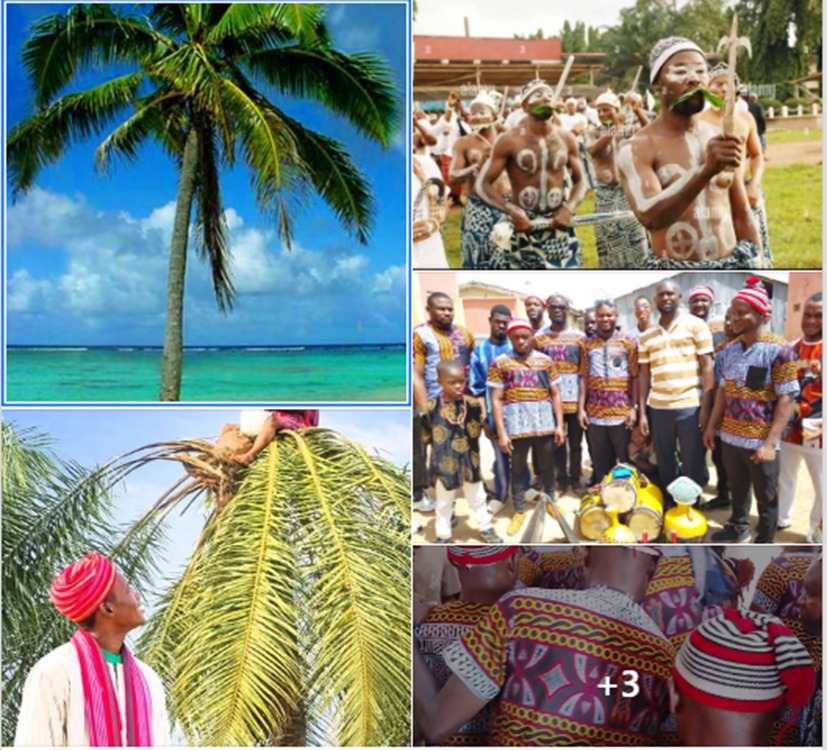
This discourse is an attempt to highlight the role of the palm tree in the life of the Igbo tribe of the South East of Nigeria, the Gworok (Kagoro) people in Southern Kaduna of Nigeria, the Jews, and the Arabian people of the Middle East, as it relates to their cultural life, sacred symbolism, religious beliefs and practices.
IGBO SOCIETY AND THE PALM TREE
In Igbo land, the palm tree is as old as the human settlement in the area. According to research findings conducted by Ezike (1987) cited by Chidi (2025), fragments of palm kernels found at Ogbodu Aba in Udenu date to 2555 – 130 BC. This is further corroborated by Ezike (1988) at Aku in Igbo – Etiti and Chikwendu (1975) at Ugwagu Afikpo point to 5000 – 2000 BC.
Apart from the economic value of the palm oil, other sacred symbolic functions to the people are obtainable. Besides, its palm wine product is used in religious and social functions like marriages, initiations, oath-taking, covenants, feasts, burials, and other cultural ceremonies.
A summary of the various traditional and religious functions the palm tree has been put into in Igbo land include the following:
(1) “Nku” – the tree of life.
The palm tree, otherwise referred to as ‘Nku’ in Igbo language represents sustenance, wealth, and community heritage.
It is a spiritual symbol of endurance and fertility, with by-products like palm oil for domestic/commercial purposes, palm wine for hospitality like marriage/traditional ceremonies and rituals. Other uses include fruits and building materials.
(2) “Omu” – its Religious/spiritual significance:
One of the many powerful Sacred symbols of the palm tree is the Omu, the tender green frond. Though delicate in form, its sacred symbolism runs deep across religious, moral, and social dimensions of the Igbo identity.
The Omu symbolizes purity, protection, justice, and spiritual authority :
* ‘Omu’ is used as a spiritual marker signaling peace, sacredness, or a boundary. ‘Omu’ is used to indicate a forbidden area (taboo), protect properties, or demarcate sacred areas for deities.
* At the death of an Igbo man, the “Omu” is used in sealing off his other houses, business premises and other property during the mourning period.
* “Omu’ is essential in ceremonies and for invoking ancestral authority. It is hung to sanctify shrines, protect against evil, and warn against breaking traditional laws.
* When tied around a disputed property/goods, farmland, or even a market stall, the “Omu” becomes a public declaration of sanctity and prohibition. The object is no longer ordinary but has been marked for attention, attached to some form of spiritual authority, and withdrawn from casual human interference, human discretion, human desecration, theft and destruction etc.
* The tender palm frond “Omu” also performs cultic functions. It is often used to decorate shrines and oracles. This signifies the sacredness of the shrines and the oracles, as the entrance into such areas is forbidden except for the Chief Priest and Priests or those that are authorized to do so.
* In ritual and cleansing ceremonies the “Omu” may be worn or displayed to proclaim ones freedom from guilt, moral pollution, and vindication especially when justice is served and the triumph that comes when right overcomes wrong.
* Connection to the supernatural is another sacred symbolism of the palm tree through the “Omu” especially where it signals that unseen forces are near, that the spirits are awake and active among the living.
This is represented by the Masquerade, where ancestral spirits manifest in physical form.
The “Omu” when carried and worn by the Masquerade becomes a spiritual symbol drawing in sacred power and reminding everyone of the invisible world.
Despite the multiple significance of the ‘Omu’, any true Igbo is able to decode its significance at any given instance.
(3) Life symbolism:
In majority of Igbo community, the umbilical cord of a new born is buried at the foot of a palm tree dedicated to that child. This symbolizes a deep nurturing connection to the land, and the palm tree’s life-giving nature.
To the Igbo, the palm tree is a symbol of wealth and heritage as it is traditionally viewed as a lasting asset often associated with a child’s heritage.
(4) Interconnectedness between the physical and spiritual:
Several practices involving the palm tree reinforces the sacred link between the physical and spiritual worlds, thereby ensuring harmony in the community.
KAGORO AND THE PALM TREE
The palm tree is one among the most valuable trees in Kagoro when it comes to natural endowment as its potency and efficacy goes beyond the ordinary eye. The palm tree plays important roles in the sacred Life, cultural, traditional belief and religious practices of the Kagoro tribe and any other tribe in Southern Kaduna of Nigeria. The various aspects to which the palm tree has been put to use has become synonymous with the peoples traditional religious beliefs and practices, economic, health, cultural and traditional lifestyle:
1. The ‘Oenkwarang’ (palm frond) is used for as many purposes as the ingenuity of the individual permits in conformity with the traditional norms, customs, beliefs and practices.
The palm frond (oenkwarang) held and waved by people in mass movement is a sign of registering victory to welcome returning heroes from war conquest or hunting expeditions.
It is sometimes used to register protest and resentment towards unpopular action or policy on the people from either the traditional leadership or civil authority.
2. The palm sticks and branches woven together by the ‘oenkwarang’ (palm frond) to form a canopy is placed strategically at the entrance of the shrine of the ‘Oebuwai’ cult in order to seclude it from trespasser’s especially the uninitiated.
3. This canopy is also placed at the entrance to the home or venue of a wedding feast.
4. In Kagoro culture, especially during crisis the palm frond is used as an olive branch by peace emissaries to signify willingness for truce and to brocker a peace accord between feuding communities.
5. In the event of death and burrying of the dead, the ‘oenkwarang’ (palm frond) is used in weaving the ropes that will assist to hold the casket as it is lowered into the grave. Both the ropes and any remaining fronds are put inside the grave along with the casket in order to avoid any bad omen or misfortune that may likely remain behind after such burial.
6. Apart from its economic value and nutritional benefits, the palm oil is used in cooking the local beans (Junjok udak) meant for the newly initiated boys into the ‘Oebuwei’ (cult system).
7. Further more, the palm kernel oil extracted from the palm kernel seed is used by traditional born healers to set the fractured bones after the chanting of incantations for effective bone healing.
8. Still on the efficacy of the extracted oil from the palm kernel seed, the Kagoro traditional healers use the oil to treat cases of ‘Kwi chen’ (epilepsy).
9. Masquerades are dressed in palm fronds as they emerge from their shrines for participation during ceremonial festivals.
10. Various traditional dance troupe use the palm fronds as Part of their costumes during traditional cultural and ceremonial festivals.
11. The palm branches and fronds are used for thatching houses and huts.
JEWS AND THE PALM TREE
The palm tree and its branches hold high sacred symbolism, profound cultural, religious, and historical significance in Jewish traditions.
The palm tree serves as a vital symbol of life, resilience, sustenance, and prosperity.
Palm Sunday commemorates Jesus’ triumphal entry to Jerusalem.
As he rode into the city on a donkey, his followers spread palm branches at his feet on the pathway with songs of “Hosanna” as they joyfully waved the palm branches in the air and on his pathway in order to announce the arrival of their king. They wanted a Jesus – a leader that will fight their battles, a leader that will bring liberation to them, a king who will save them from the ruling Roman Empire tyranny. What the Jewish people were doing was not a Christian way of celebration but purely their traditional local way of welcoming their king.
However, as Christianity evolved around the personality of Jesus Christ, the palm branches assumed a christian outlook where Palm Sunday became a major feast in the liturgical calendar that commemorates Jesus’ triumphal entry into Jerusalem, and is joyfully celebrated in prayers, songs, and dancing procession with Palm fronds spread on the road as Jesus rides triumphantly on a donkey into the town, thereby signifying the beginning, and marks the first day of Holy Week in the Catholic Church. Thus representing freedom and emancipation, the best of goodness, and victory.
SIGNIFICANCE OF PALM BRANCHES TO THE JEWS
Palms are famous in the culture of Israel and the Arabs :
1. Palm branches symbolizes conquest and victory, triumph, joy, peace, honour and respect to royalty.
This is a celebration by the people of their new found king and his selfless Leadership as opposed to the tyrannical rule of the Roman leaders.
2. Palm branches represents goodness, well being, grandeur, steadfastnessand actualization.
3. Kings, conquerors, and visiting dignitaries were welcomed with waving Palm branches by joyful dancing citizens reminiscent of the present day “red carpet reception” and presentation of buquay of flowers.
5. Even today, agitations and demonstrations by pressure groups hold palm branches as signs of struggle symbols for solidarity, conquest, victory and triumph.
6. National symbol: In Judea, palm branches are used to celebrate National triumph especially such as during the Maccabean Revolt. Similarly, the date palm became a recognized symbol of life in the Kingdom of Judah and was frequently depicted on Jewish coins.
7. Ritual use: In Judaism, the palm frond is one of the things commanded in Leviticus 23:40 to be used in rituals and prayers during the seven-day festival of the Sukkot (feast of Tabernacles) to express gratitude for the harvest of the year.
8. Sanctification and Righteousness: King Solomon carved palm trees on the walls and doors of the Temple in Jerusalem signifying sanctity and beauty. Similarly, the palm tree is a symbol of righteousness and peace. The palm tree is mentioned in the Torah, where it is associated with the land of Israel’s agricultural bounty.
9. Sporting victories are celebrated with fans waving palm branches as signs of victory and success.
PALM TREE IN THE QURAN
The palm tree in the Quran represents devine favour. It is associated with several good things including Maryam (Mary) who was told to shake a date palm to eat from it during childbirth.
In another reference Prophet Muhammad reportedly built his home using palm wood.
Another important religious function is that dates are traditionally eaten to break the fast during Ramadan.
The palm tree and its fruits are featured about 20 times in the Quran, often highlighting Allah’s blessings. These include:
– Surah Maryam 19:25, 2:266, 13:4
– Surah Qaf 50:10
– Surah Al-Masad 111:5
– Surah 6:99
– Surah 6:141
– Surah 59:5
– Surah 17:91
– Surah 18:32
– Surah 23:19
– Surah 36:34
– Surah 54:20
– Surah 80:29
PALM TREE IN THE BIBLE
The palm tree is a metaphor for a righteous person.
Psalm 29:12 states, “The righteous shall flourish like palm tree,” signifying stability, uprightness and spiritual fruitfulness.
Others include
1. John 12 : 12 – 15 “They took branches of palm trees and went forth to meet him, and cried, Hosanna, Blessed is he who comes in the name of the Lord”
2. Matthew 21 : 1 – 11
3. Mark 11 : 1 – 11
4. Luke 19 : 28 – 44
5. Revelation 7 : 9
6. Leviticus 23 : 40
7. 1Kings 6 : 28 – 29
8. Nehemiah 8 :15
CONCLUSION
Therefore, among the Jewish culture, feasts and festivals, among the Igbo and Kagoro traditional feasts and festivals, non moves their beliefs and religious affiliation to their ancestral lineage like the ones where palm fronds especially when it is held in the hand by so many people at the same time and in procession of joyous celebration, protests, and festivities.
Situations like these always awakens the people’s spiritual consciousness.
The palm branches celebration was purely a pagan way of welcoming a leader. It was never a Christian thing because there was no Christianity at the time.
The early christians merely adopted the culture of the Jews into the life and practice of the church. Since ever before christian missionaries introduced the Palm Sunday celebration, the importance and significance of the palm tree/fronds had long been established in many parts of Africa and indeed the Jewish society.