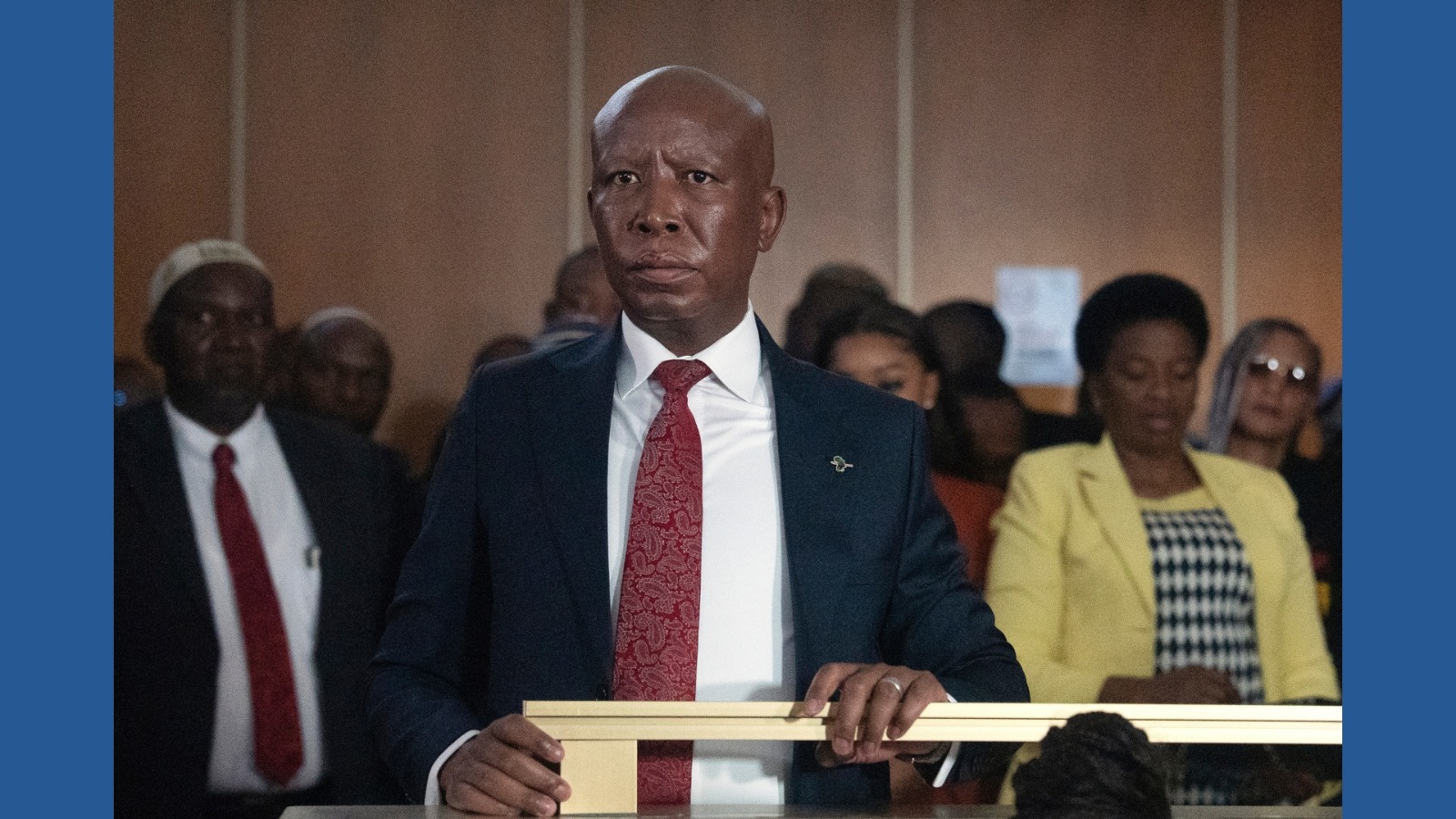
South Africa’s political landscape was shaken on Thursday as a court handed down a five-year prison sentence to controversial opposition figure Julius Malema, in a ruling that has ignited intense debate across the nation.
The leader of the Economic Freedom Fighters (EFF), known for his fiery rhetoric and radical left-wing stance, was found guilty of violating firearm laws after he discharged an assault rifle during a rally eight years ago. The incident, which took place at an EFF celebration in 2018, has lingered in the courts for years, culminating in a judgment that now threatens to reshape the country’s political dynamics.
Outside the courtroom, hundreds of supporters dressed in the EFF’s signature red attire gathered in defiance and solidarity. Songs of resistance echoed through the air, mingling with chants that portrayed Malema not as a criminal, but as a revolutionary figure being targeted for his political beliefs.
Inside, however, the tone was markedly different.
Presiding over the case, Magistrate Twanet Olivier delivered a firm and unambiguous judgment. She stated that Malema had “deliberately and unlawfully” discharged a firearm, emphasizing that no individual regardless of political influence should be above the law.
“The reckless use of a firearm in a public setting cannot be justified,” Olivier said, underscoring the potential danger such actions pose to public safety. Her ruling reinforced the principle that South Africa’s gun laws are designed to protect citizens and must be respected without exception.
The case has long been viewed as more than a legal matter. For many, it represents a collision between law enforcement and political expression in a country still navigating its democratic evolution. Malema’s supporters argue that the prosecution is politically motivated, aimed at silencing a leader who has consistently challenged economic inequality and called for radical reforms.
Critics, however, see the ruling as a necessary affirmation of accountability. They argue that public figures must set an example, and that the normalization of such behavior could have dangerous consequences in a society already grappling with high levels of violence.
Malema, a polarizing yet influential figure, has built his political identity on confronting authority and advocating for the marginalized. His speeches often resonate with young South Africans frustrated by unemployment, inequality, and slow economic transformation. For them, his conviction feels like a blow to a voice that speaks directly to their struggles.
Yet, others believe the judgment sends a crucial message that the rule of law remains intact, even when it involves powerful individuals.
Political analysts suggest the sentencing could have far-reaching implications. The EFF, one of South Africa’s most prominent opposition parties, now faces uncertainty about its leadership and future direction. While the party has a strong organizational structure, Malema’s charisma and visibility have been central to its identity.
There are also concerns about potential unrest. The large turnout of supporters at the court hints at the depth of loyalty Malema commands, and authorities are likely to remain on high alert in the coming days.
As news of the sentencing spreads, reactions continue to pour in from across the political spectrum. Some leaders have called for calm and respect for the judicial process, while others have urged a review of the case.
For now, South Africa stands at a crossroads caught between the demands of justice and the realities of a deeply divided political environment.
Whether Malema’s imprisonment will weaken his movement or strengthen it remains to be seen. History has shown that in politics, adversity can sometimes amplify influence rather than diminish it.
What is certain, however, is that this ruling marks a defining moment, one that will shape conversations about leadership, accountability, and the boundaries of political expression in South Africa for years to come.