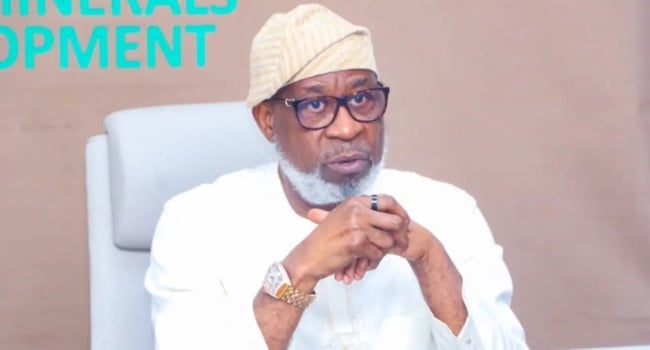
Nigeria has attracted over $2.6 billion in foreign direct investment (FDI) into the mining sector within the last two years, the Minister of Solid Minerals Development, Dele Alake, has said.
The minister attributed the significant investment inflow to ongoing reforms in the sector, including improved governance, digitisation of licensing processes, and a sustained crackdown on illegal mining activities across the country. According to him, these reforms have helped to rebuild investor confidence and position Nigeria as an emerging destination for mining investment in Africa.
Alake made the remarks at the Powering Africa Summit held in Washington, D.C., where he participated in a high-level panel discussion titled “Critical Minerals in Africa: Meeting Global Demand.” The summit brought together policymakers, investors, energy experts, and development partners to discuss Africa’s role in global energy transition and mineral supply chains.
Speaking during the panel session, the minister called on the United States and African countries to work together to establish regional energy hubs that would support mining industrialisation across borders and help secure global supply chains for critical minerals such as lithium, cobalt, nickel, and rare earth elements.
He explained that the global demand for critical minerals is increasing rapidly due to the transition to clean energy, electric vehicles, and advanced technologies. According to him, Africa has large deposits of these minerals, but the continent must move beyond exporting raw materials and instead focus on local processing, value addition, and industrialisation.
Alake said Nigeria’s recent success in attracting investment into the mining sector is largely due to reforms introduced by the Federal Government to make the sector more transparent and investor-friendly. One of the major reforms, he said, is the digitisation of the mining licensing process, which has reduced corruption, improved efficiency, and made it easier for investors to obtain licences.
He also noted that the government’s crackdown on illegal mining has helped to protect legitimate investors and increase government revenue. Illegal mining has long been a major problem in Nigeria, leading to revenue losses, environmental damage, and security challenges in mining communities.
The minister stressed that Africa’s vast mineral resources can only be fully developed through strong partnerships between African countries, international investors, and development partners. He said there is a need for integrated infrastructure such as railways, power supply, and processing facilities that can support mining operations across multiple countries.
According to a statement issued by his Special Assistant on Media, Segun Tomori, the minister emphasised that sustainable partnerships and infrastructure development are essential for Africa to benefit fully from the global demand for critical minerals. He said without proper infrastructure and regional cooperation, many African countries would continue to export raw minerals without gaining the full economic benefits.
Alake also highlighted the importance of environmental sustainability and responsible mining practices, noting that mining activities must be carried out in a way that protects the environment and benefits local communities. He said the government is working on policies that will ensure mining companies comply with environmental and community development regulations.
Economic experts at the summit noted that critical minerals are becoming increasingly important in global geopolitics because they are essential for renewable energy technologies, batteries, electronics, and defence industries. As a result, countries around the world are competing to secure reliable sources of these minerals.
They said Africa has a unique opportunity to become a major player in the global supply chain if it invests in infrastructure, strengthens governance, and promotes regional cooperation in the mining sector.
The minister concluded by reiterating that Nigeria is open for mining investment and ready to partner with local and international investors to develop its solid minerals sector. He expressed optimism that with the right policies and partnerships, the mining sector could become a major contributor to Nigeria’s economy and help reduce the country’s dependence on oil revenue.
The Powering Africa Summit ended with a renewed call for collaboration between governments, investors, and development institutions to unlock Africa’s mineral potential and position the continent as a key supplier in the global energy transition and critical minerals market.