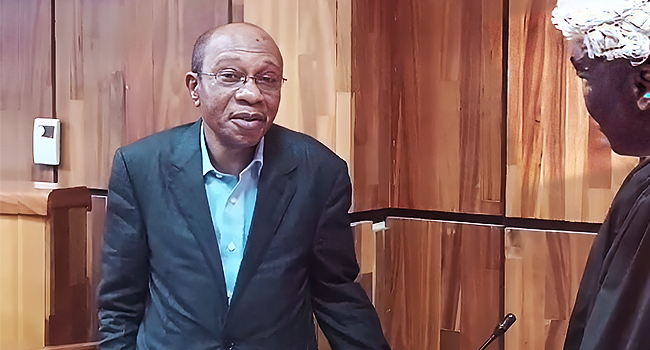
Proceedings at the High Court of the Federal Capital Territory in Maitama took a dramatic turn as the court sanctioned the Economic and Financial Crimes Commission for what it described as persistent delays in prosecuting the high-profile case against former Central Bank chief, Godwin Emefiele.
In a ruling that underscored the court’s growing impatience, Hamza Muazu imposed a fine of N500,000 on the anti-graft agency after it failed to present a witness at the resumed hearing. The judge did not mince words, pointing to a pattern of adjournment requests that, in his view, had slowed the pace of justice.
The case, which has drawn nationwide attention, centers on a 20-count amended charge filed against Emefiele. The allegations range from criminal breach of trust and forgery to abuse of office, conspiracy, and obtaining money under false pretence—charges that strike at the heart of public accountability in Nigeria’s financial system.
At the heart of Wednesday’s proceedings was the prosecution’s inability to move forward. Despite prior adjournments granted to allow adequate preparation, the EFCC again came to court without a key witness, prompting visible frustration from the bench.
Justice Muazu, while delivering his ruling, made it clear that the court would no longer tolerate unnecessary delays. He granted what he described as a “final adjournment,” signaling that the prosecution must be fully prepared to proceed at the next hearing or risk further consequences.
Legal observers say the fine, though modest in financial terms, carries symbolic weight. It sends a strong message about judicial expectations in high-profile corruption trials, particularly those involving public officials whose cases often attract intense scrutiny.
For Emefiele, who once held one of the most powerful economic positions in the country as head of the Central Bank of Nigeria, the trial represents a significant legal battle with potential long-term implications for his reputation and legacy.
The courtroom exchange also highlights a broader issue within Nigeria’s justice system—the balance between thorough prosecution and timely adjudication. While investigators are expected to build solid cases, prolonged delays can erode public confidence and raise questions about efficiency and intent.
As the case heads toward its next hearing date, all eyes will be on the EFCC to see whether it can meet the court’s expectations and present its witnesses as directed. For now, the judge’s ruling stands as both a reprimand and a warning: the clock is ticking, and the patience of the court is wearing thin.