By Emmanuel Gandu
HIGHLIGHTS
* Introduction
* Who is a knight?
* Who is a Catholic knight?
* How does the church legitimize the existence of the Catholic Knighthood?
* What do the knights seek to achieve in the church that the clergy cannot?
* The establishment of the knights of St. Mulumba (KSM)
* Why the name “Mulumba”?
* Is the Knighthood not a secret society?
* Why do they use black color if they are not hiding anything?
* How can someone become a Catholic knight?
INTRODUCTION
In the words of His Lordship Most Rev. Dr. Anthony Nwedo, the late Bishop of Umuahia Diocese, “the Catholic Knighthood as it is today has its origin in the Feudal System of Christian Europe, and draws its inspiration from the gallantry, heroism, and noble service of Christian Knights especially during the period of the crusades.”
The Catholic Knighthood is therefore a sacred institution in which the church lay great emphasis. The concept of faith; prayer; justice; and service to humanity, the church, community, country, and by extension the entire world are some of the cherished ideals of the Knighthood. Others include the protection and support of the weak, vulnerable, and the less previlaged.
The Knights carry out these activities through courage, honour, humility, fidelity, and selflessness in the use of their talent, time, and treasure.
As selfless as their activities have been, the Catholic Knighthood is not spared of “public attention” as they have come under a series of scrutiny, critical questions, examination, and commentary through private and public discourse, as well as their impact on the religious life of the laity. Some have argued in support of the Knighthood while others think otherwise.
This discourse and exposition is therefore an attempt to acquaint the Catholic lay faithful and the general public on some of the activities of the Catholic Knighthood. This effort is coming on the backdrop of the perception, views, opinions, issues, and questions which have likely been on the minds of the public.
WHO IS A KNIGHT ?
The Oxford Advanced Learners Dictionary defines a Knight as a man of noble disposition with a rank of honour conferred on him in recognition of his character, qualities, and meritorious services, with a duty to defend his country, and having the title, “Sir” before his name.
In England for example, Knighthood is bestowed upon distinguished personality of high achievement by the King or Queen. Some of these include Sir Isaac Newton – (Newton’s Law of Motion), Sir Winston Churchill – (Former British prime minister), Sir John Lenon – musician (the Beetles), Sir Alex Ferguson – (football manager). Others from Nigeria are Sir Abubakar Tafawa Balewa, Sir Akanu Ibiam, Sir Udo Udoma, Sir Ahmadu Bello, etc.
WHO IS A CATHOLIC KNIGHT ?
A Catholic Knight is a Catholic Lay Apostolate of high christian values in character and conduct through prayers, honesty, charity, loyalty, humility, service, fidelity, and bravery, and he is thus knighted for the purpose of defending the catholic faith.
He is one who strives and makes efforts to be a better person today than he was, and through his actions, words, and deeds draws men to God and the faith.
HOW DOES THE CHURCH LEGITIMIZE THE EXISTENCE OF THE CATHOLIC KNIGHTHOOD?
1. The Knighthood is a pious association/society like any other, for instance the Sacred Heart, Legion of Mary, Charismatic, and hence the church allows and permits “Christ’s faithful to freely establish such groups which serve charitable pious purposes and fosters christian unity and vocation, and may hold meetings to pursue these purposes for the common good” – Code of Canon Law – Canon 215.
2. In carrying out these actions to support and promote apostolic action, Canon 216 states that they must do this with the consent of competent ecclesiastical authority, who as enshrined in Canon 223 section 2 must supervise and regulate the activities of such association.
3. The church therefore encourages both the clergy and the laity to join the Knighthood which have been established, praised, and recommended to forster evangelizationand works of charity as stipulated in Canon 298 sections 1&2.
4. In line with this philosophy, and in strict compliance with the statutes as contained in the code of Canon law, the church supervises the formation, constitution, code of conduct, purpose and objectives, administrative set up, condition of membership of the Knights orders.
5. This expression is contained in Canon 304 sections 1 & 2.
6. In addition, the local Bishop is the Patron of every established Knights order in his Diocese, and he in turn appoints one of his clergy as the chaplain in strict compliance with Canon 305 sections 1 & 2.
7. Apart from the Papal Knighthood established by the Pope where he confers honour to distinguished personality for their contributions to the cause of the faith, the other category of knighthood are those founded by Priests and others, eg the Knights of St. Columbus founded by Rev. Fr. Michael McGivney in 1882 in USA, the Knights of St. John International founded in 1048 in Italy, the Knights of St. Mulumba founded by Rev. Fr. Anselm Abraham Ojefua (Monk) in 1953 Nigeria.
WHAT DO THE KNIGHTS SEEK TO ACHIEVE IN THE CHURCH THAT THE CLERGY CANNOT
The Knighthood like any other lay apostolate society play an indespensable role in the mission of the church. Indeed, the church can do better with the lay apostolate as scripture clearly shows their fruitfulness – Acts 11:19-21, Acts 18:26, Rom.16:1-6 Phil.4:3
The clergy alone cannot do the work of God. That is why the church is made up of the clergy, the religious, and the laity.
In the church there is diversity of ministry but unity of mission. To the Apostles and their successors Christ has entrusted the office of teaching, sanctifying and governing in his name and power.
But the laity are made to share in the priestly, prophetic, and kingly office of Christ. The laity which the Knighthood belong to have in the church and in the world, their own assignment in the mission of the whole people of God, as called upon and duly recognized in Vatican II section 59.
The duties, objectives, and aims of the Knighthood are many and diversed but not limited to the following :
– To bring Catholics together in a fraternal organization for the defence of the church, the good and progress of the church, support the clergy, improve the spirituality of members, and the wellbeing of the country.
– To work towards a high sense of order and discipline in the church and the society.
– To be sensitive to the needs of the poor and give succor to the destitute, the disadvantaged, vulnerable, less privileged, and the oppressed in the society.
– To live an exemplary Catholic life, defending the Catholic faith as the salt of the earth.
– To work for social justice always and everywhere for the benefit of humanity.
– To promote fraternity, love and care of members, and also one’s neighbours.
These activities and duties of the Knights are largely carried out in the various programs as explained in the foregoing.
The knights undertake visits to churches, seminaries and convents, orphanages, old people’s homes, hospitals, schools, prisons etc in order to assist with needs.
They also undertake advocacy through retreats, lectures, workshops and seminars for the spiritual, intellectual, and health enrichment of the public.
The knights carry out these activities more importantly because of the call of Christ, and so that they can be effective in drawing men to God, since, as the Lord says: “Your light must shine so brightly before men that they can see your good works and glorify your father in heaven.” – Matthew 5:16
THE ESTABLISHMENT OF THE ORDER OF THE KNIGHTS OF ST MULUMBA (KSM)
The Order of the Knights of St Mulumba was established on the 14th of June 1953 by Rev. Fr. Anselm Abraham Isidahome Ojefua, who later became a monk at the Illah Monastery in the old Mid Western Nigeria.
The foundation members of the KSM were 23. They included three (3) Priests who are : Rev. Fr. Abraham A. Ojefua (Later became a Monk), Rev. Fr. Anthony Nwedo (Later became a Bishop), and Rev. Fr. M.O Unegbu (Later became a Bishop).
WHY THE NAME MULUMBA?
(1)The choice of the name of Mulumba was in recognition of the sacrifice and martyrdom of the Martyrs of Uganda.
The Martyrs of Uganda are part of a group of 23 Anglicans and 22 Catholics who were brutally executed in Uganda between 1885 and 1887 for converting to, and refusal to renounce Christianity.
For this rare show of martyrdom, the 22 Catholics among them were beatified in 1920 by Pope Benedict XV, and later Canonized Saints by Pope Paul VI on 18 October 1964.
The name Mulumba is the surname of one of the 22 Martyrs – Matthias Kalemba Mulumba.
(2) Another reason leading to the choice of the name Mulumba is that Matthias Kalemba Mulumba was :
(a) Earlier a Worshiper of the African Traditional Religion.
(b) He converted to Islam religion.
(c) Converted to Christian Anglican, and finally –
(d) Converted to Catholicism
(3) Matthias Kalemba Mulumba was the oldest (50 years) of the 22 Martyrs of Uganda.
(4) He exhibited exemplary leadership and courage to the younger ones which they emulated.
(5) There was the need to have an African indigenous Saint name for the Knights group founded in Africa by Africans.
IS THE KNIGHTHOOD NOT A SECRET SOCIETY?
The Catholic Knighthood is not a secret society because of the following reasons :
(1) The Knighthood is a lay Apostolate Marian Society like other Marian associations established and formed in the church for the spiritual growth of the lay faithful.
(2) The Knights are under the supervision of each of the Bishop of every Diocese in compliance and as enshrined in the code of Canon law 1374, and as expressed in Vatican II who :
(a) approves their formation and establishment.
(b) scrutinizes their constitution and code of conduct.
(c) supervises their spiritual activities.
(d) regulates their recruitment and membership.
(e) appointment of a chaplain from among his clergy to oversee the Knighthood activities in his domain.
(f) Membership is open where intending members names are announced in church during Mass on three consecutive Sundays (calling of banns of membership).
(g) The meetings and activities of the Knights begin with Mass and the chaplain stays through the proceedings to the end.
(h) Many Catholic Priests are members of the Knights.
The Catholic Church therefore calls on the “lay members of Christ’s faithful to hold in high esteem the associations/societies constituted and established by the church for the spiritual and temporal growth” – Vatican II section 59.
WHY DO THE KNIGHTS USE BLACK COLOUR IF THEY ARE NOT HIDING ANYTHING?
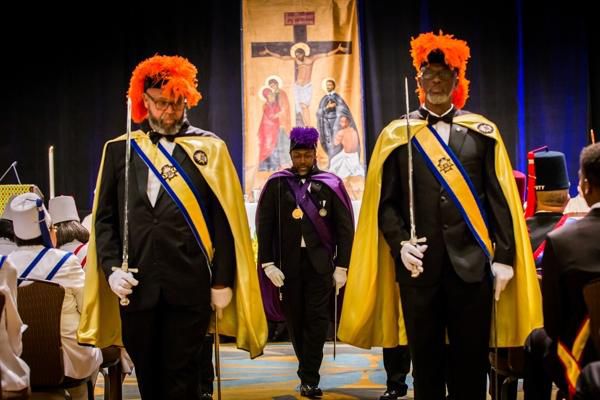
The choice of black as the dominant colour in the regalia of the Knighthood, and the black suit was deliberate, and in conformity with the fashion trend. In those days, the black colour and the black suit was the in-thing, it was in vogue, it was fashionable, it was for those that belong to a class – the cream of society, it was the ultimate, the reverred colour in fashion.
If therefore the use of the black colour and the black suit by various groups including the following is anything to go by, the Knighthood is right with the choice of the black colour:
1. Black is the dominant colour in the academia regalia used by University Faculty Professors to major academic functions all over the world.
2. The dress code for the learned legal profession is predominantly black. This is used by the Justices, members of the bar and bench, the solicitors be them advocates, attorney or judges.
3. The black suit was and is still the choice attire to formal, corporate, and business functions anywhere in the world.
4. The black suit was and is still the no.one choice of the groom and the groomsmen at any prestigious wedding ceremony all over the world.
5. The back suit is generally acceptable and popularly worn to major awards and conferment ceremonies, anniversary celebration, and dinner parties like the Grammy, Academy, BAFTA, Emmy, HEADIES, and Sports awards, not forgetting the Nobel prize awards.
6. After all, black is an enduring colour, as further made popular by the musician James Brown in his “I am black and proud” song released in 1968, becoming an anthem for the Black Power Movement, and ranking 305 on Rolling Stone Magazine’s list of the 500 greatest songs of all time in 2004.
7. The Cardinals and priests of the Catholic church use black colour in their liturgical regalia. It is therefore not out of place for the use of black colour by the Knighthood.
HOW CAN SOMEONE BECOME A KNIGHT
(A) The Lay faithful:
The Knights identify and invite men who are, but not limited to the following :
1. Literate lay Apostolate Catholics.
2. Married.
3. Practicing Catholic.
4. Active and productive in church/Parish
5. Well known in the community with good character.
6. Prepared to use his talent, time, and treasure in the service of God and humanity.
The identification and recommendation is done in conjunction with the clergy including his parish priest, members of the church, the laity and the community.
When eventually identified, both husband and wife are carefully screened in accordance with the laid down procedure. In addition, they must receive positive written recommendation from their parish priest.
The general public is also given opportunity to take part in the screening of the candidates. This is done through the mandatory calling of banns of intending membership of the Order by the candidate(s) for three (3) consecutive Sundays announced in church during Mass. Any objection(s) to the candidate for membership of the Order is routed through the parish priest.
As soon as an intending candidate scales through the mandatory hurdles, other procedure leading to the final admission commence.
(B) The Clergy:
A good number of Catholic priests across the country are members of the Catholic Knighthood.
It may interest you to know that they also go through some aspects of the screening exercises except some few exemptions like the calling of banns from beginning up to the final admission.
And once his Bishop grants approval, the priest is good to go.
You may also know that as at today (28/2/2026) there are five (5) Catholic priests who are members of the Honoured Order of the Knights of St. Mulumba in the Kaduna Metropolitan Council area – with three (3) in Kafanchan Diocese, one (1) in Kaduna Diocese, and one (1) in Kano Diocese.
Don’t also fail to recall that three Catholic priests were among the 23 pioneer/foundation members of the Knights of St Mulumba in 1953, and out of this three the founder was a priest who went on to become a Monk.
The other two both went on to become Catholic Bishops.
If you wish to become a Knight, be active and be of service to your Church and your community, live a good christian life, and be a practicing catholic. You would then be spotted and may be invited to join.
THE LAST WORD
The knights carry out these activities more importantly because of the call of Christ, and so that they can be effective in drawing men to the faith and God, since as the Lord says, “Your light must shine so brightly before men that they can see your good works and glorify your father who is in heaven.” – Matthew 5:16