It was a gathering of generations, a reunion of old newsroom comrades, and a celebration of a distinguished life devoted to the written word. But above all, it was a tribute to the enduring power of journalism and the men and women who, through discipline, courage, professional integrity, and an unwavering commitment to the truth, helped shape its traditions in Nigeria.
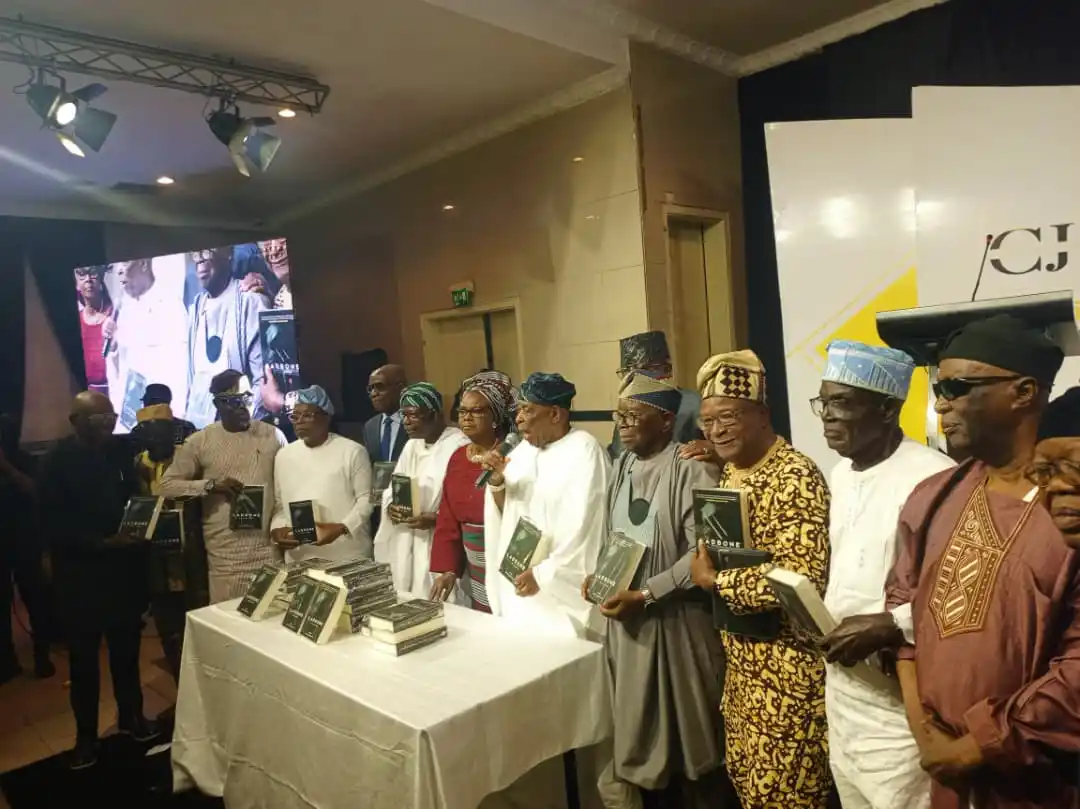
On Thursday, October 22, 2026, the Civic Centre in Victoria Island, Lagos, became a meeting point for some of the most influential figures in Nigerian journalism, publishing, politics, and public life. They came together to celebrate Lade Bonuola, affectionately known across the Nigerian media landscape as Ladbone, on his 80th birthday and to witness the launch of a commemorative volume documenting his remarkable professional journey.
The occasion was more than a birthday celebration. It was a homecoming of sorts for men and women whose professional lives had intersected with Bonuola’s over several decades, in newsrooms where deadlines were unforgiving, standards were exacting, and the printed newspaper remained one of the most powerful instruments for informing society and holding public officials accountable.
Friends, former colleagues, admirers, protégés, and members of the younger generation of journalists gathered to honour a man whose influence extended beyond the pages of the newspapers he helped produce.
The event, organised by the Centre for Journalism Innovation and Development (CJID), in collaboration with Premium Times and under the leadership of its founder, Dapo Olorunyomi, also marked an important intervention in the preservation of Nigeria’s journalistic heritage.
At its centre was the unveiling of Ladbone: A Life in Print, a commemorative book bringing together contributions from more than 80 editors, academics, media managers, political figures, and other personalities whose lives and careers had been touched by Bonuola’s work. The book was edited by Mr Dapo Olorunyomi, CEO of Prime Times and CJID.
The message of the day was unmistakable: a journalist’s legacy should not be measured only by the stories he writes or the newspapers he edits, but also by the standards he establishes, the people he mentors, the institutions he strengthens, and the professional culture he leaves behind.
For Bonuola, that legacy is considerable.
A Gathering of Media Heavyweights
The list of those who assembled to celebrate Ladbone read like a roll call of distinguished figures from different eras of Nigerian journalism.
Among them were Chief Olusegun Osoba, former governor of Ogun State and one of Nigeria’s most accomplished journalist-politicians; Alhaji Lai Mohammed, former Minister of Information and Culture; and a formidable collection of former Guardian editors, newsroom leaders, and veteran reporters.
The gathering included Dr Yemi Ogunbiyi, Femi Kusa, Emeka Izeze, Ted Iwere, Sully Abu, Martins Oloja, Yaya Awosanya, Taiwo Obe, Mbadiwe, Fred Ohwahwa, Dr Wole Agunbiade, and Banji Adisa.
Also present were prominent journalists and media figures such as Funke Egbemode, former President of Guild of Editors, Eze Anaba, the current president, and Kunle Ajibade, whose formal review of the commemorative book provided an opportunity to reflect on Bonuola’s professional philosophy and enduring influence.
Among the celebrated reporters and newsroom professionals who joined the tribute were Mike Asuquo, Aaron Ukodie, Adeleke Adeseri, Kunle Sanyaolu, Banji Ayoola, and veteran media librarian Mrs Oba and members of Ldbone’s family.
Their presence gave the occasion a special significance.
These were not simply acquaintances who had come to exchange pleasantries at a birthday party. Many belonged to a generation that experienced Nigerian journalism when newsroom culture was shaped by close editorial supervision, intensive fact-checking, rigorous sub-editing, and a collective understanding that a newspaper’s credibility depended on the quality of every line it published.
Their reunion brought back memories of a professional era in which editors and reporters could disagree passionately over a headline, a misplaced comma, an inaccurate figure, or a poorly constructed sentence.
It was an era in which the editor’s desk was both a workshop and a classroom, and in which the most demanding editors often became the most influential teachers.
Bonuola was one of those editors.
His career, marked by an insistence on accuracy and an intolerance of carelessness, helped establish him as a formidable presence in the Nigerian newsroom.
The occasion also demonstrated that the influence of a great editor is rarely confined to the newspaper that employs him. It travels with the reporters he trains, the editors he inspires, and the institutions that continue to uphold the standards he championed.
Osoba’s Nostalgic Tribute: The Editor who Would not Compromise
One of the most engaging moments of the celebration came from Chief Olusegun Osoba, who chaired the occasion and drew on personal memories of his long professional relationship with Bonuola.
Osoba’s tribute was especially significant because he knew Bonuola not merely as a celebrated colleague but as a fellow professional from the demanding world of newspaper production.
Before his years in public office, Osoba had established himself as a respected journalist. His recollections therefore offered an insider’s perspective on the discipline and working habits that defined Bonuola’s approach to journalism.
Osoba recalled that Bonuola joined the Daily Times as a sub-editor at a time when he himself was editor of the Sunday Times.
That connection took the audience back to an era when the Daily Times occupied an influential position in Nigeria’s newspaper industry and its editorial operations were staffed by professionals who understood the enormous responsibility attached to publishing information for a national audience.
In Osoba’s recollection, Bonuola stood out for his meticulousness.
He was the kind of editor who wanted to examine every detail, scrutinise every sentence, and ensure that a newspaper was fit for publication before it left the newsroom.
His thoroughness, however, sometimes created tension during the late-night production process.
Newspaper production was a race against the clock. Pages had to be completed, headlines settled, corrections made, and printing schedules met. Every minute mattered.
But Bonuola was not easily persuaded to sacrifice editorial quality for speed.
Osoba recalled, with humour and obvious affection, the production tug-of-war that could develop when Bonuola insisted on painstakingly reviewing copies that others believed were ready for the press.
For the production team, the delay could be frustrating. For Bonuola, the principle was straightforward: the newspaper had to be right.
It was a conflict between the urgency of the deadline and the demands of professional responsibility.
Yet, beneath the humour of Osoba’s recollection lay an important lesson about the culture of journalism.
A deadline is an operational necessity, but accuracy is a professional obligation. Speed determines when a newspaper reaches its readers; editorial discipline determines whether those readers can trust what they read.
Bonuola’s insistence on checking the details reflected his understanding that errors in a newspaper were not merely blemishes on a page. They could misinform readers, damage reputations, distort public understanding, and undermine the credibility of the institution responsible for publishing them.
His approach was demanding, sometimes inconvenient, but rooted in a clear professional conviction.
Osoba and other speakers at the event celebrated him as a serious-minded and passionate professional whose work helped establish enduring standards in Nigerian journalism.
At 80, Bonuola was being honoured not only for the positions he occupied but also for the principles he refused to abandon.
How Ladbone became Ladbone
In Nigerian journalism, some names become larger than the individuals who bear them. They become shorthand for a particular style, temperament, or professional reputation.
For Lade Bonuola, the name Ladbone became synonymous with an editor’s eagle eye.
His reputation for detecting grammatical mistakes, factual inaccuracies, and editorial shortcomings was such that newspapers across the country could attract his scrutiny.
The nickname, according to accounts of his career, became associated with his ability to spot errors that others had overlooked.
The idea of being caught out by Ladbone became a familiar reference point in media circles.
His celebrated Caught-out by Ladbone column at the Daily Times gave public expression to this reputation. It highlighted errors in published newspapers and served as a reminder that even established media organisations could fall short of the standards they professed to uphold.
The column was more than an exercise in identifying mistakes.
At its best, such scrutiny represented a form of professional accountability. It challenged journalists and editors to examine their own work, reconsider their assumptions, and recognise that accuracy required sustained effort.
The name Ladbone consequently acquired a special resonance within the profession.
For some, it might have inspired apprehension: no editor wanted his newspaper to become an example of carelessness.
For others, it represented a standard to aspire to.
And for younger journalists, the legend offered a reminder that mastery of the profession depended on details that readers might never consciously notice but would certainly miss when they were absent.
A misplaced word, an incorrect date, a misspelt name, a misleading headline, or an unsupported assertion could diminish the value of an otherwise important story.
Bonuola understood this.
His reputation was built on the belief that good journalism begins long before a newspaper reaches the street. It begins with the discipline of the reporter, the judgement of the editor, and the willingness of every person involved in production to accept responsibility for the finished product.
In an age when information travels rapidly and errors can spread across multiple platforms within minutes, that philosophy remains relevant.
Indeed, the contemporary media environment may need it more than ever.
The Guardian Years: Building a Culture of Editorial Excellence
Bonuola’s professional journey extended beyond the Daily Times.
He subsequently became a pioneering editor and managing director of The Guardian, one of Nigeria’s most influential newspapers, helping shape an institution that became an important reference point in the country’s media history.
The Guardian emerged with an editorial identity that emphasised professionalism, analytical depth, intellectual engagement, and a serious approach to public affairs.
Within such an environment, the editor’s role was not simply to correct errors or approve pages for publication.
It involved cultivating a newsroom culture, defining professional expectations, guiding reporters, shaping the presentation of news, and protecting the integrity of editorial judgement.
Bonuola’s reputation for painstaking editing fitted naturally into this tradition.
A strong newspaper depends on the quality of its reporters, but reporting alone cannot guarantee excellence. Stories require scrutiny. Claims must be tested. Context must be established. Headlines must accurately reflect the substance of the reports they introduce.
The editor’s responsibility is to ensure that these elements work together.
This is why great editors often leave a legacy that is difficult to capture through a list of published stories.
Their influence is dispersed across thousands of decisions: the story they insist should be pursued, the allegation they refuse to publish without evidence, the headline they send back for revision, and the young reporter they encourage to ask a better question.
Such decisions may never be celebrated individually, but together they determine the character of a newspaper.
Bonuola’s association with The Guardian placed him within a tradition of Nigerian journalism that sought to combine professional competence with intellectual seriousness and editorial independence.
He later became supervising chief consultant to Compass Newspapers before returning to The Guardian as chief consultant.
He also co-founded The Comet in 1999, extending his involvement in newspaper publishing and editorial leadership.
These professional chapters demonstrate a career that was not limited to the mechanics of editing. Bonuola participated in the development of media institutions and contributed to the transmission of professional knowledge across different organisations and generations.
His career is therefore part of the broader story of Nigerian journalism: its evolution, its institutional struggles, its achievements, and its continuing effort to balance commercial pressures with public responsibility.
Kunle Ajibade’s Review: A Titan of Truth and Discipline
If Osoba’s tribute brought the memories of the old newsroom to life, Kunle Ajibade’s formal review of Ladbone: A Life in Print provided an opportunity to examine the intellectual and ethical principles that underpin Bonuola’s reputation.
Ajibade, the prominent journalist and former editor of The News magazine, approached the commemorative volume against the background of a profession in which editorial judgement often determines the difference between responsible journalism and the careless circulation of information.
He described Bonuola as a titan committed to truth, excellence, and iron discipline.
The description captured three qualities that repeatedly emerge from accounts of Bonuola’s professional life.
Truth represents the journalist’s obligation to establish what happened and report it honestly.
Excellence represents the determination to ensure that a story is accurate, coherent, readable, and worthy of publication.
Discipline represents the willingness to maintain those standards even when circumstances make doing so difficult.
Ajibade also drew attention to Bonuola’s belief that newspapers should be readable, inventive, and truthful rather than merely neutral.
The distinction is important.
Journalism requires fairness, accuracy, and a willingness to represent relevant perspectives honestly. But these obligations do not require journalists to pretend that truth and falsehood are interchangeable.
The pursuit of truth demands that evidence be examined, claims be tested, and conclusions be proportionate to the facts.
Neutrality, when interpreted as refusing to distinguish between substantiated facts and demonstrable falsehoods, can become an excuse for abandoning editorial judgement.
Bonuola’s philosophy, as described at the event, challenged journalists to recognise this distinction.
A newspaper should not distort facts to satisfy a political interest or protect a powerful individual. Nor should it confuse professional fairness with indifference to the truth.
The task is to establish the facts as carefully as possible, explain their significance, and give readers a credible basis for understanding events.
Ajibade’s review also highlighted Bonuola’s influence on editorial independence and his commitment to preserving newspaper archives and newsroom libraries.
These may appear to be separate concerns, but they are closely connected.
Editorial independence enables journalists to investigate powerful interests without surrendering their judgement to those interests.
Archives preserve the evidence through which journalists, historians, researchers, and citizens can examine what was reported, what was promised, and what actually happened.
Together, they help sustain journalism as a public institution rather than a temporary stream of headlines.
Ajibade also recalled Bonuola’s demanding but caring approach to colleagues. His high expectations could be formidable, but they were accompanied by a commitment to helping others improve their work.
This combination is familiar in the history of demanding editors.
The best among them understand that criticism should not be an end in itself. It should be a means of developing professional competence.
A good editor does not merely identify what is wrong. He helps the reporter understand why it is wrong, how it can be corrected, and how the same mistake can be avoided in future.
That is how editorial standards become professional culture.
And that is how an editor’s influence survives beyond his own working life.
A Book that Rescues Memory from Oblivion
The launch of Ladbone: A Life in Print was one of the central features of the celebration, but its significance extended beyond the presentation of a birthday gift to an eminent journalist.
The volume, an anthology of essays and recollections contributed by more than 80 editors, academics, media managers, political figures, and other personalities, represents an effort to document the life and work of a man whose professional influence has been felt across several generations.
Such a project is important because journalism is often more effective at documenting the lives of others than preserving its own institutional memory.
Newspapers chronicle elections, political crises, economic changes, cultural developments, and the daily experiences of citizens. Yet the people who produce those records frequently leave behind incomplete accounts of their own professional journeys.
Editors retire. Newsrooms are reorganised. Newspaper companies change ownership. Libraries are neglected, and old editions disappear into private collections or deteriorate in storage.
With time, the stories of the people who helped build influential media institutions can become fragmented.
Their contributions survive in anecdotes, fading recollections, occasional obituaries, and the memories of former colleagues.
A commemorative volume helps bring those fragments together.
By collecting the perspectives of people who knew and worked with Bonuola, Ladbone: A Life in Print creates an opportunity to examine his career from different angles.
A former colleague may remember his habits during production. A reporter may recall the lessons learned under his supervision. A fellow editor may reflect on his professional philosophy. A media executive may assess his contribution to institutional development.
These accounts, taken together, offer a richer portrait than any single biography could provide.
They also preserve the voices of people who participated in the evolution of Nigerian journalism.
The book’s importance therefore lies not only in its celebration of Bonuola but also in its contribution to the historical record of the profession.
It reminds readers that journalism has a history, that professional standards are inherited and developed, and that the experiences of earlier generations can help illuminate the challenges facing those who follow.
In this respect, the publication represents an investment in institutional memory.
Dapo Olorunyomi, Premium Times, and the Duty to Remember
The role played by Dapo Olorunyomi and Premium Times in organising the celebration deserves particular recognition.
Olorunyomi, a prominent figure in Nigerian journalism, has been associated with efforts to strengthen investigative reporting, media development, and professional journalism.
Through Premium Times and the Centre for Journalism Innovation and Development, the event brought together two important dimensions of the profession: the practice of journalism in the present and the preservation of its history.
The collaboration also reflected the role of media institutions in recognising the people whose work established the foundations on which contemporary journalism operates.
It is easy for a profession to become absorbed in its immediate concerns.
Newsrooms must respond to breaking events, investigate new allegations, analyse public policies, and navigate the commercial and technological pressures confronting the industry.
But a profession that is constantly looking forward can lose sight of the experiences that shaped it.
The celebration of Bonuola offered an opportunity to pause and examine those experiences.
It recognised that the craft of journalism is sustained not only by technological innovation or the arrival of new platforms but also by professional knowledge accumulated over time.
The Centre for Journalism Innovation and Development’s Living Archives Initiative, launched in conjunction with the occasion, gave the event a broader institutional purpose.
Its emphasis on preserving the memories, records, and experiences of journalists addresses an important gap in the continent’s media landscape.
Archives are not simply repositories of old documents. Properly maintained, they are resources for research, education, accountability, and professional development.
They help journalists reconstruct the history of public events, compare past claims with subsequent outcomes, and examine how media institutions have responded to changing political and social circumstances.
They also allow younger journalists to study the work of their predecessors, including the mistakes they made, the challenges they faced, and the standards they sought to maintain.
Without such records, every generation risks starting from scratch.
The Living Archives Initiative, as presented at the event, therefore offers an opportunity to connect the experiences of veteran journalists with the aspirations of younger practitioners.
Bonuola’s 80th birthday provided a fitting occasion for that undertaking.
His life in journalism is itself an archive of professional experience, and the commemorative book is one way of ensuring that the lessons of that experience remain available to future generations.
THE LIBRARY, THE ARCHIVE, AND THE MEMORY OF A NATION
One of the themes associated with Bonuola’s professional philosophy is the importance of proper newspaper archives and newsroom libraries.
This concern deserves special attention in a country where the preservation and accessibility of historical newspapers can be uneven.
A newspaper is more than a daily account of events. It is also a historical document.
Its pages record the language of political campaigns, the promises of public officials, the emergence of social movements, the evolution of cultural tastes, and the changing priorities of society.
An old newspaper can reveal what people knew at a particular moment, what they feared, what they celebrated, and what they believed the future might hold.
For journalists, access to past editions helps establish context and prevent the repetition of errors.
For historians, newspapers provide evidence of how events unfolded and how they were interpreted by contemporaries.
For researchers, they offer material for studying political communication, economic development, social change, and public opinion.
For citizens, they can serve as a record against which public claims and official narratives may be examined.
But these benefits depend on preservation.
When newspaper collections are destroyed, neglected, or rendered inaccessible, a part of the country’s documentary memory is lost.
The disappearance of an archive can make it harder to reconstruct events accurately. It can also weaken the ability of journalists and citizens to hold powerful institutions accountable for their actions and promises.
Bonuola’s concern for newsroom libraries and proper archival practices reflects an understanding that journalism has responsibilities extending beyond the day of publication.
A newspaper should not simply report today’s events and forget them tomorrow.
It should preserve a record that enables tomorrow’s readers to understand today.
This is one of the most compelling reasons to celebrate the Living Archives Initiative.
Its success could help establish a more systematic approach to collecting, preserving, organising, and making accessible the records of Nigerian and African journalism.
Such an undertaking would require institutional commitment, professional expertise, sustainable funding, and the use of appropriate digital preservation technologies.
But the underlying principle is clear: a profession that fails to preserve its memory weakens its capacity to learn from its own history.
From the Print to the Digital Platforms
Bonuola’s career unfolded during a period when newspaper production was a demanding physical and intellectual process.
Reporters gathered information, editors worked through manuscripts, sub-editors checked copy, and production teams raced to meet printing deadlines.
The printed newspaper was a central vehicle for the circulation of public information.
Today, journalism operates in a substantially different environment.
Digital platforms have transformed the speed of publication, the relationship between news organisations and audiences, and the economic foundations of the industry.
News can now be published almost instantly. Information moves through websites, messaging applications, social networks, and other digital channels before traditional editorial processes have necessarily been completed.
This has created opportunities for broader participation and faster access to information.
It has also intensified the challenges of verification, context, accuracy, and accountability.
The pressure to publish first can encourage careless reporting. The competition for audience attention can reward sensational headlines. Unverified claims can spread widely before corrections are issued.
Artificial intelligence and automated content production have introduced further questions about authorship, reliability, transparency, and editorial responsibility.
These changes do not diminish the relevance of the principles associated with Bonuola’s career.
If anything, they make them more urgent.
The modern newsroom may no longer depend on the same production routines that characterised the Daily Times era, but it still requires journalists who understand the importance of checking facts, questioning assumptions, and taking responsibility for what they publish.
The technology has changed; the obligation to be accurate has not.
The speed of digital publication may make meticulous editing more difficult, but it does not make editing unnecessary.
Indeed, the abundance of information makes professional judgement more valuable.
Readers need journalists who can distinguish verified facts from speculation, explain complex events without distorting them, and resist the temptation to substitute speed or popularity for credibility.
Bonuola’s career offers a reminder that journalism’s most durable assets are not its printing presses, software, or distribution networks.
They are the professional standards that enable the public to trust its work.
A Generation of Journalists, A Shared History
The presence of so many distinguished media personalities at the Civic Centre was itself an important part of the story.
The gathering brought together people whose careers spanned different newspapers, professional responsibilities, and historical periods.
Some had occupied editorial positions. Others had managed media organisations, reported major national events, worked in public communication, or helped shape the intellectual life of the profession.
Their convergence around Bonuola suggested that his significance could not be understood through his own career alone.
He belonged to a professional network whose members influenced one another, debated editorial choices, exchanged ideas, and contributed to the evolution of Nigerian journalism.
Osoba’s memories of the Daily Times connected the celebration to an earlier newsroom tradition.
The presence of former Guardian figures recalled the development of one of the country’s influential newspaper institutions.
Ajibade’s review brought the discussion into the realm of editorial philosophy and professional ethics.
The participation of media figures from other organisations showed that Bonuola’s reputation transcended institutional boundaries.
Such relationships matter because journalism is, at its best, a collective enterprise.
Even the most celebrated editor depends on the work of reporters, photographers, sub-editors, researchers, librarians, designers, production staff, and countless others whose contributions combine to produce the final publication.
A strong newsroom recognises these interdependencies.
It also understands that professional excellence is sustained through the exchange of knowledge between generations.
Veteran journalists carry memories of earlier challenges and solutions. Younger journalists bring new methods, technologies, and perspectives.
When these generations interact meaningfully, the profession gains an opportunity to renew itself without abandoning the principles that give it credibility.
The gathering in honour of Bonuola offered a visible expression of that continuity.
It was a celebration of an individual, but it also acknowledged the wider community that makes journalism possible.
The Editors Teacher
One of the most revealing aspects of Bonuola’s professional reputation is the combination of strictness and care described by colleagues.
An editor who insists on high standards can be intimidating, especially to inexperienced reporters.
A manuscript returned repeatedly for correction can be frustrating. A headline rejected minutes before publication can create tension. A demand for further verification can appear unreasonable when a deadline is approaching.
Yet these experiences can become formative when they are accompanied by clear guidance and a commitment to professional development.
The editor’s responsibility is not simply to produce a better newspaper today. It is also to help build journalists capable of producing better newspapers tomorrow.
This requires patience, consistency, and the willingness to explain the reasons behind editorial decisions.
Bonuola’s reputation as a demanding but caring professional suggests that his influence was not confined to correcting the work placed before him.
He helped colleagues understand what excellence required.
Such teaching often happens informally in newsrooms.
A young reporter learns to distinguish a fact from an assumption because an editor asks a difficult question. A sub-editor develops an eye for detail because a senior colleague insists that every name and figure be checked. A writer learns to construct a more coherent argument because an editor refuses to accept a weak opening paragraph.
Over time, these lessons become habits.
The reporter becomes an editor. The sub-editor becomes a newsroom leader. The professional who once received corrections begins to teach others.
In this way, editorial discipline becomes part of the profession’s collective inheritance.
An editor’s legacy is therefore measured not merely by the pages he has approved but by the quality of the journalists who continue to apply the lessons they learned under his supervision.
At 80, Bonuola can look back on a career whose significance includes precisely this kind of influence.
The llenge of Preserving Journalism’s Standards
While the celebration was an occasion for praise, it also provided an opportunity to consider the pressures facing Nigerian journalism.
The profession operates in an environment shaped by financial constraints, competition for advertising revenue, changing audience habits, political pressures, and the disruptive effects of digital technology.
News organisations must find sustainable business models while continuing to invest in reporting, editing, fact-checking, and the professional development of their staff.
These pressures can make it difficult to maintain the standards associated with traditional editorial institutions.
Experienced editors may be stretched across multiple responsibilities. Newsrooms may operate with limited resources. The demand for continuous publication can reduce the time available for verification and reflection.
The consequences are visible whenever inaccurate reports, misleading headlines, or unsubstantiated allegations circulate without adequate scrutiny.
The answer is not to romanticise the past or suggest that earlier generations of journalists were immune to mistakes.
Every era has had its shortcomings, and the history of journalism includes both outstanding achievements and serious failures.
Rather, the lesson of Bonuola’s career is that standards must be consciously maintained.
Accuracy does not happen automatically. It requires systems, training, editorial oversight, and a professional culture that rewards careful work.
Editorial independence also requires protection. Journalists must be able to investigate matters of public interest without allowing political loyalties, commercial considerations, or personal relationships to determine what they publish.
And archives must be preserved so that the profession can examine its own performance and learn from experience.
These are not nostalgic concerns. They are practical requirements for credible journalism.
The value of celebrating an editor such as Bonuola lies partly in asking how the principles associated with his career can be adapted to contemporary conditions.
How can digital newsrooms preserve the rigour of traditional sub-editing while publishing at speed?
How can journalism schools teach accuracy as a daily professional habit rather than an abstract ethical principle?
How can media organisations invest in archives when they are already struggling with financial pressures?
How can experienced editors pass on their knowledge to younger colleagues in an industry where newsroom structures and employment patterns are changing?
These questions deserve sustained attention.
A birthday celebration can honour the past, but its greatest value may lie in the conversations it inspires about the future.
Eighty Years and a Legacy in Motion
Turning 80 is a personal milestone, but for a figure such as Lade Bonuola, it also provides an opportunity for a wider professional reckoning.
His life has intersected with important chapters in the development of Nigerian journalism, from the influential newspaper culture of the Daily Times to his pioneering role at The Guardian and his subsequent work in other media organisations.
Across these experiences, a consistent image has emerged: that of an editor who believed that words mattered, facts mattered, and the quality of a newspaper depended on the discipline with which it was produced.
His insistence on accuracy could complicate late-night production schedules. His standards could place demanding expectations on colleagues. His reputation for spotting errors became so well established that it helped define his professional identity.
But these qualities also earned him the respect of generations of journalists.
The tributes at the Civic Centre reflected that respect.
Osoba’s recollections gave the audience a glimpse of Bonuola at work, defending editorial standards amid the pressures of newspaper production.
Ajibade’s review situated his career within a broader philosophy of truth, excellence, discipline, and editorial independence.
The participation of colleagues from The Guardian, the Daily Times, and other media organisations demonstrated the breadth of the professional relationships he built.
The launch of Ladbone: A Life in Print offered a means of preserving those memories, while the Living Archives Initiative pointed towards a more systematic effort to safeguard the history of African journalism.
Together, these elements transformed the celebration into something more enduring than a birthday gathering.
They made it an occasion for reflection on the values that sustain the profession.
Beyond the Birthday: What Ladbone Leaves Behind
When the speeches ended and the guests departed the Civic Centre, the immediate celebration of Bonuola’s 80th birthday gave way to a larger question: what does it mean to preserve the legacy of a great journalist?
The answer cannot rest solely on commemorative books, birthday tributes, or the recollections of distinguished colleagues, valuable as these are.
A legacy becomes truly enduring when its principles are carried into practice.
For Bonuola, that means a journalist checking a name before publication, a reporter refusing to rely on an unverified claim, an editor insisting that a headline accurately reflects the story, and a media organisation investing in the preservation of its records.
It means a newsroom recognising that credibility is built through thousands of small decisions rather than occasional declarations of professional commitment.
It also means giving younger journalists access to the experiences of those who came before them, so that they can understand the history of their profession and adapt its best traditions to new circumstances.
In that sense, Ladbone: A Life in Print is more than a record of one man’s achievements. It is an invitation to examine the values that make journalism worthy of public trust.
The book’s title captures the central truth of Bonuola’s life: his story is inseparable from the printed word and the institutions through which he practised his craft.
But the significance of his work extends beyond print.
The habits of accuracy, clarity, fairness, intellectual curiosity, and editorial courage that shaped his career remain relevant across every platform on which journalism is practised.
A newspaper may now be read on a phone rather than purchased at a street corner. A breaking story may reach millions before a printing press begins its work. Archives may be digitised and stored across multiple systems.
Yet the fundamental questions remain unchanged.
Is the information accurate? Has it been verified? Is the reporting fair? Does the headline tell the truth? Has the journalist distinguished evidence from speculation? Will the published record withstand scrutiny?
These are the questions that define serious journalism.
And they are the questions that Ladbone’s professional life continues to place before the industry.
At 80, Lade Bonuola has earned the affection of friends, the respect of colleagues, and a place in the history of Nigerian journalism.
The gathering in Lagos was a celebration of that achievement, but it was also a reminder that the standards he championed must be continually renewed.
For the younger journalist struggling to get a story right, the veteran editor checking a final proof, or the media institution deciding whether to preserve its archives, his example offers a simple but demanding lesson.
Journalism is not merely about publishing first. It is about publishing responsibly. It is not enough to fill pages with words; those words must be accurate, meaningful, and worthy of the public’s trust.