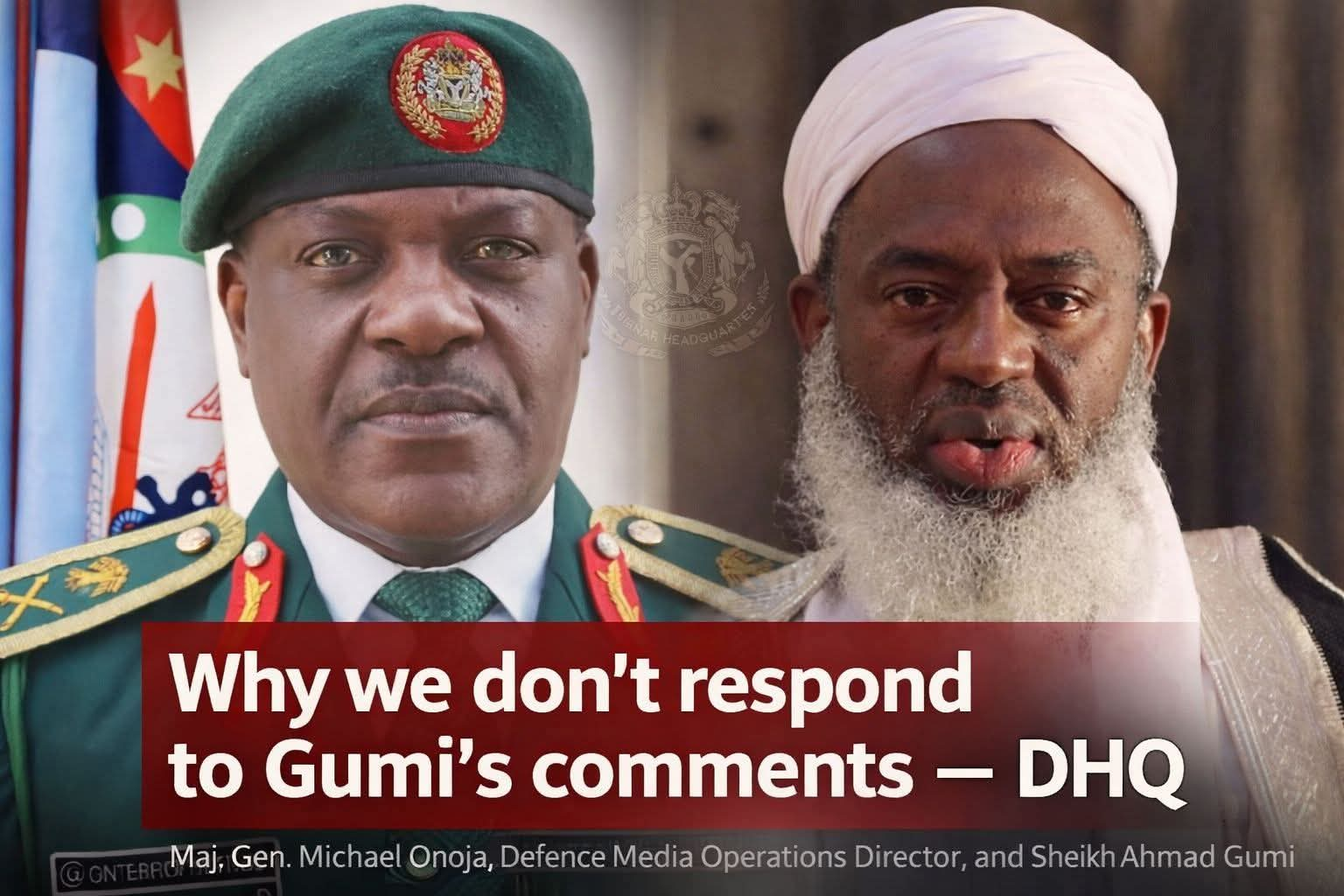
The Defence Headquarters (DHQ) has explained why the Nigerian military has not responded directly to comments made by Islamic cleric Sheikh Ahmad Gumi following recent counter-terror air operations carried out in Sokoto State.
On December 25, 2025, the United States, working in coordination with Nigerian security authorities, conducted airstrikes on camps described by officials as enclaves linked to the Islamic State (ISIS) faction operating in the North-West. Security sources said the operation was part of ongoing efforts to degrade the operational capacity of terrorist groups threatening national security.
Shortly after the strikes, Sheikh Gumi criticised the operation, calling on the Federal Government to end military cooperation with the United States. He described the airstrikes as a “neo-Crusade war against Islam,” comments that quickly gained traction on social media and sparked public debate. Many Nigerians questioned why the military had neither invited nor arrested the cleric over the remarks.
Addressing journalists in Abuja on January 1, 2026, the Director of Defence Media Operations, Major General Michael Onoja, said the Armed Forces would not be drawn into responding to public commentary outside their constitutional mandate. He stressed that the military’s role is strictly operational.
“Every agency has its functions. It is not for the Armed Forces to focus on what some people in society do not agree with in our activities,” Onoja said. “Ours is to focus on our kinetic operations and, as much as possible, conduct non-kinetic operations when necessary.”
He further clarified that assessing the implications of public statements, including whether they pose legal or national security concerns, falls under the responsibility of other state institutions. “There are relevant agencies who are tasked to consider such statements, whether they are against or for the country, and I believe they are doing so,” he added.
The DHQ reiterated that issues relating to intelligence assessment, internal security, and possible legal action over public utterances are handled by civilian intelligence and law-enforcement agencies, not the military.
Nigeria continues to battle insurgency, banditry, and other non-state armed threats through a combination of domestic security efforts and international defence partnerships. Officials maintain that while military operations require coordination across agencies, oversight of public discourse and civil matters remains firmly within the domain of civilian governance structures.