Chinese Ambassador to Nigeria, Yu Dunhai, says more than 10,000 Nigerians cutting across different sectors of the nation’s economy have benefited from various Chinese government sponsored exchange training programmes.
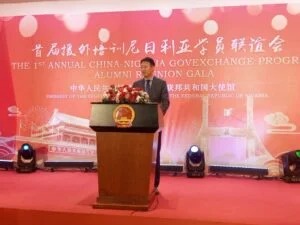
Yu disclosed this at the first Annual China–Nigeria Government Exchange Programme Alumni Reunion Gala on Friday in Abuja.
According to him, the initiative has strengthened individual capacity, institutional effectiveness, and contributed to Nigeria’s national development.
The event brought together many Nigerians, who had previously studied or received various trainings in China.
Ambassador Yu explained that the event aimed to sustain engagement among alumni and provide a platform for collaboration, idea-sharing, and continued contribution to China–Nigeria relations.
“The purpose of tonight’s gathering is to allow our alumni to stay connected, exchange ideas, and contribute meaningfully to China–Nigeria relations,” he said.
Yu said China has over the years offered training in diverse areas, including governance, poverty reduction, manufacturing, agriculture, public health, trade, investment, science, technology, innovation, blue economy, and digital economy.
He emphasised that the programmes had strengthened the capabilities of individuals while contributing to Nigeria’s economic and social development.
The ambassador noted that the alumni were spread across major Nigerian cities, including Abuja, Lagos, Ibadan, and Maiduguri, reflecting the nationwide reach of the initiative.
He described Nigeria and China as “natural partners” with over half a century of evolving friendship, noting that their mutual support on core national interests.
Yu cited China’s recent opposition to potential external military threats against Nigeria as an example of this partnership.
He also highlighted China’s support for Nigeria’s international role, including backing its return to the International Maritime Organisation and aspiration to join the G20.
On Nigeria’s stance regarding China’s territorial integrity, he affirmed that the Federal Government upholds the One-China principle, which recognises only one indivisible China in its foreign policy.
On economic cooperation, the ambassador revealed that bilateral trade between China and Nigeria had surpassed 22 billion dollars in 2025.
Yu added that China’s direct investment in Nigeria increased by 130 per cent, while Nigeria’s exports to China rose by over 200 per cent.
He also announced China’s zero-tariff policy for 100 per cent of products from all 53 African countries, including Nigeria.
“China’s today is Nigeria’s tomorrow,” he said, describing China as Nigeria’s “most important, reliable and trustworthy partner.”
The Chinese envoy reiterated his country’s readiness to work closely with Nigeria to achieve social and economic development.
The Permanent Secretary, Federal Capital Territory Social Development Secretariat, Mrs Olubunmi Olowookere, lauded the initiative saying it enhanced her social welfare, poverty alleviation, and community development mandates.
“The training exposed us to practical, people-centred development models and innovative social protection strategies, contributing significantly to China’s development journey,” she said.
Mr Muhammad Kalgo, Special Assistant to the Minister of Humanitarian Affairs and Poverty Reduction, described the programme as “eye-opening and humbling.”
Kalgo said that the initiative demonstrated how poverty eradication was achievable with well-coordinated policies, persistent leadership, and people-focused development.
He concluded that the alumni reunion marked a new beginning for continued collaboration.
“Our return is not the end; it is a new beginning to engage and build bridges between our nations,” he added.
At the end of the event, participants shared their unique experiences while they were in China during the exchange programmes.