A Nation’s Last Warning Before the Fall
By Charles Obiajulu Ugwu – PhD
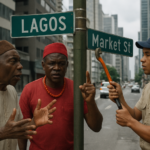
There are scenes you do not forget, not because they are dramatic, but because they reveal a truth you have quietly feared and avoided for years. The kind of truth that strips all your borrowed optimism and leaves you face-to-face with what you have become. That evening, at a lonely junction in Lagos, I saw one of those scenes. It wasn’t staged. It wasn’t grand. But it was the closest thing I have seen to a living prophecy stumbling into public view.
She came out of nowhere thin, disheveled, shaking with a kind of grief that does not ask for permission. The old woman was hurling curses into the hot, indifferent air. Not at any person in particular, but at a country that had betrayed her too many times to count. She shouted words that made even the hardened okada riders pause. Not because they were obscene, but because they were true in a way that felt like a blade across the nation’s conscience.
At first, everyone assumed she had finally snapped the way many Nigerians do, silently, invisibly, under the weight of a life that keeps taking and taking without mercy. But when she held her head up, her eyes were steady. Clear. Sharp with pain, yes, but also with memory. And memory when it carries both love and disappointment can shake mountains.
People gathered around her, as Lagos crowds do: half pity, half curiosity, half hunger for drama. But the woman refused pity. She demanded something else. “If you want me to stop shouting,” she said, “then promise you will carry this message. Promise you will tell those bleeding this country what they have done to us.”
A small boy at the front nodded first, perhaps without understanding the weight of what he agreed to. Then a few others murmured assent. She took that as permission to open the wound.
And what poured out of her wasn’t rambling. It was testimony. It was indictment. It was the mourning song of a woman who had watched her country crumble slowly, then all at once.
“THIS COUNTRY HAS BEEN BLEEDING LONG BEFORE YOU STARTED COMPLAINING,” SHE SAID.
Her voice wavered only at the beginning. After that, it had the force of someone who had been silent too long. She described Nigeria as if it were a body she had nursed from childhood healthy once, hopeful once, beautiful once. She spoke of a nation that walked with the gait of promise, a place where people believed the next morning held something worth rising for.
Then she spoke of what came after.
She described how Nigeria began to wobble not stumble, wobble as though its legs had been weakened by some slow poison. A country that once had the sturdy confidence of youth now stuttering like a malnourished drunk. The kind of staggering that begins as a joke and ends as tragedy.
She remembered this country when public schools worked, when hospitals were not death traps, when water flowed through pipes, when light was available without the hum of generators. “We were not perfect,” she said, “but we were not this insult.”
People listened now not because of nostalgia, but because she was describing a Nigeria that most of them had only heard about in stories. A Nigeria that sounded fictional.
Then she began listing the lootings.
Billions in refineries that never refined anything except the ambition of thieves. Trillions swallowed by budgets with no face, no evidence, no remorse. Projects commissioned on paper and abandoned on ground. Ministries turned into private ATMs. Agencies that existed only to provide cover for men who considered national wealth an inheritance. Turnaround maintenance contracts repeated like a children’s rhyme year after year while the refineries decayed like abandoned corpses.
She did not fumble numbers. She recited them like someone who had carried them in her chest for too long.
But what stunned me most was not her accuracy it was the crowd’s reaction.
Some laughed.
Not at her, but at the absurdity. At the familiarity. At the fact that nothing she said sounded shocking anymore. Corruption had so thoroughly baptized the nation that truth now sounded like entertainment.
She noticed the laughter. And something inside her collapsed.
“YOU THINK THIS IS NORMAL,” SHE SAID QUIETLY, “BUT WHAT YOU CALL NORMAL IS SLOW DEATH.”
Her shoulders dropped. She looked at the faces around her—faces hardened by survival, faces dulled by disappointment—and for a moment she seemed to shrink. Then she delivered a warning so calm it silenced even the loudest among us:
“This country’s resources are not infinite. You cannot bleed a cow to death and still expect milk.”
She said the world was already done with our excuses. That we have sold our tomorrow’s oil before today’s oil even left the ground. That our debt was now taller than our pride. That every government that came promising salvation only sharpened its teeth for a fresh round of feeding. “This frenzy,” she said, “this gluttony you think it has no consequences? You think God is your accountant?”
Someone in the crowd muttered, “Mama, calm down.”
She turned on him with fire.
“Calm down for what? You are standing at the edge of the cliff and still stretching your neck to admire the view!”
The crowd fell quiet. Lagos itself seemed to hold its breath.
Then, like a chorus rehearsed in secret, they all shouted almost in desperation
“This can’t continue! We are heading into the abyss!”
She nodded slowly, not triumphantly. Sadly. As though she had been waiting years to hear that collective confession.
Then she gathered her wrapper, steadied herself, and walked away. No drama. No theatrics. Just a tired woman leaving behind the truth like a small bomb.
THE REAL MESSAGE: A COUNTRY SLEEPWALKING INTO OBLIVION
I have replayed that scene in my mind, because it wasn’t just an outburst.
It was a mirror.
A mirror held up to a nation that has learned to romanticize suffering.
A nation that treats corruption as weather unpleasant but unavoidable.
A nation so exhausted that it mistakes numbness for resilience.
Her warning was not poetic. It was literal:
A country cannot leak this much blood and survive.
The numbers are not just statistics; they are symptoms of an illness we no longer acknowledge. Our institutions have become mausoleums. Our democracy a ritual of recycling failures. Our economy a sinking ship patched with slogans. Our national spirit once fiery, once ambitious, is now a dim flame flickering in a storm.
Nigeria is no longer bleeding slowly.
Nigeria is hemorrhaging.
Our oil revenue is mortgaged far into the future.
Our debt obligations are devouring the budget.
Our currency is gasping for air.
Our cities groan under insecurity.
Our young people are fleeing in waves.
Our leaders steal without shame because they know we will forget by morning.
We are living through a silent collapse, but because it is happening gradually, we have mistaken the descent for stability.
THE DEADLIEST DISEASE: NATIONAL NONCHALANCE
What struck me most was not the woman’s grief.
It was the crowd’s resignation.
Their laughter.
Their shrugs.
Their silence.
Their weary acceptance that everything is broken and nothing will change.
There is nothing more dangerous than a population that has stopped expecting accountability.
Nothing more tragic than a people who know the truth yet feel too defeated to demand better.
Nothing more fatal than a society that has made peace with decay.
Once a people stop believing their country belongs to them, collapse becomes a matter of time.
That is where Nigeria stands now—at the thin line between a fragile nation and a failed one, between disorder and catastrophe, between a warning and a funeral.
And the worst part?
Most Nigerians do not realize how close the edge is.
A COUNTRY DOES NOT FALL IN ONE DAY IT FALLS IN THE MOMENT ITS PEOPLE STOP FEELING RESPONSIBLE FOR IT.
The woman’s scream was not madness.
It was history speaking through the throat of an exhausted citizen.
Her message is the last alarm bell:
The world will not wait for Nigeria.
Our neighbors will not hold the cliff for us.
Our children will not forgive us.
And the abyss will not negotiate with our apathy.
This is no longer a political crisis.
It is a moral one.
A psychological one.
A civilizational one.
We cannot continue to behave like tenants in our own country—passive, detached, fatalistic. We cannot keep imagining that some miraculous force will intervene and stretch the boundaries of survival for us. We cannot keep treating national decline as entertainment.
A nation collapses first in the mind, then in the streets.
A FINAL WORD: THIS IS YOUR LAST UNCOMFORTABLE WAKE-UP CALL
If this essay reaches you, let it reach you deeply.
Let it disturb your comfort.
Let it unsettle your excuses.
Let it break through the layers of cynicism you’ve worn like armor.
Let it remind you that even a wounded country can heal
but only if its people stop pretending the wound is cosmetic.
Nigeria is not dead, not yet.
But it is dangerously close to irreversible damage.
That old woman was not speaking for herself.
She was speaking for all of us:
for the tired,
for the betrayed,
for the forgotten,
for the unborn,
for the departed,
for those still holding on to a country that keeps slipping away.
Her voice was a warning.
This essay is a reminder.
If we ignore both, the next sound we hear will not be another cry.
It will be the unmistakable thud of a nation that finally fell.
About the Author
Dr. Charles Obiajulu Ugwu is a contrarian thinker, creative philosopher, and systems analyst whose work focuses on dissecting the unnoticed delusions that underpin modern human institutions