By Charles Obiajulu Ugwu-PhD
I was fourteen the first time I watched a grown man laugh at his own misfortune. Not the laugh of denial no, I mean the deep, heavy, shoulder-shaking laugh of someone who had finally accepted that the world around him was not malfunctioning; it was functioning exactly as designed. My father had driven to the local council office to resolve a minor land document. What should have taken minutes stretched into hours of deliberate confusion, missing files that were never missing, signatures that magically expired, requests that multiplied like flies around a ripe wound.
At some point, exhausted, he leaned against the wall and chuckled quietly, bitterly, with the resignation of someone watching a thief steal in slow motion while the neighborhood applauded. When he stepped outside, he said something I never forgot: “You don’t get angry in this country. Anger is for people who still believe something can be fixed.”
I didn’t fully understand it then. But today, that line could serve as Nigeria’s unofficial national philosophy. We have become a people who have outlived our capacity for shock. Every disappointment is pre-loaded, every failure already priced in. No one expects truth anymore; they expect performance and almost always, a bad one. That boyhood memory was my first lesson in the anatomy of distrust. What I did not know was that this distrust would one day harden into our national software, shaping how we live, vote, negotiate, worship, marry, and navigate the labyrinth of daily survival.
A country becomes ungovernable long before it collapses. The real death begins in the mind of the citizen the moment people stop expecting truth and start expecting trickery. Once that psychic shift settles, legitimacy evaporates. And without legitimacy, institutions do not merely weaken, they become decorative. They exist the way old colonial buildings exist: outwardly impressive, inwardly hollow.
Nigeria today is that building.
To live here is to inherit an instinctive suspicion, refined over decades of betrayal. A minister makes an announcement and nobody listens for meaning; they listen for motive. A budget is released and nobody examines its potential impact; they estimate the scale of the coming theft. A new administration steps in and citizens do not wait to observe performance; the verdict is already written before the president warms the seat.
The ritual is predictable: new government, fresh slogans, frantic honeymoon sermons, followed by the familiar melody of incompetence, inflation, excuses, and televised promises with no expiration date. Nigerians no longer feel deceived; deception is expected. Leaders no longer feel compelled to pretend; they offer governance with the swagger of men performing a public duty to themselves.
The erosion of trust is not an event it is sedimentation. It gathers in layers.
Ask the trader whose goods were seized by a task force because she refused to pay “informal royalties.”
Ask the young graduate asked to “drop something” to secure a job he already earned on merit.
Ask the family that lost a loved one because a hospital demanded a police report before touching a bleeding body.
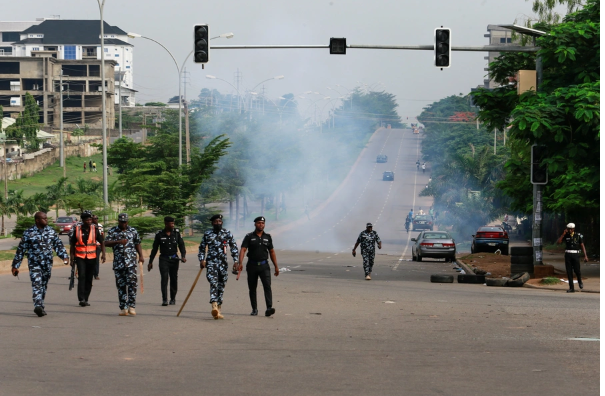
Ask the driver who was stopped by a police officer who already assumes he is guilty of something, anything because guilt is the national currency.
Every citizen carries a catalogue of these small injuries, and each injury chips away at the fragile idea of a shared civic contract. Over time, distrust becomes easier than hope.
The story of a nation is coded in its small absurdities. Consider the traffic light. In most countries, traffic lights are agreements: red means stop, green means go, amber means prepare. Here, a traffic light is an elaborate suggestion. Obey it, and you might get rear-ended. Follow it too faithfully and you become a curiosity. People look at you as if you are naïve enough to believe that rules were designed to bind everyone and not merely the unlucky.
Or take our elections. Democracy, in its ideal form, rests on trust a trust that votes matter, that institutions are independent, that the announced results reflect a collective choice. But in Nigeria, elections operate like elaborate theater productions, complete with actors, costumes, and scripts written months before ballots touch boxes. Citizens do not ask who won; they ask who rigged more elegantly. They do not complain when the referee blows a crooked whistle; the surprise would be if he didn’t.
A country without referees becomes a playground for the audacious and a graveyard for the honest.
I recall a friend who once attempted to challenge an illegal charge by a utility company. He gathered receipts, manuals, regulations he was armed with facts. He stood before the office supervisor who nodded sympathetically throughout. When my friend finished, the man smiled and said, almost warmly, “Oga, you are technically correct, but practically wrong.”
What do you do with a system where correctness is irrelevant and compliance depends on mood, privilege, or palm-greasing? In such a system, distrust is not only rational it becomes sophisticated.
Over time, the Nigerian learns not to trust the policeman, but also not to trust the neighbor reporting the policeman; not to trust the civil servant, but also not to trust the activist demanding reform; not to trust the politician, but also not to trust the opposition claiming purity. Distrust becomes a blanket—thick, itchy, suffocating, but familiar.
And once familiarity sets in, dysfunction becomes culture.
The state, deprived of trust, transforms into something else—not a government but an elaborate warning sign. Policies oscillate like pendulums. Agencies contradict themselves. Regulations emerge without teeth, commitments appear without timelines, reforms surface without context. Leadership becomes a performance art practiced before international audiences, while local citizens watch behind the scenes and see the props, the wires, the script.
But the deeper tragedy is this: distrust kills ambition. Not personal ambition as Nigerians are some of the most individually ambitious people on the planet. I’m speaking of civic ambition, national ambition, collective ambition. The big, sweeping dreams that move societies including industrial leaps, infrastructure revolutions, scientific awakenings all require trust. They require that people believe the system will not sabotage them. In a country where sabotage is expected, people shrink their dreams to fit their environment. They pursue survival, not progress. They chase personal mobility, not public reform.
You see this at airports, where lines dissolve into clusters because everyone assumes the official in charge will favor someone else. You see it in the way landlords demand two years’ rent upfront because they assume their tenants will default. You see it in the way citizens travel with their passports inside their shirts, because the uniformed man at the checkpoint may decide he needs a “token of appreciation” to return it.
Distrust does not merely corrode institutions; it rearranges behavior.
There’s a famous anecdote about a man traveling at dawn on a lonely expressway. His car malfunctioned. He parked and walked toward a police checkpoint seeking help. When the officers spotted him, they dispersed fleeing into the bushes. They assumed he was part of some ambush to expose them. He assumed they were trying to avoid responsibility. In that moment, both sides manifested the same disease: mutual suspicion wrapped in the memory of past betrayals.
This is how nations unravel: not through explosions but through quiet, corrosive dysfunction.
A functioning society relies not only on laws but on belief in those laws. On the idea that referees stand between power and the citizen. But in Nigeria, the referees are compromised, intimidated, politicized, or simply indifferent. Courts dance to the rhythm of politics. Regulatory bodies tilt according to ethnic winds. Anti-corruption agencies pursue selective epiphanies. Even religious institutions once moral anchors often disintegrate into political chapels.
A friend once told me, after losing a court case he should have won, “I didn’t lose because I was wrong. I lost because the judge decided my opponent was richer.” Imagine the corrosive power of such certainty. Imagine millions of citizens forming their worldview around such experiences generation after generation.
This is how institutional distrust becomes an operating system.
Not a glitch.
Not an accident.
A system.
A system where every success is interrogated, every failure is predicted, and every promise is discounted. A system where citizens do not believe the fire service will arrive, the ambulance will respond, the police will protect, or the judge will arbitrate fairly. A system where governance transitions from a social contract to a perpetual hostage negotiation.
Observe how Nigerians interpret tragedy. When a building collapses, citizens do not say, “How unfortunate.” They say, “Who collected the bribe during inspection?” When the economy dips, they do not ask about global headwinds; they ask whose incompetence or greed accelerated the decline. Institutions have lost the right to be seen as institutions; they are treated as gangs with letterheads.
And once distrust becomes absolute, conspiracy becomes common sense.
People no longer debate facts; they debate narratives. They assume every action has a hidden agenda because history has trained them so. Even when leaders attempt genuine reform, the public responds with suspicion, not because they are irrational, but because the past has been too consistent to ignore.
Without trust, infrastructure collapses—not only physical infrastructure, but the softer architectures of cohesion, empathy, and collective will. Citizens become cynics. Leaders become survivalists. Society becomes fragmented into micro-trust enclaves, ethnic blocs, religious bubbles, professional networks. The nation becomes a mosaic of isolated islands pretending to be a federation.
And yet, the most dangerous part is not that distrust exists. It is that distrust feels normal.
Nigerians navigate dysfunction with the dexterity of veterans. They laugh at their pain. They construct workarounds. They become their own regulators, their own security, their own welfare system. Resilience, praise-worthy as it is becomes an anesthetic. It numbs the instinct to demand better. The system relies on this resilience like a parasite relies on its host: sucking strength from a suffering body while encouraging it to “stay strong.”
But how long can a nation run on resignation?
Every great upheaval in history began not when people were suffering, but when people stopped normalizing suffering. Nigerians have not reached that threshold not because they lack courage, but because the distrust is so total that they do not believe change is possible. A people who distrust their institutions eventually distrust their own capacity to reform those institutions.
That is the true cost of this crisis.
Leadership thrives when citizens expect something.
In Nigeria, citizens expect nothing.
And nothing is a dangerous expectation for it births complacency at the top and quiet rage at the bottom.
Our challenge is not merely corruption or incompetence; our enemy is psychic fatigue. We must rebuild legitimacy from the ground up. Reconstruct the idea of referees. Cultivate leaders who treat truth not as an accessory but as a spine. Create institutions that can stand upright without political breath propping them.
For a nation of over 200 million people, trust is not a luxury it is a survival requirement. Without it, we become a crowd, not a country. A territory, not a society.
For decades, we have lived inside a republic of lowered expectations. But sooner or later, a generation will emerge that refuses to inherit this psychological poverty. A generation unwilling to laugh at their own misfortune. A generation that demands the whistle be restored, the field leveled, the scoreboard honest.
Because no nation, no matter how resilient, can thrive without referees.
And we must decide: will we remain a people who smirk through our suffering, or a people who reclaim the right to be outraged?
Will we continue living inside a system designed to betray, or finally insist on building one designed to protect?
History has one caution: a society built on distrust eventually confronts the moment when the center snaps not loudly, but with that same bitter, exhausted laughter I saw on my father’s face decades ago.
Nigeria deserves better than a laugh where a scream should be.
And perhaps this—right here, right now is where we begin the work of learning to scream again.
About the Author
Dr. Charles Obiajulu Ugwu is a contrarian thinker, creative philosopher, and systems analyst whose work focuses on dissecting the unnoticed delusions that underpin modern human institutions