By Charles Obiajulu Ugwu – PhD
It begins in the kind of heat that hums with restlessness, the type found in a Lagos bus when traffic has reduced time itself to a spectator sport. The air is thick with impatience, gospel music spills from the driver’s radio, and the woman beside you clutches her worn Bible like a passport to safety. Suddenly, the bus hits a pothole so deep it feels theological. Someone mutters, “Na enemy.” Another snaps, “Na government.” Then, quietly, the oldest passenger says, “Maybe na life just doing what life does.” Everyone goes silent. That silence, that refusal to blame or explain is rare. We are a people who must believe something, even if it hurts us.
The Nigerian instinct is to find meaning in every motion, to locate a spiritual culprit for every chaos. When the generator dies, it’s warfare. When promotion delays, it’s witchcraft. When the pastor falls, it’s a test of faith. We cannot stand the nakedness of randomness. Yet in that crowded bus, for a flicker of a second, someone allowed mystery to breathe. And that’s when the thought struck me: perhaps belief in this land has become too noisy to hear itself think. Perhaps what we need is not more faith, but better rhythm in the form of belief that can dance again. There comes a point when humanity must admit its most dangerous addiction: the need to be right. Not free, not alive but just right.
We cling to our creeds, our systems, our gods, our theories, as if letting go would send us into some moral outer space. Yet history keeps whispering the same truth: the world does not collapse when beliefs are questioned, it expands. But we are now living in an age where belief has stopped walking and started limping. Faith religious, ideological, institutional has become a frozen theater of repetition. We mistake loud conviction for truth. We reward conformity disguised as conviction. The tragedy? The human spirit once elastic, curious, exploratory has grown brittle under the weight of certainty. When belief learns to dance, civilization breathes again. Until then, we will keep mistaking noise for meaning.
The Stillness Before the Rhythm
Belief was never meant to be a cage. It was a song, a rhythm through which humanity conversed with the unknown. In older societies, faith and reason were not enemies; they were twin dancers circling the mystery of existence. But modernity, with its obsessive precision and industrial arrogance, split them apart. We built temples to logic and prisons for wonder. What remains now is a civilization choking on its certainties of science without soul, religion without reflection, politics without conscience. Every ideology believes it is the last train to salvation. Every tribe believes it alone carries the pure flame. But as each insists on its monopoly of truth, the human story disintegrates into competing fragments. There’s a Yoruba proverb that says, “The man who owns all the drums never dances.” That’s where we are. We’ve surrounded ourselves with too many instruments of belief in the forms of religions, markets, national myths, data cults yet forgot the movement that once made them meaningful.
Faith as a Cultural Operating System
Faith is not religion. It is the architecture of trust that allows humans to organize uncertainty. From ancestral rites to blockchain tokens, faith is the invisible bridge across the abyss of the unknown. The problem is not belief itself it is when belief stops evolving. Religion, like any technology, can become obsolete. But humans rarely admit this. Instead, we keep upgrading the ritual, repainting the symbol, adding new hymns to a crumbling temple. In the process, faith becomes domesticated. It stops seeking. It stops dancing. This is where the African condition becomes both tragic and illuminating.
Across the continent, belief has often been hijacked not by gods, but by men who sell them. The colonial project understood this perfectly: to control a people, rewrite their gods. Replace their ancestral dances with imported hymns, their diviners with priests, their cosmologies with creeds written elsewhere. Yet, beneath this forced conversion, something refuses to die. The African psyche, even in exile, remembers rhythm. It remembers that belief was once participatory a community in motion, not a hierarchy of control. And in these remembering lies the possibility of renewal.
When Belief Learns to Dance—Three Stories1
The Prophet and the River (Nigeria, 1980s)
In a small village by the banks of the Niger, a self-proclaimed prophet arrived, claiming he could walk on water. He gathered a crowd, blessed the river, and announced that faith would carry him. The villagers many of them devout Christians but still deeply animist in intuition watched with quiet curiosity. The prophet stepped forward. The river swallowed him whole. The next day, elders gathered under the udala tree. One of them, an old fisherman, simply said: “Even Jesus knew which waters to walk.” That statement captures a quiet rebellion against blind belief. It wasn’t cynicism it was intelligence wrapped in humor. The old man wasn’t mocking faith; he was reminding everyone that faith without discernment is not strength but suicide. This story became a local proverb: “When the prophet drowns, the river laughs last.” It echoes still, in marketplaces and pulpits, as a caution against imported certainty and unexamined zeal.
2. The Shrine and the Stadium (Lagos, 1999)
On the eve of democracy’s return to Nigeria, Lagos was tense. Churches were full, shrines restless, and politicians busy buying blessings. Amid the chaos, Femi Kuti stood on stage at the New Afrika Shrine, wailing through his saxophone as if summoning ancestral ghosts. He was not preaching. He was invoking. His message: freedom must have rhythm or it will become another religion. Across town, a megachurch hosted a “Victory Night.” Thousands prayed for divine intervention to end corruption and suffering. The irony was palpable: the same citizens who shouted “fire!” at their politicians were tithing to pastors with private jets. Femi’s music and the church’s worship represented two forms of faith one kinetic, the other static. One danced with truth; the other demanded it kneel. And in that contrast lies the cultural tension of our time: will Africa rediscover belief as a creative act or remain enslaved by its performance?
3. The Market Woman’s Gospel (Enugu, 2012)
Chinyere sold peppers at the Ogbete market. One morning, her stall caught fire. Everything burned. Neighbors wept, but she smiled and said, “Perhaps my ancestors are clearing the road for a bigger stall.” Three months later, with help from others, she built a new shop twice as large. When asked why she wasn’t bitter, she replied, “Because I don’t believe in tragedy. I believe in turning. ”That phrase I believe in turning has haunted me ever since. It is not religious; it is regenerative. It refuses to bow to catastrophe. It trusts the cyclical logic of life. Chinyere’s kind of belief dances, it adapts, flexes, flows. It’s an African metaphysics hidden in plain sight, the opposite of Western rigidity. Where Western religion often seeks salvation from the world, African spirituality seeks harmony with it.
The Tyranny of the Unquestioned
The problem with belief today is not that people are faithless it’s that they have outsourced faith. Religion has become institutionalized obedience, politics has become moral theatre, and science, too, has its dogmas. Each domain, once meant to liberate thought, now competes for monopoly on what it means to be right. This tyranny of the unquestioned thrives on the illusion of moral certainty. It rewards fanaticism because nuance doesn’t trend. Yet, as history keeps proving from the crusades to colonialism to today’s algorithmic echo chambers, unquestioned belief is civilization’s most elegant suicide note. Every empire fell because its ideology became incapable of self-doubt. Rome collapsed under divine entitlement. The Soviet Union crumbled under its own gospel of reason. And today’s neoliberal faith in infinite growth is just another creed masquerading as economics. Belief becomes lethal the moment it stops dancing and that shall be when it loses rhythm with reality.
The Return of the Dancing Mind
What does it mean, then, for belief to dance again? It means returning faith to motion allowing it to question itself without fear of annihilation. It means creating spiritual architectures that can evolve, that can learn. This does not mean discarding religion or mocking conviction. It means treating belief like jazz, not a military march.
Improvisation, not repetition. Dialogue, not dogma. In African cosmology, the divine is not static it is emergent. God dances because existence itself is movement. From the Yoruba Bata drums to the Igbo ekpe rituals, faith was never a set of rules, it was choreography with the cosmos. This worldview, if recovered, could be Africa’s greatest philosophical export: an epistemology of rhythm. In a world suffocating under rigid systems, the ability to dance to adapt, to weave, to unlearn is not cultural trivia. It’s survival strategy.
The Post-Belief Era
We are entering an era where information has replaced wisdom, and algorithms have become the new gods. Our faith in technology mirrors ancient idolatry: we worship what we don’t understand. We pray to the cloud, confess to data, and await salvation through innovation. But the dance hasn’t died it’s just migrating. You can see it in protest movements, in regenerative communities, in the quiet rebellion of those who choose connection over consumption. The future will not belong to those who believe most fiercely, but to those who can hold belief lightly and still act boldly. To dance, in this sense, is to be porous to hold truth as an evolving rhythm, not a frozen creed.
The Call to Redesign
This essay is not a lamentation; it is a challenge. It is a design brief for cultural engineers, organizational alchemists, faith-leaders, policy-architects. Ask yourselves: What belief-systems guide our communities, our institutions, our movements? Which of those beliefs are core values and which are methods in disguise? Where are we clinging to methods because they still feel sacred, even though conditions have shifted? How do we build belief-rituals of review, revision, recalibration? How do we incentivize belief-leaders who revise rather than defend? Who adapt rather than entrench? What metrics do we use to test whether belief is still serving or holding back? The work is subtle. It is metaphysical and material at once. It demands bravery: to say “yes, I engaged my belief-system and it misaligned with this world so I’ll fix the pathway, not the purpose.” It requires humility: to accept that belief is not a fortress but a living organism. And it demands strategy: yes, faith matters but faith that does not flex under pressure becomes dread.
Belief in Motion
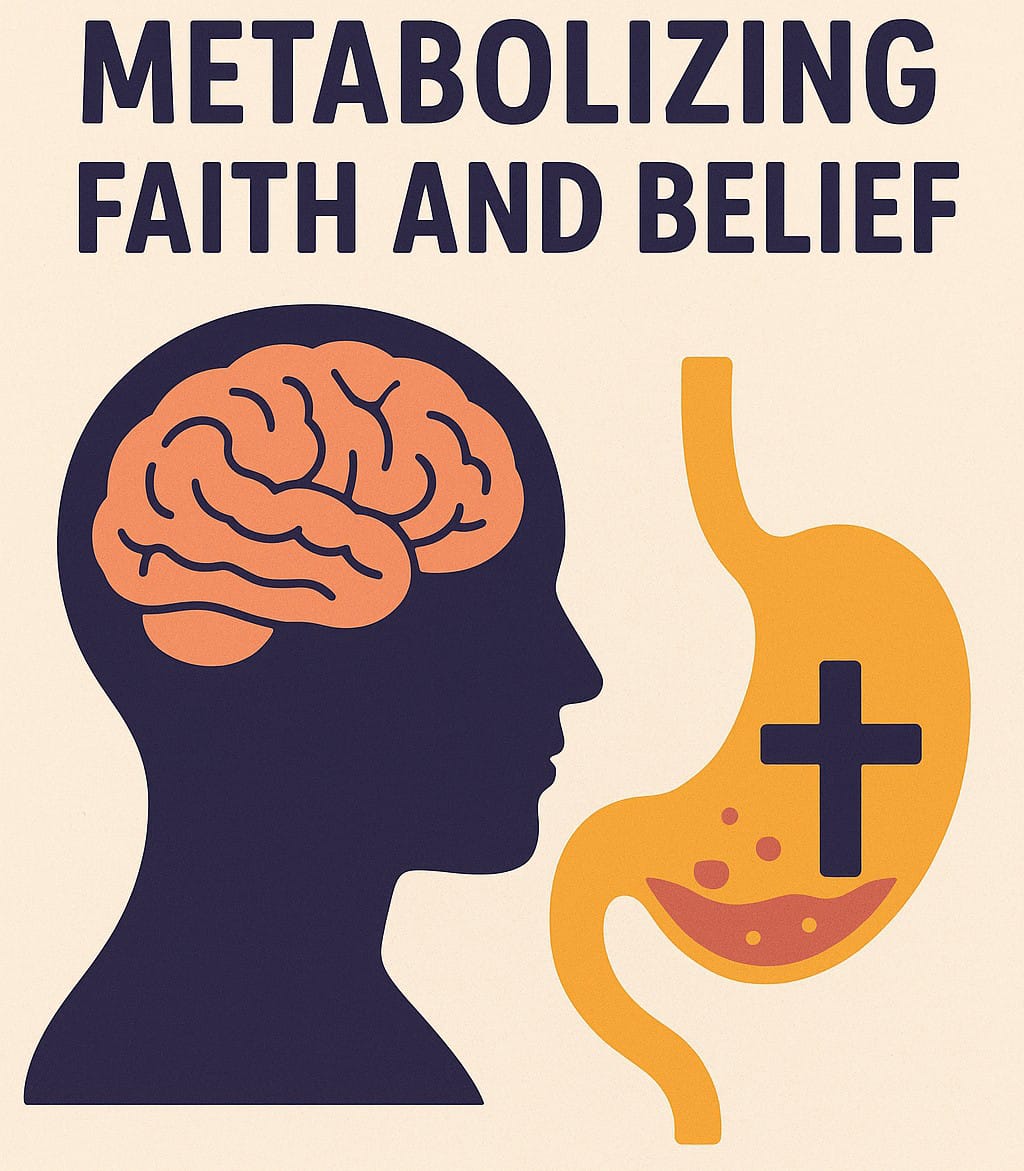
We stand at the cusp of rapid ecosystemic transformation. The forces are not waves we ride they are tectonic plates shifting beneath us: climate, technology, demographics, geopolitics. If we want to stay ahead of the fracture lines, we must rethink not just our actions but our faith-systems. The old image of belief is a monument. Heavy, silent, unchanging. That era is over. The new image must be belief as metabolism circulating, generative, adaptive. Anchoring, yes but not anchoring us to yesterday. Instead anchoring us through change. Let conviction flex. Let faith stretch like muscle. Let belief become part of the architecture of emergence, not its retardant. In doing so, we may not only adapt to the future we may regenerate it.
When the Music Stops
The greatest danger to any civilization is not disbelief rather it is arrogance masquerading as faith. Humanity has always survived collapse by rediscovering movement. When religion became tyrannical, mysticism danced around it. When reason grew cold, poetry rekindled it. When empire hardened, resistance turned into rhythm. Sometime last year, I met an old masquerade maker in Nsukka a man named Onwurah who carved spirits out of wood. His small hut smelled of camwood and wisdom. As he sanded the face of a half-finished mask, I asked him whether he still “believed” in the power of the gods he carved.
He chuckled. “Believe?” he said, pausing to lift the mask toward the light. “My son, belief is for those who want to sleep not for those who want to wake up from calcified slumber.” I stood there, unsure whether he meant it as poetry or prophecy. But as I watched him polish that wooden face into life, I realized he had just described the future of the human spirit. We have built cathedrals and apps and algorithms all in search of certainty. But maybe what we’ve lost is movement, the grace to turn, to unlearn, to bend without breaking.
When belief learns to dance, we stop fearing the unknown. We begin to co-create with it. And perhaps, someday, when the noise of the world grows unbearable, we’ll remember that old man in Nsukka carving spirits from silence, teaching the rest of us that the purpose of faith was never to finish the song, but to keep the rhythm alive. The next renaissance will not begin in the lecture hall or the Cathedral it will begin wherever people remember how to move meaningfully again. Because the moment we learn to metabolize belief, humanity will stop kneeling to false gods and start standing with itself.
Author Bio:
Dr. Charles Obiajulu Ugwu is a management consultant, regenerative systems thinker, and adaptability theorist. Known for his contrarian intellect and depth-driven frameworks, he explores how belief, cognition, and civilization evolve through creative tension. His work merges African epistemologies with global transformation theory.