In the run-up to Nigeria’s 2023 general election, President Bola Tinubu delivered a disturbing message to his top party members in London. He said, “Political power is not going to be served in a restaurant. It is not served a la carte. At all costs, fight for it, grab it, snatch it, and run with it.” At the time he made this infamous statement in 2022, he had not become President.
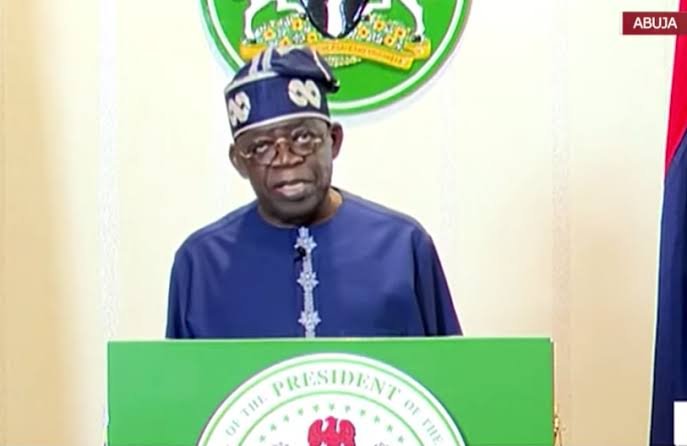
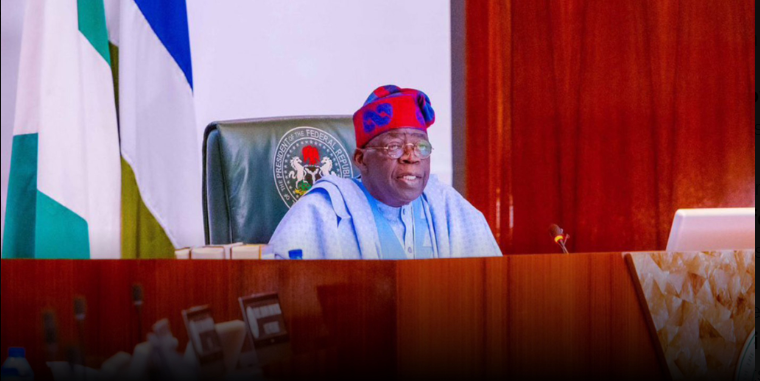
Now as President, Tinubu presents himself as a born-again democrat who dreams and desires transparent elections. On Thursday, October 23, 2025, he swore in the new Chairman of the Independent National Electoral Commission (INEC), Professor Joash Amupitan (SAN), at the State House Council Chamber of the Presidential Villa in Abuja. He charged the new INEC boss to serve with integrity.
Hear him: “It is important that our elections are free, fair and credible. We must consistently improve our electoral process, addressing the challenges of yesterday and innovating for today and tomorrow.” He urged Prof. Amupitan to protect electoral integrity and ensure that all aspects of the process, including registration, media access, voting and counting are transparent, non-violent and credible. Amupitan, who has since assumed office, has pledged to uphold the highest standard of integrity, transparency and discipline in the electoral system.
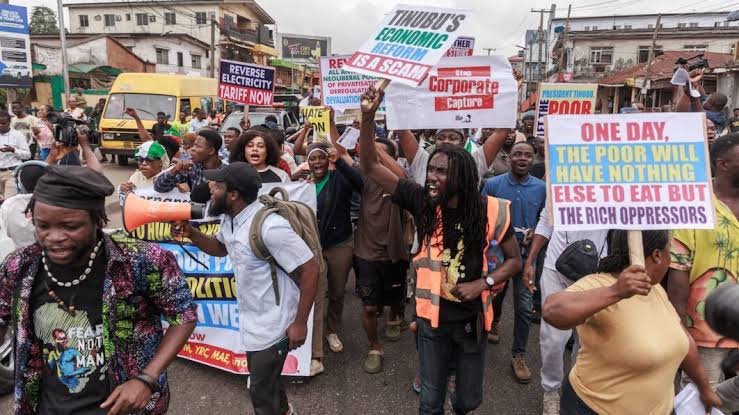
There appears to be some political film tricks here. In deference to Tinubu’s philosophy of power grab, some stalwarts of his All Progressives Congress (APC) and their supporters did everything humanly possible to ensure that they grabbed power in 2023. Thus, they succeeded in large measure to thwart the wishes of the majority of the Nigerian people.
In Rivers State, where former governor Nyesom Wike held sway, election was massively rigged. The result of that poll did not reflect the voting pattern of the people. In an attempt to snatch victory in Lagos, the ruling party deployed every arsenal in its possession. Some of its members and sympathizers resorted to harassing and intimidating the electorate suspected to be sympathetic to the opposition party candidates. People of Igbo extraction were even warned not to bother coming out to vote. Despite all these, Tinubu still lost Lagos to the presidential candidate of the Labour Party, Mr. Peter Obi. The margin of victory would have been far higher than what was presented if not for the manipulations.
The worst was that many voters were technically disenfranchised across the country. Out of over 93 million registered voters, only about 25 million people (about 27 per cent) voted. This happens to be the lowest turnout in the history of presidential elections in Nigeria. In 1999, the voter turnout was 52.3 per cent. It was 69.1 per cent in the 2003; 57.5 per cent in 2007; 53.7 per cent in 2011; 43.7 per cent in 2015; and 34.7 per cent in 2019.
The final straw that broke the camel’s back was the so-called “technical glitch” that gripped the INEC Result Viewing Portal (IReV). The electoral umpire had assured that votes would count and that results would be transmitted real time to the IReV. This worked with the collation of the National Assembly election, but failed with the presidential election result collation held the same day.
Power grabbers had also latched onto the loophole in the Electoral Act 2022 to manipulate the outcome of the 2023 elections. The Electoral Act confers power on the umpire to issue regulations and guidelines for the conduct of elections. INEC had issued some guidelines which included electronic transmission of election results. But because that option did not suit some entrenched interests, the guideline was changed in the middle of the game. When the matter got to the Supreme Court, it ruled that the use of technological innovations like Bimodal Voter Accreditation System (BVAS) and IReV was not mandatory because it was not a provision of the Electoral Act.
A lot of people, including me, blamed INEC under Professor Mahmood Yakubu for this duplicity. But greater blame lies elsewhere. INEC leadership might not have done what it did if it was given full independence to do its work. Obviously, it went through tremendous pressure. The judiciary apparently faced the same pressure.
In my intervention on this page titled, ‘Yakubu, Amupitan and INEC’s banana peels’, published on Monday, October 13, 2025, I noted that the major problem with our elections was not strictly the personalities at the helm at INEC, but the institutionalized bottlenecks that crippled every poll in the country.
For instance, it is improper for the President to appoint the central referee in a game he is a major player. If this provision is not changed in the constitution to make room for a credible independent body to make the appointment, it will be difficult to have a transparent election in Nigeria.
This mode of appointment was the first mistake in the assumption of office by Amupitan. The second mistake was taking his oath of office in the Presidential Villa. Tinubu, who appointed Amupitan and swore him in at the Villa, is a possible candidate in the 2027 election. He has told the chief electoral umpire to ensure credible elections. I laugh. Amupitan cannot perform any magic if they don’t give him the freedom to operate.
Meanwhile, they are already perfecting their rigging strategies. Many opposition figures, including governors, have defected to the ruling APC. A number of them were elected on the platform of the Peoples Democratic Party (PDP). Their defections were not based on any ideology. Nigerian politicians have no ideologies, no shame, and no principles. It’s not as if the ruling party has recorded any tremendous achievement. The major attraction to its fold is that bread is well buttered there. Besides, those who have tainted records are promised protection once they join the party.
Nigerians must be wary of the grand design to muscle out the opposition and make Nigeria a one-party state. The PDP is pursuing shadows while its house is on fire. The African Democratic Congress (ADC) made some noise recently. It appears to be fizzling out. The Labour Party is fragmented. I am yet to see that strong opposition party that could challenge the ruling party in 2027.
The selfish inclinations of some chieftains of these parties are part of the problem. No one wants to step down for the other. The convention in Nigeria today is that the presidency rotates between the North and the South. Currently, it is with the South. It will be so for eight years. In 2031, it will be the turn of the North. Unfortunately, Atiku Abubakar, a northern political stalwart, insists on contesting the 2027 presidential election. It will not work. If he and a former governor of Kano State, Musa Kwankwaso, could rally behind Peter Obi, Tinubu will get the challenge of his life. But they may not. And that is the beginning of the downfall of the opposition.
Nigeria is due for a constitutional overhaul, not this piecemeal amendment the National Assembly is doing currently. A former President of the Nigerian Bar Association (NBA), Wole Olanipekun (SAN) said it all. According to him, the National Assembly should suspend further amendments to the 1999 Constitution to allow for a new constitution. Delivering the 13th Convocation Lecture of the Afe Babalola University, Ado-Ekiti, last week, Olanipekun said Nigeria required a new homegrown legal framework that would genuinely reflect the collective will of its people and their uniqueness. To achieve this, he recommended, among others, a national referendum and the review and harmonization of reports of previous national conferences.
We must embrace true federalism and do away with undue concentration of power at the centre. This is what has engendered the intense fight to grab federal power and corner national resources.
Tinubu must show in his actions that he truly means what he told Amupitan about conducting free and fair elections. He must push for the total overhaul of the legal framework for our elections. Electronic voting and electronic transmission of results must be made compulsory. The President must be stripped of the power to appoint the INEC Chairman and Resident Electoral Commissioners (RECs). Without the necessary reforms, many Nigerians will take his charge to Amupitan as an exercise in hypocrisy and grand delusion.