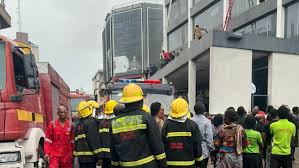
The fire that engulfed the Afriland Tower on Broad Street, Lagos, on September 16, re-echoed what has become the frequent incidents of fires, from which no lessons had been learned. The latest disaster, as usual, no doubt, has plunged many families into unexpected traumatic agony by the loss of their loved ones who perished in the inferno.

What is worrisome is that after several fire incidents had occurred in Lagos on different occasions in the past, with loss of precious lives and properties, the government and owners of the buildings learned no lessons to prevent future disasters and save lives and properties. The traumas and pains are quickly swept under the carpet, as life goes on no sooner than they occurred. The result is that more disasters keep recurring. Could the latest disaster make any difference? Have any lessons been learned?
According to reports, fire suddenly broke out at the seven-storey Afriland Tower building at the heart of Lagos on Broad Street, with thick fumes enveloping the edifice housing the offices of the United Bank for Africa (UBA), Federal Inland Revenue Service (FIRS), and United Capital Plc. The, hitherto glassy cynosure of financial prowess, quickly turned into a suffocating chamber. The fire that, reportedly, started in the basement inverter room around 1pm, spiraled to a catastrophe that claimed ten lives, with many more injured.
Eye witnesses said as the smoke billowed and panic ensued, those trapped fought for every breath to survive. Some jumped through the windows to the ground, sustaining injuries.
“We just noticed the light tripped off and it was taking unusual long to come back, said one survivor. He said power outages in the tower were usually brief – most times resolved by the building’s inverters. But this time, over 20 minutes passed without power being restored. Everybody became apprehensive and suddenly we started running. Amid the chaos, visibility dropped to zero as the fumes filled the corridors. The smoke was so thick that we could not see anything,” added the survivor.
“I think it was just the grace of God that I was able to come out. I just followed one person and was able to make it to the ground floor,” explained the survivor. He said the people who died were those who passed through the basement. The fire started in the inverter room close to the entry in the basement, and that was why some people could not come out”.
At the last count, 10 top professional staffers of the companies in the building were reported dead. United Bank for Africa lost six young professionals, while the Federal Inland Revenue Service (FIRS) lost four. Those injured were rushed to various hospitals for treatment.
President Bola Ahmed Tinubu and the Lagos State Governor, Babajide Sanwolu condemned the tragedy and called for stricter safety measures to prevent future disasters. The Nigeria Labour Congress (NLC), raised concern about the incident, questioning the response time and risk management in high- rise buildings. Several other stake holders expressed shock at the disaster questioning the response time of rescuers.
On its own, the Civil Rights Advocacy Group, (HURIWA) said that the deaths could have been avoided if only the safety precautions were put in place including fire hydrants, fire extinguishers and emergency exits. Besides, HURIWA condemned the delay in the arrival of first responders at the scene of the inferno, which contributed to the high fatalities.
It asked the families of those who died in the fire to institute legal suits against the owners of the complex, the Lagos State and Federal Government, praying the court to grant each of the claimants a compensation of not less than N1 billion, because of the criminal negligence to protect the occupants from avoidable deaths.
“We watched on live social media videos as good spirited Nigerians battled for nearly one hour to salvage the situation and save the lives of people trapped in the building… There was absence of professional first responders such as the fire service department, the state and national emergency management agency’s”.
“We also noticed that the massive structure itself lacked the necessary fire fighting facilities that could have been deployed even before external first responders arrived. Why, for instance, does Lagos State not have air ambulance that could have been seamlessly deployed to the scene of the disaster to rescue as many people as possible”?
HURIWA said, “Lagos State Government is guilty of criminal negligence by not enforcing safety codes for high-rise buildings, which is the fundamental reason that infernos in buildings of Lagos State have killed many citizens in recent times, just as many Nigerians have lost billions of naira worth of commercial assets due to fire incidents that could have been avoided.
”Certainly, the deaths were preventable if the Lagos State Government had enforced appropriate measures based on the previous similar disasters in the state. The following are some of the recent fire disasters in high-rise buildings in Lagos:
· Balogun Market fire (2019): A massive fire broke out in multiple buildings, resulting in several deaths and millions of naira worth of assets lost.
· Eko Hotel Annex fire (2020): A late night blaze forced mass evacuations, with no deaths recorded.
· Mandilas Building fire (2021): A fire said to be caused by faulty electrical wiring injured dozens of traders.
· Dosunma Plaza fire (2022): Exploding generators and batteries worsened the fire, highlighting the dangers of alternate power sources, like the incident at the Afriland Tower.
· Dosunma Market fire (2024): Over 20 high-rise buildings were affected, with four collapsing due to the intensity of the fire. Properties worth billions were destroyed.
There is no doubt that Lagos has recorded a number of high-rise building fire incidents from the 80s to the present. The NET building on Broad Street, the tallest building in West Africa, got burnt on January 23, 1983. All these should have served as enough experience to prevent new fire incidents and save lives and properties in the event of fire outbreak.
For instance, it is shocking that there were no smoke detectors to ignite alarm at the Afriland Tower building. If there was fire alarm in the building, within 20 minutes before smoke covered the exit routes, everyone would have escaped. It is unimaginable how such a huge structure did not have fire alarms installed in it.
Aside from fire alarms, there were inadequate evacuation plans, which led to panic and increased risk of injury and death. That explains why people were seen jumping through the windows to the ground and got injured.
As hinted above, the high-rise buildings don’t have adequate fire safety equipment such as sprinklers, fire alarms and smoke detectors. There is poor building maintenance. The failure to maintain fire safety equipment and systems could lead to equipment failure during fire.
Finally, blocked escape routes like stairways and corridors hinders evacuation efforts and increase the risk of injury and death. The frequent high-rise buildings fire disasters have raised concerns about building safety, fire regulations and emergency preparedness in Lagos. Government and emergency agencies should enforce strict safety rules in the likely event of fire outbreak.
· Dr. Onyekakeyah, a former member of The Guardian Editorial Board, is a pfcsde3ublic affairs commentator and Daily Query columnist.