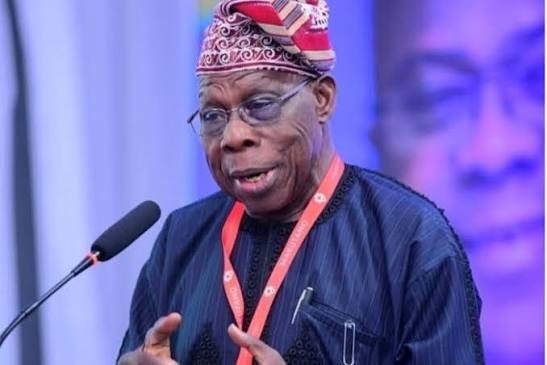
Former President Olusegun Obasanjo has refuted claims made by former Ogun State Governor, Aremo Olusegun Osoba, asserting that he never deceived or misled leaders of the Alliance for Democracy (AD) during the political realignments leading up to the 2003 general elections.
Speaking to journalists in Abeokuta, Ogun State on Thursday, the former Nigerian president insisted that his political dealings ahead of the historic 2003 polls were conducted without bad faith or deceit, pushing back against long-standing accusations from South-West opposition figures.
Former Ogun Governor Olusegun Osoba had maintained that Southwest AD governors entered an informal arrangement with Obasanjo in 2003 to support his presidential bid in exchange for non-interference in the state-level governorship elections.
Rejecting the allegation, Obasanjo stated that he operated transparently and did not strike any deal designed to trick the AD governors out of power.
The Peoples Democratic Party (PDP), under Obasanjo, went on to sweep five of the six South-West states in 2003 Ogun, Ondo, Oyo, Osun, and Ekiti leaving Lagos as the sole AD stronghold under then-Governor Bola Ahmed Tinubu.
”I neither misled anyone nor acted in bad faith,” Obasanjo emphasized, addressing claims that he orchestrated a betrayal against the Yoruba political leadership to gain a second presidential term.
The dispute stems from the 2003 general elections, when the AD leadership agreed to endorse Obasanjo, a fellow South-Westerner for the presidency without fielding a candidate against him. However, during the gubernatorial elections, the PDP swept the region, taking control of five southwestern states and unseating incumbents including Osoba in Ogun State.
While Osoba and other AD stalwarts have repeatedly characterized the outcome as the result of political deceit and broken promises, Obasanjo maintained that the electoral sweep was simply a reflection of the voters’ choice at the polls.