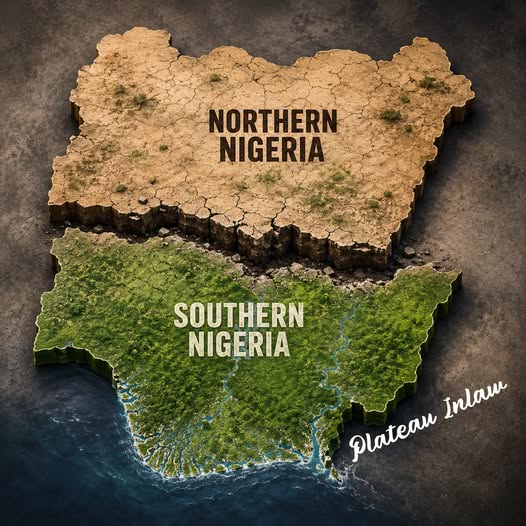
Every few months the conversation resurfaces. Divide Nigeria. Let the North go. Let the South go. Everyone will be better off.
I have one question for those making that argument — especially from the Northern side:
Have you done the mathematics?
Because we have. And the numbers are devastating.
THE NORTH CANNOT FEED ITSELF
The food that feeds Northern Nigeria does not come from Sokoto or Zamfara. It comes from the Middle Belt — Plateau, Benue, Taraba, Nassarawa. And the Middle Belt is predominantly Christian and indigenous. It is not “the North.” It is a contested, bleeding region that has been fighting northern political dominance for decades.
A divided North — cut off from the Middle Belt food basket — faces immediate food security collapse.
Hunger. Within years. Not decades. Years.
THE NORTH HAS NO PORT
Every landlocked nation on earth struggles. A divided Northern Nigeria would be entirely landlocked — cut off from Lagos, Port Harcourt, and Calabar.
Every import. Every export. Every container of goods entering or leaving — gone.
The North would be entirely dependent on Niger, Chad, Cameroon, and Benin Republic for access to global trade.
Those are among the poorest countries on earth.
Welcome to your new economic reality.
THE OIL STAYS IN THE SOUTH
This one is simple. Nigeria’s oil is in the Niger Delta. Solidly, entirely, geographically in the South.
The North currently receives a disproportionate share of federal allocation — funded almost entirely by Southern oil revenue.
Kaduna, Kano, Sokoto, and Zamfara generate some of the lowest internally generated revenue figures of any states in Nigeria. They survive on federal transfers. Federal transfers survive on oil. Oil stays in the South.
Division ends that revenue stream. Overnight.
THE ISLAMIC DIVISIONS WILL TEAR THE NORTH APART
And here is the argument that pro-division voices in the North never want to answer:
Which North? Whose North? Whose Islam?
The North is not one thing. It is not even two things. It is a collection of deeply competing religious and ethnic factions that the federal structure — imperfect as it is — currently holds in fragile tension.
The moment that federal referee disappears — the fight begins.
Tijaniyya vs Qadiriyya — two Sufi brotherhoods with centuries of bitter rivalry across the North.
Izala movement vs traditional Sufi orders — a conflict that has already produced mosque burnings, deaths, and community fractures across multiple northern states.
Shia Muslims — thousands of whose members were massacred at Zaria in 2015 by the Nigerian Army. The Islamic Movement of Nigeria has millions of followers who are deeply alienated from the Sunni establishment.
Boko Haram and ISWAP — who consider every other Muslim in the North — Sufi, Izala, moderate, secular — an apostate worthy of death. They are not going away. Division gives them a weaker state to fight.
Moderate Muslims — who want secular governance, reject Sharia criminal law, and are tired of being governed by religious politics they never chose.
And then there is the Sharia question itself. Even among the 12 states that adopted Sharia in 1999 — there is no consensus on what Sharia means, how far it goes, or who enforces it. Zamfara adopted Sharia and descended into banditry so catastrophic that its own government lost control of entire territories. Kaduna has a massive Christian population in its south that categorically rejects Sharia imposition.
A divided Northern nation built on Sharia immediately faces the question:
Whose Sharia? The Tijaniyya version? The Izala version? The Shia version? The Boko Haram version?
They have been killing each other over that question for decades. Division removes the federal referee and lets that war run freely — with no one to stop it.
THE MIDDLE BELT WILL NOT GO WITH THE NORTH
This is the detail that collapses every northern division fantasy completely.
The Berom, Anaguta, Afizere, Tarok, Ngas, Irigwe, Tiv, Idoma, Igala, Mwaghavul, Goemai — the indigenous Christian peoples of the Middle Belt — have been fighting for their survival against northern political dominance for decades. Their communities have been attacked. Their farmers have been killed. Their lands have been encroached upon.
Why would they — in the event of division — choose to join the very political structure they have been resisting with their blood?
They would not. And without the Middle Belt — the North loses its food, loses its geographic buffer, and loses millions of its most productive citizens.
WHAT HISTORY TELLS US ABOUT DIVISION
South Sudan became the world’s newest nation in 2011 — after decades of war with Muslim northern Sudan. Within two years it descended into catastrophic civil war. It remains today one of the poorest, most violent, most unstable nations on earth.
Division did not bring peace. It brought new wars — between the same people who had united to fight for independence.
Nigeria’s factions are far more numerous and far more complex than South Sudan’s. The post-division conflict in a broken Nigeria would make South Sudan look manageable.
THE TRUTH THAT NORTHERN POLITICIANS KNOW BUT WILL NOT SAY:
The North needs Nigeria more than Nigeria needs the North.
That is not an insult. It is arithmetic. It is geography. It is economic reality. Every honest northern economist, every credible northern intellectual, every northern leader who has actually studied the numbers — knows this privately. Politics just prevents saying it publicly.
SO WHAT IS THE SOLUTION?
Not division. Division creates new catastrophes while solving none of the existing ones.
The solution is true federalism.
Genuine devolution of power to states and local governments
Resource control for oil and mineral producing states and communities
An end to federal character as a substitute for merit and competence
A secular constitutional order that protects every Nigerian — Christian, Muslim, traditionalist — equally
Investment in education, healthcare, and economic opportunity in the North — starting with dismantling the Almajiri pipeline that feeds terrorism
Justice for Middle Belt indigenous communities whose lands and lives have been sacrificed on the altar of federal negligence
Nigeria’s problem is not that it is together.
Nigeria’s problem is how it is together.
That is a governance problem. Not a geography problem.
And governance problems are solved by accountability — not amputation.
Nigeria can work. But not like this. And not by running away from the hard questions.