By Enyinnaya Appolos
Ekeoha Shopping Centre in Aba is not just another marketplace, it is the heartbeat of Nigeria’s textile trade and the pride of Abia State’s commercial landscape. Every day, thousands of traders and buyers from across Nigeria and other African countries converge there to buy and sell, making it a major economic hub and one of the busiest commercial environments in West Africa.
When the Abia State Government under Governor Alex Otti announced plans to remodel the Ekeoha Shopping Centre, expectations were high, not merely because it was the first major infrastructure project the administration initiated from foundation since assuming office in 2023, but because the Aba business community looked forward to another remodeled major market in the commercial city, following the successful reconstruction of the A-Line section of the Ariaria International Market by the immediate past administration of Dr. Okezie Ikpeazu, the 4th Governor of the state.
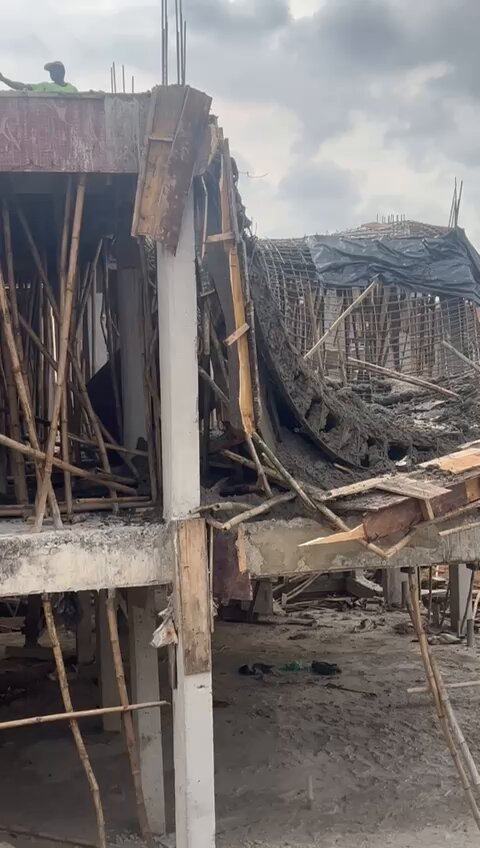
However, those hopes were abruptly dashed when the structure, still under construction, collapsed yesterday, raising disturbing questions about competence, supervision, transparency, and accountability.
The contractor handling the remodeling, Rhino Homes and Properties Limited, is a private company incorporated in November 2010, with its head office at No. 6 Badore Road, Ajah-Lekki, Lagos. However, there is no verifiable record showing that Rhino Homes has ever handled any large-scale public or structural engineering project of this magnitude, certainly not one as complex and sensitive as a multi-storey market hub designed to accommodate thousands of traders.
Governor Otti flagged off the project on August 9, 2024, amid fanfare. Yet, the cost of the project remains undisclosed, a red flag for a public project of this scale. What is publicly known, however, is that the state government, through Rhino Homes, is collecting ₦10 million upfront per shop from traders. This raises critical concerns:
• Under what legal framework is a private company allowed to collect such funds on behalf of the state?
• What form of contract or concession agreement exists between the government and Rhino Homes?
• Were traders issued verifiable receipts tied to a government account, or were payments made directly to the contractor?
This tragedy now marks the first government building project in Abia State’s history to collapse during construction. Such an incident is not just unprecedented, it is unacceptable. It exposes possible failures in supervision, due diligence, and project execution.
The incident raises urgent and uncomfortable questions:
• Who was in charge of project supervision and quality assurance?
• Were structural integrity and soil tests carried out before construction began?
• Was there a resident government engineer or independent consultant assigned to monitor compliance with approved standards?
• Why was a relatively obscure company with no proven large-scale construction record entrusted with such a sensitive project?
• Who recommended Rhino Homes, and what criteria were used in the selection process?
The market, which is designed to be a three-floor shopping complex upon completion, collapsed while construction of the second floor was still ongoing. This points to the alleged use of substandard materials, inadequate supervision, and rushed construction timelines, all suggesting negligence on the part of the government and incompetence on the part of the contractor.
For a government that came to power on the promise of transparency, efficiency, and a “New Abia,” this incident is deeply embarrassing. The collapse is more than a structural failure, it is a failure of governance, oversight, and responsibility. It exposes the dangers of awarding public-interest projects without strict due diligence or transparent procurement processes.
Abians deserve clear and honest answers. The traders whose hard-earned money was collected deserve justice. And the families of those who might have been injured or psychologically affected deserve empathy and truth.
Governor Otti’s administration must now come clean:
• Who approved the contractor?
• What due diligence was conducted before the contract was awarded?
• What technical evaluation report supported Rhino Homes’ capacity to handle such a project?
• Were there political or personal interests influencing the award?
• And most importantly, who will be held accountable for this avoidable disaster?
The collapse of the Ekeoha Shopping Centre is not just a tragic event, it is a litmus test for the Otti administration’s integrity, transparency, and commitment to good governance. Abians and indeed Nigerians are watching to see whether this will be swept under the carpet or investigated thoroughly, with sanctions for all those found culpable.
Until these questions are credibly answered, the Ekeoha Shopping Centre disaster will remain a painful symbol of government negligence, failed oversight, and misplaced trust, a stark reminder that public safety must never be sacrificed on the altar of political expediency, private greed, or administrative complacency.
This is not just a collapsed building; it is a collapse of accountability.