There is a recurring truth in the history of war: conflict changes when the children of those who declare it are forced to fight it. War is easiest to wage at a distance. When decisions are made in marble halls and consequences are absorbed by nameless others, violence becomes abstract—numbers, maps, strategies.
But when the sons of kings stand on the battlefield, war loses its abstraction. It becomes personal, fragile, and unbearable. Homer understood this. In The Iliad, the war between the Greeks and the Trojans is not merely a clash of armies; it is a tragedy of families.
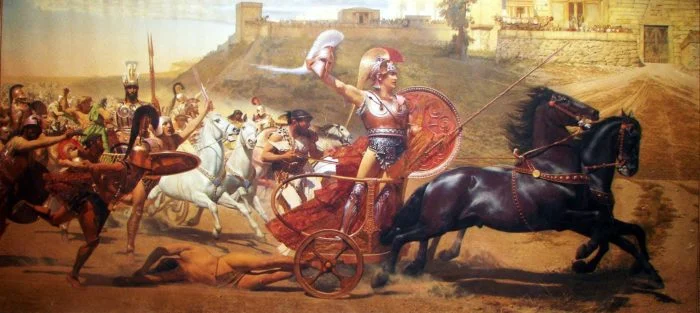
Achilles and Hector are not anonymous soldiers—they are the best of their people, heirs of legacies, carriers of futures. Their duel is not only about victory but about the extinction of what comes next. Hector fights knowing what awaits Troy if he falls. He is a son, a husband, a father. Achilles fights knowing that glory will cost him his life.
Both are trapped in a logic older than politics: honor demands sacrifice, even when the price is unbearable. Yet the most shattering moment does not happen on the battlefield. It happens when King Priam, Hector’s father, enters the enemy camp. The old king kneels before Achilles—the man who killed his son. He bows, kisses his hands, and begs for Hector’s body. In that moment, power collapses. Priam is no longer a ruler; Achilles is no longer a warrior.
They are simply a father who has lost his child and a son who knows he will die young. Homer is showing us something radical: When leaders feel the cost of war in their own blood, the logic of endless violence breaks down. Achilles weeps. Priam weeps. Even war pauses. Throughout history, this pattern repeats. Wars escalate when elites are insulated.
They slow—or end—when loss becomes personal. When the sons of nobility, presidents, kings, or generals share the same risks as everyone else, war is no longer a tool; it becomes a tragedy. This is why societies once demanded that rulers lead from the front. Not because it made them better tacticians, but because it made them humanly accountable.
Modern warfare often reverses this logic. Distance is 2maximized. Risk is outsourced. Decisions are made by those whose children will never see the front line. And so war persists—not because it is necessary, but because it is survivable for the decision-makers. Homer’s lesson is not about heroism alone. It is about responsibility.
A war led by those who have nothing to lose becomes endless. A war that endangers the children of its architects becomes cautious—or does not begin at all. Priam kneeling before Achilles is not weakness. It is the final truth of power: No throne is higher than a grieving father. And no war remains noble once it demands that sacrifice.