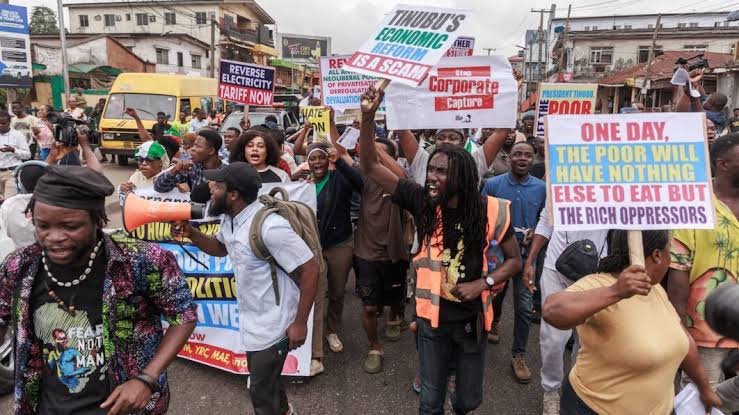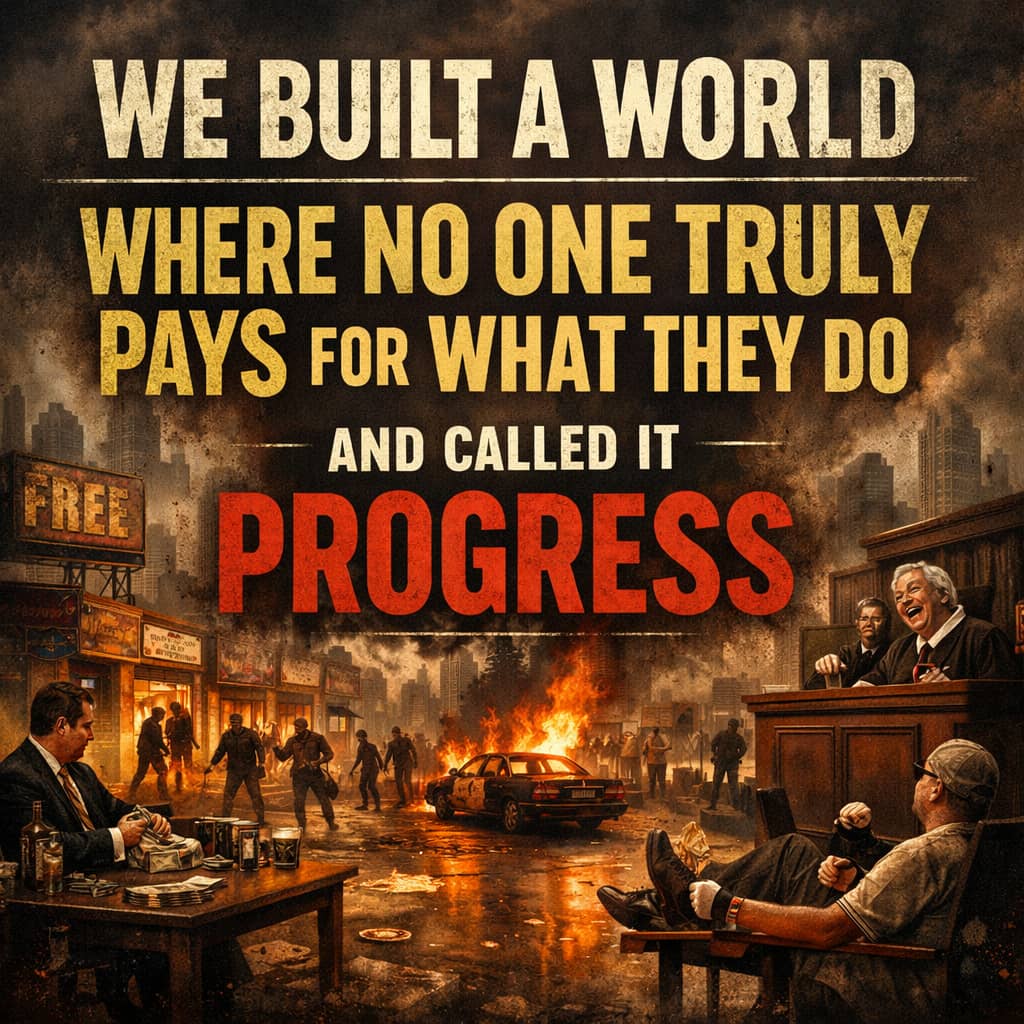
Civilization did not collapse because people forgot the rules. It began to wobble the moment consequences became negotiable.
By Charles Obiajulu Ugwu- PhD
There was a time long before treaties, traffic lights, compliance manuals, or courts of appeal when consequence was not an abstraction but a lived tutor. You did not debate it, litigate it, or outsource it. You met it. Quickly. Often painfully. And because it arrived without intermediaries, it taught. It shaped restraint not as virtue-signaling but as survival intelligence. You learned not because you were told, but because reality answered back.
This was the original deterrence. Not fear of punishment, but intimacy with outcome. Cause and effect lived close to each other, like neighbors who could not avoid eye contact.
A fisherman who took too much fish did not need a regulation; hunger arrived next season. A trader who cheated did not require a consumer protection agency; word traveled faster than contracts. A leader who abused trust did not retire to a gated estate; exile or revolt followed. These were not moral fantasies. They were crude, unforgiving feedback systems. But they worked. They trained foresight.
Modern humanity congratulates itself for transcending that world. In truth, it escaped it. And in escaping it, it severed itself from the very tutor that made self-restraint possible.
Today we know more than any generation before us about consequence. We have models, projections, simulations, and data dashboards that map the future with terrifying clarity. We know what carbon does to the climate, what debt does to economies, what corruption does to institutions, what unchecked power does to societies. Ignorance is not the problem. It is proximity. Consequences no longer sit where decisions are made.
Consider the oil executive approving a project that will pollute a delta he will never visit, drinking water shipped in glass bottles while communities downstream drink poison. Or the policymaker whose austerity decisions collapse hospitals and schools, but who flies home to insulated neighborhoods with private security and foreign healthcare. Or the banker whose algorithm destabilizes entire economies while losses are absorbed by taxpayers he will never meet. These are not accidents. They are architectures of consequence displacement.
Once consequences stop landing on their authors, morality weakens. Not because humans are evil, but because restraint is a function of feedback. We are disciplined by what we feel, not merely by what we know. When harm becomes abstract, delayed, or externalized, it loses its regulatory force. Desire outruns judgment. Appetite detaches from cost.
This is the quiet engine behind many of our modern pathologies. Climate paralysis is not a failure of awareness; it is a failure of consequence alignment. Those most responsible often suffer least. Those who will suffer most had the least say. So action stalls. Everyone waits for someone else to pay.
Financial crises follow the same script. In the lead-up to the 2008 collapse, risk was not misunderstood. It was deliberately mispriced. Profits were privatized; consequences were socialized. When the system imploded, bonuses were protected, institutions rescued, and ordinary lives shattered. The lesson learned was not humility, but impunity. And so the cycle repeats, with thicker rulebooks and thinner accountability.
Faced with this erosion of self-restraint, societies responded not by restoring consequence, but by inventing force. We layered regulation upon regulation, surveillance upon surveillance, enforcement upon enforcement. We built entire industries around monitoring behavior we no longer trust people to regulate internally. Compliance replaced conscience. Checklists replaced judgment.
This expansion of control is often sold as progress. It is more accurately a confession. Every new protocol is an admission that something upstream has failed. That foresight is weak. That responsibility is fragmented. That trust has collapsed.
And yet, despite the explosion of rules, misconduct has not disappeared. It has become more sophisticated. People no longer ask, “Is this right?” They ask, “Is this allowed?” Or worse, “Can I get away with it?” The moral imagination shrinks to the size of the loophole.
The cost of this shift is staggering. Economically, we spend trillions managing fallouts in the forms of; litigation, enforcement, remediation, insurance, auditing money that produces no real value, only damage control. Morally, we raise generations fluent in compliance but illiterate in consequence. Cognitively, we hollow out agency. People stop thinking systemically. They follow instructions.
One sees this clearly in organizations. In high-trust teams, very few rules are needed. Reputation does the heavy lifting. In low-trust institutions, rules multiply endlessly, yet violations persist. The difference is not intelligence; it is consequence proximity. Where actions reliably affect standing, opportunity, and belonging, behavior regulates itself. Where consequences are diluted by hierarchy, bureaucracy, or power, misconduct flourishes.
Even at the individual level, the pattern holds. People manage what they feel accountable for. A parent needs no policy to protect a child. A craftsperson needs no manual to guard their reputation. A community that sees itself as interdependent polices itself informally. The moment anonymity, scale, or insulation enters, restraint weakens.
This is why the modern obsession with punishment misses the point. Punishment is a crude substitute for consequence-awareness. It arrives late, often unevenly, and rarely teaches wisdom. It teaches avoidance. People learn how not to be caught, not how to be responsible.
A truly mature society would invest less in punishment and more in perception. It would design systems where consequences are visible, timely, and unavoidable. Where power carries proportionate risk. Where decisions cannot be divorced from their effects. Where feedback loops are short enough to teach.
Imagine an economy where executives’ compensation is tied not just to quarterly profits but to long-term ecological and social outcomes they cannot evade. Imagine political systems where policy architects remain exposed to the consequences of their decisions rather than retiring into protected obscurity. Imagine education that trains young people to think in second- and third-order effects, not merely in personal gain.
These are not utopian fantasies. They are design choices. Consequence can be restored if we stop treating it as an afterthought and start treating it as an operating constraint, like gravity. Engineers do not resent gravity; they respect it. They build with it. Societies must do the same with consequence.
To live a consequenced life is not to live timidly. It is to live intelligently. It means optimizing desire within reality rather than fantasy. It means recognizing that freedom without consequence-awareness is not freedom, but deferred chaos. It means asking, habitually and honestly: who pays for this, when, and how?
We avoid these questions because they are inconvenient. They slow us down. They puncture comforting narratives of innocence. But the alternative is far more costly. A civilization that refuses to internalize consequence will attempt to regulate its way out of disaster. It will fail. No amount of force can substitute for foresight at scale.
We are now entering a period where the margin for error is thin. Technologies amplify impact. Ecological limits harden. Interdependence means local actions produce global effects. In such a world, consequence blindness is not merely immoral; it is suicidal.
The future will belong not to societies with the most laws, but to those with the deepest internal restraints. Not to those who manage consequences best after the fact, but to those who prevent catastrophe by design. The most advanced civilization is not the one that punishes most efficiently, but the one that needs punishment least.
Consequence did not fail humanity. Humanity demoted it. Reinstating it will demand something we have avoided: moral courage, institutional honesty, and a willingness to collapse the distance between action and outcome. But if we fail to do so, we will continue building ever more elaborate cages to contain behavior we never taught ourselves to master.
And history will not be gentle in its judgment. Consequence, unlike us, always keeps its appointments.
About the Author
Dr. Charles Obiajulu Ugwu is a contrarian thinker, adaptability thought leader, and regenerative systems expert.