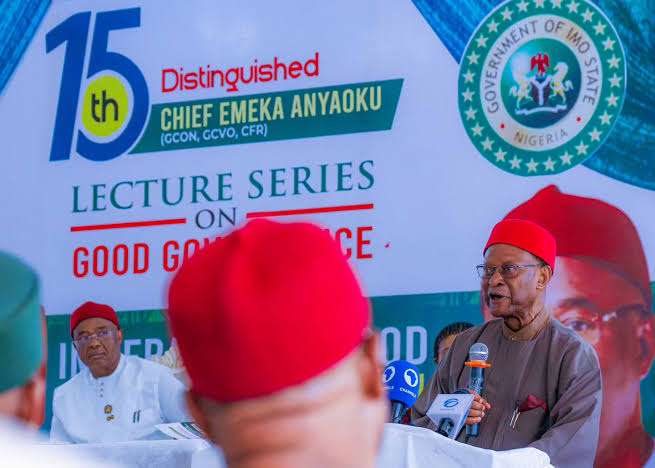
The 15th Chief Emeka Anyaoku Lecture Series, held at Rockview Hotels, Owerri, featured several distinguished speakers who delivered well-crafted presentations, resulting in a divergence of opinions on national issues.
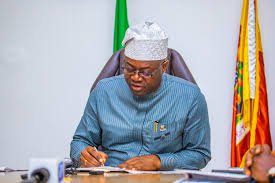
The Imo State Governor, Senator Hope Uzodimma, while commending former Commonwealth Secretary-General, Chief Emeka Anyaoku, described him as “a symbol of integrity, courage, and visionary leadership.” He drew parallels between Anyaoku’s enduring legacy and what he termed the ideals underpinning President Bola Ahmed Tinubu’s current economic reforms.
Uzodimma compared the leadership qualities of both Anyaoku and Tinubu—particularly courage, transparency, and accountability—highlighting Anyaoku’s exemplary diplomatic career. He noted that Tinubu is demonstrating similar traits through his ongoing economic policies.
“The decisions we make now will determine what kind of country we leave to the next generation. Fortunately, President Asiwaju Bola Ahmed Tinubu has shown the courage to make those hard decisions now to secure the future of Nigeria,” Uzodimma said.
The governor also referenced Nigeria’s suspension from the Commonwealth in 1995 during Anyaoku’s tenure as Secretary-General, following the aftermath of the June 12, 1993 presidential election and the execution of Ken Saro-Wiwa and the Ogoni Nine.
“That decision underscored your unwavering commitment to democratic values, even when it meant confronting your own country,” he added.
Uzodimma further argued that both Anyaoku’s leadership and Tinubu’s policies reflect character, capacity, and discipline. As Chairman of the Progressives Governors Forum, he stated that Tinubu inherited an economy plagued by dwindling foreign reserves, rising inflation, and the burden of fuel subsidies. He, however, praised the president for pursuing structural reforms rather than temporary fixes.
“Tinubu chose to confront these challenges head-on. He chose structural reforms over cosmetic patches. He chose to rebuild Nigeria’s foundations rather than postpone the day of reckoning,” he said.
In sharp contrast, Chief Jim Nwobodo, former governor of old Anambra State and chairman of the occasion, refrained from commenting on the Federal Government or President Tinubu. Instead, he described the lecture series as “a mirror held up to the nation and a call for reflection, renewal, and action.”
ADVERTISEMENT
Unlike Uzodimma, who attributed Nigeria’s current challenges to previous administrations, Nwobodo emphasized that the country’s situation is largely the result of leadership choices over time. He urged public officials to prioritize national interest above personal gain.
“Good governance is not a slogan but the architecture of national progress,” he stated.
In his remarks, Chief Emeka Anyaoku explained that the lecture series, established by Youth Affairs International, aims to inspire young people and promote national growth and development.
Delivering the keynote address, Professor Kate Azuka Omenugha, Vice-Chancellor of Chukwuemeka Odimegwu Ojukwu University, focused on the role of citizens in promoting accountability and national progress, offering a different perspective from the other speakers. She emphasized that the family remains the foundation of good governance.
“If we are raised with the right values, we are likely to carry them into the larger society. Nations do not rise merely because of responsible leaders; they rise because of responsible citizens who model what they demand,” she said.
The event attracted a wide range of participants from academia, business, politics, industry, sports, diplomacy, and journalism.