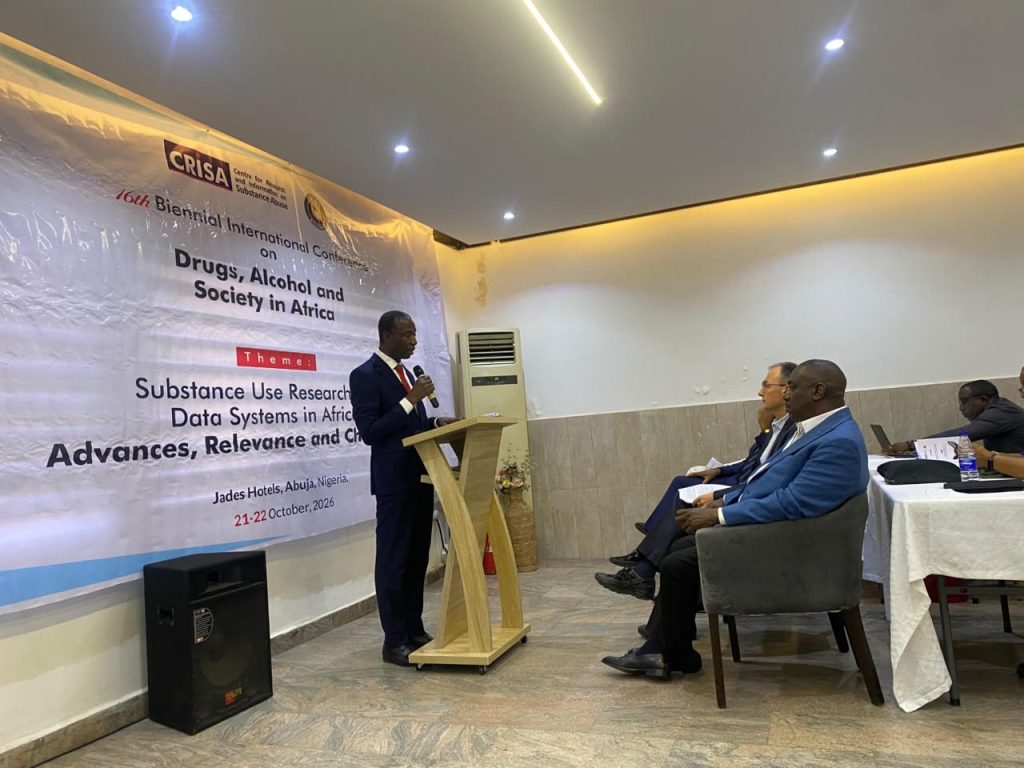
The United Nations Office on Drugs and Crime (UNODC) has issued a stark warning to African nations, urging governments across the continent to bridge the widening disconnect between scientific research on substance use and state-level policy decisions.
Speaking on October 21, 2026, during a high-level briefing in Abuja, Nigeria, UNODC representative Dr. Oliver Akanidomo cautioned that failing to align policy with empirical research carries severe human, social, and public health consequences.
Dr. Akanidomo underscored that the continent possesses ample academic talent and research capacity, yet policy formulation remains routinely isolated from data.
”Africa does not lack researchers. We do not lack expertise. We do not lack institutions capable of generating knowledge,” Akanidomo said. “What we must continue to confront is the gap between the evidence we generate and the decisions we make—and that gap has consequences.”
He highlighted that while regional institutions continue to produce detailed insights into substance consumption patterns, national strategies often rely on outdated, strictly punitive frameworks rather than evidence-based interventions.
The briefing also featured contributions from representatives of the Economic Community of West African States (ECOWAS) Commission. Speakers emphasized that effective drug strategies must strike a delicate balance between supply reduction and public health priorities.
Dr. Akanidomo noted that the ECOWAS Commission explicitly recognizes the necessity of addressing both illicit drug trafficking and the health and social ramifications of substance abuse.
Sub-Saharan Africa faces an escalating threat from drug mixtures and synthetic substances, such as “kush,” “kadhafi,” and “nyaope” which frequently contain potent synthetic opioids like nitazenes.
Demographic surveys indicate that young people bear the heaviest burden, with over one-third of individuals receiving drug treatment in Africa being under 25 years of age.
Despite rising addiction rates, access to evidence-based healthcare and rehabilitation facilities remains critically low across the region, with fewer than 1 in 10 individuals receiving necessary care.
The UNODC urged African governments to institutionalise formal mechanism channels linking national researchers, health authorities, and law enforcement agencies to ensure future drug policies reflect scientific reality rather than conjecture.