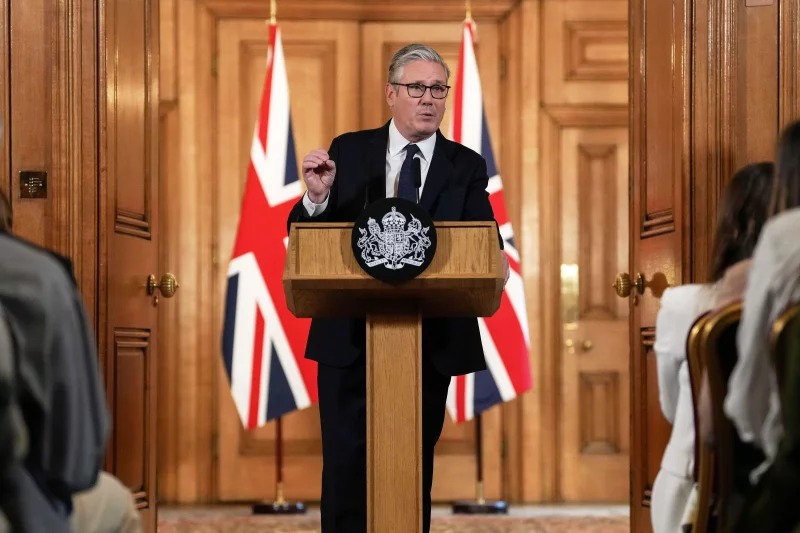
British Prime Minister Keir Starmer has announced plans for a sweeping ban on social media use by children under the age of 16, arguing that online platforms are contributing to poor mental health among young people and exposing them to harmful content.
The proposed measure, which would represent one of the most far-reaching internet safety policies in Europe, was unveiled by Starmer on Monday as part of a broader government effort to protect children from the growing influence of social media and other digital services.
Speaking about the planned legislation, the prime minister said the government had concluded that stronger action was necessary to shield children from the dangers associated with excessive social media use.
According to Starmer, social media platforms are increasingly affecting the well-being of young users, many of whom are being exposed to content that is inappropriate, harmful and deliberately engineered to keep them engaged for long periods.
“The government will ban access to social media for all children under the age of 16,” Starmer declared.
He argued that many of the platforms currently used by teenagers are “making children unhappy,” while exposing them to material that can negatively influence their mental health, self-esteem and overall development.
The British leader also accused social media companies of designing their services in ways that encourage addictive behaviour, making it difficult for young users to disconnect from their screens.
Under the proposed regulations, children below the age of 16 would be prohibited from accessing some of the world’s most popular social media platforms, including Snapchat, TikTok, YouTube, Instagram, Facebook and X.
However, the government clarified that messaging services such as WhatsApp would not be covered by the ban, as they are primarily used for communication rather than social media engagement.
Officials said the proposed law is expected to be introduced before Parliament later this year, with the government hoping to secure its passage by late December.
If approved, the ban would come into effect during the spring of next year, giving regulators and technology companies time to implement age-verification systems and compliance measures.
The announcement signals a significant escalation in the United Kingdom’s efforts to regulate the digital environment for children and teenagers.
Beyond social media, Starmer indicated that the government intends to widen its focus to other online services that are increasingly popular among young people.
He revealed that ministers are preparing what he described as “world-leading action” targeting gaming platforms and live-streaming services, sectors that have also come under scrutiny over concerns relating to addiction, cyberbullying, harmful content and excessive screen time.
In a statement released after the announcement, the government said it is examining additional safeguards for young internet users.
Among the measures being considered are overnight curfews that could restrict access to certain online services during late-night hours, as well as mandatory breaks in features such as infinite scrolling, which allows users to consume content continuously without natural stopping points.
The government indicated that further details regarding these proposals would be unveiled in July following consultations with technology companies, child safety experts, educators and parents.
The planned reforms reflect growing concerns among policymakers, health professionals and child advocacy groups about the impact of social media on children’s mental and emotional well-being.
Several studies in recent years have linked excessive social media use to increased levels of anxiety, depression, sleep deprivation, cyberbullying and body image concerns among teenagers.
Campaigners have long argued that technology companies have not done enough to protect young users, despite repeated promises to improve online safety standards.
Supporters of stricter regulation believe governments must intervene to establish stronger safeguards, particularly as digital platforms continue to play a central role in the lives of children and adolescents.
The British government’s decision appears to have been influenced significantly by developments in Australia, which became the first country in the world to introduce a nationwide ban on social media access for children under 16.
Australia’s landmark legislation, adopted in December, attracted global attention and sparked debates about the balance between child protection, digital rights and parental responsibility.
Starmer acknowledged that Australia’s experience helped shape the UK’s approach, suggesting that the British government had closely monitored the implementation of the Australian model before deciding to pursue similar measures.
The proposed ban is expected to generate considerable debate across the country.
While many parents and child welfare organisations have welcomed tougher regulation, critics are likely to raise concerns about enforcement challenges, privacy implications and the practicality of verifying users’ ages without collecting extensive personal information.
Technology companies may also face pressure to redesign their platforms and invest heavily in age-verification systems to comply with the new rules.
Digital rights advocates have argued that any restrictions must be carefully crafted to avoid limiting young people’s access to educational resources, social support networks and opportunities for online participation.
Despite the expected controversy, Starmer signalled that his government remains determined to proceed with the legislation, describing child protection as a national priority.
The announcement marks one of the most ambitious attempts yet by a major Western government to reshape the online experience for young people and could influence similar policy discussions in other countries.
If enacted, the ban would place the United Kingdom among a growing number of nations seeking tougher oversight of social media companies and stronger protections for children navigating an increasingly digital world.