By Etim Etim
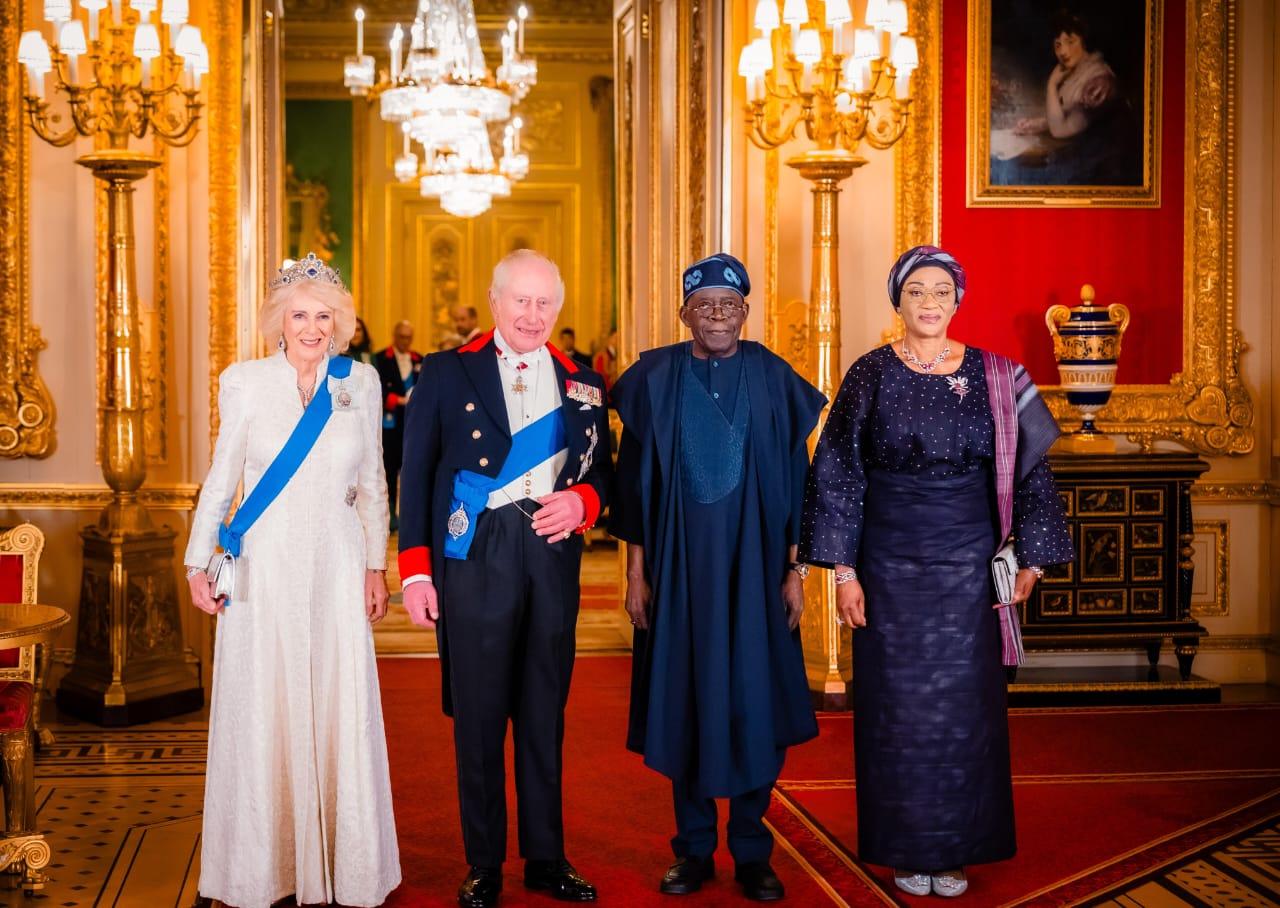
Undoubtedly, Nigeria had a beautiful outing at the world stage this week during President Tinubu’s two-day state visit to the UK. He arrived Tuesday evening and left Thursday afternoon, after participating in three major events, including attending an art exhibition. During that time, Zenith Bank formally opened a branch in Manchester, the second in the UK, further positioning Nigeria as the powerhouse of Africa’s financial services sector. The pomp and panoply of British royal ceremonies are always beautiful to watch.
As they say, no country does events like the UK. I congratulate the President on such a successful visit. But what has Nigeria really benefitted from it? Diplomatically, it is good for our country to be so well received by a G7 and a leading OECD country. Opening with Yoruba words for welcome; and spiced with some Nigerian proverbs and slangs, King Charles’ welcome speech at the luncheon was beautiful and elegantly delivered.
The President also read a well written speech that touched on the long relationships between the two countries. It was graceful poignant. The Nigerian delegation was made up of mostly government officials – governors, ministers and a sprinkling of business people. I was, however, surprised to see the Minister of Defence, Gen. Christopher Gwabin Musa (rtd) in the crowd in London. I had expected him to stay back home and perhaps travel to Maiduguri to coordinate the military’s response to the terrorist attacks that occurred in that city the morning the president left the country.
Even if the minister had already left town in advance team by the time the terrorists struck, he ought to have returned immediately. A twin suicide bombing in a vast metropolis requires the presence of the high command of our security forces and political leadership. And this is why Vice President Kashim Shettima’s quick trip to Maiduguri to comfort and console the people was quite helpful in the absence of the state governor.
Nigeria signed two main MOUs during Tinubu’s meeting with Prime Minister Keir Starmer. The first is a £746 million (approx. $902 million) deal to modernize the Lagos port complex (Apapa and Tin Can Island Port). The purpose is to upgrade infrastructure, enhance efficiency, reduce congestion and digitalize operations at the two ports – the nation’s busiest – which handle over 70% of the our exports and imports. The project is supported by the UK Export Finance (UKEF), with loans arranged by Citibank and guaranteed by the UK government. UKEF is the UK’s export credit agency that helps British companies win overseas contract by providing financial support and insurance.
Expectedly, the MOU specifies that British firms would be the sole beneficiaries in the supply chain, meaning that the main and sub-contractors in this project would have to be British firms. In fact, British Steel, a major steel producer in UK, would be the sole supplier of steel for the project. Contract value is £70 million. This loan is a good example of how the developed countries typically exploit Africa. They give you a loan or aid and you’re bound to import everything from that country, including the technicians that would work on the project. This is why Chinese technicians, steel and locomotives were brought in to build rail network funded with Chinese loans during the Buhari era. There was no provision to build the locomotives in-country or train Nigerian engineers. You borrow the money, pay huge interests on it and export jobs and business opportunities back to them!
Why were Nigerian banks not contacted to arrange funding for the ports upgrade? Our banks are present in many African countries where they provide funding for capital development. In 2013, a few Nigerian banks came together to provide over $3.3 billion to part-finance Dangote Refinery. In 2025, Nigerian banks participated in a $4 billion syndicated refinancing deal to the same company. They would have been glad to put up the £746 million and we would have had the liberty to choose the contractors and suppliers.
And this brings me to the important issue of port development in Nigeria. With the Tinubu administration’s plan to grow the economy to $1 trillion in 2031, Nigeria requires new ports outside Lagos. It is therefore critical that the federal government provide the needed support for Akwa Ibom State to build its deep seaport. With a natural draft of over 17 meters, Ibom Deep Sea Port is a significant investment in Nigeria’s maritime sector that would serve the Gulf of Guinea and the nation’s eastern states renowned for international trade. IDSP is designed to be a transshipment hub for West and Central Africa. With a berth depth of over 16 meters, land area of 2,565 hectares and additional 1,565 hectares for future expansion, quay length of 7.5 kilometers, the port would be suitable for handling large cargoes. Nigeria needs Ibom Deep Sea Port now, and President Tinubu is the right man to deliver it.
Another MOU signed by Nigeria during the President’s state visit will permit Britain to repatriate Nigerians who are staying illegally in Britain back to Nigeria, even if such persons do not have valid travel documents. The returnees would be issued what is known as ‘’UK Letters’’ which is essentially identification document given to individuals without valid passport so that the returnees will no longer have to wait for emergency travel documents before they could be deported. Over 2,000 Nigerians would be deported in the first batch under this scheme, according to one report. I really do not have any qualms about deportations of illegal migrants back to their country. On return to Nigeria, such persons should be mobilized and supported by their respective state government acquire skills with which they would be useful to themselves and society.
The Tinubu administration has signed over 30 MOUs with several countries including Benin Republic, Chad, Ghana and many other African countries. Outside Africa, we have signed MOUs with Brazil, Germany, the Netherlands, USA, UAE and many others. MOUs are not as binding as formal agreements. MOU, otherwise known as handshake deal, is just an understanding between parties, unlike an agreement which is a more formal, legally binding contract that spells out the terms and conditions of a deal. How far have we gone with all these MOUs? What have they brought to the table, as we say in the streets?