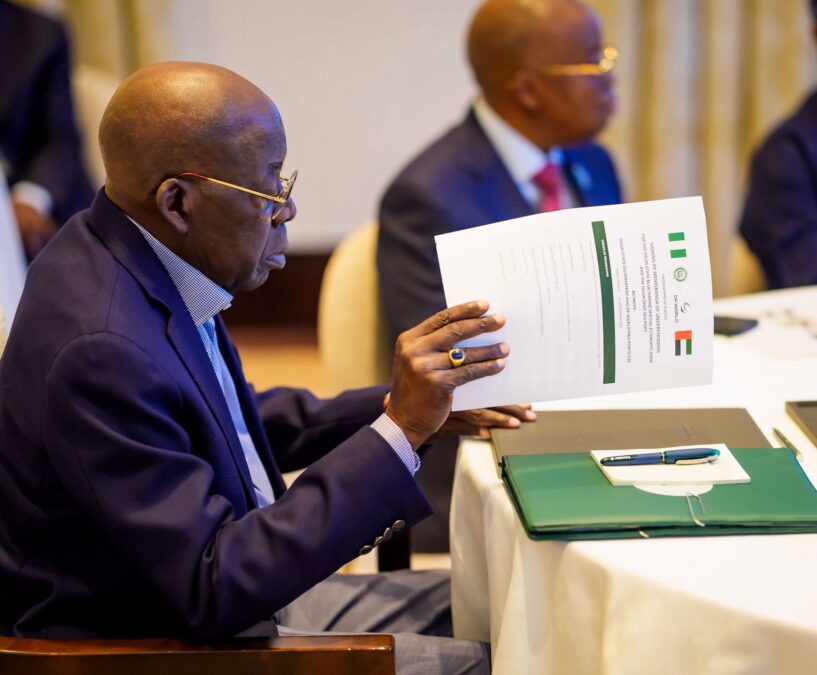
President Bola Ahmed Tinubu has defended his administration’s proposed $21.7 billion external borrowing plan, assuring Nigerians that the funds will be directed into critical national infrastructure to expand the country’s productive capacity and build long-term economic assets.
The President’s position was contained in a comprehensive policy paper titled “From Reforms to Delivery: Our Infrastructure Investment and Growth Strategy,” released on Thursday, October 29, 2026, in Abuja. The statement was formally made public and distributed to the media by the Special Adviser to the President on Information and Strategy, Bayo Onanuga.
The defense comes two days after President Tinubu formally transmitted a request to the National Assembly on Tuesday, October 27, 2026, seeking Senate approval for a supplementary 2026–2027 external borrowing plan comprising $20.52 billion and €1.045 billion, totaling approximately $21.7 billion.
Addressing lingering public concerns and criticisms from opposition figures regarding Nigeria’s debt profile, President Tinubu emphasized that responsible borrowing is measured by the value created rather than the size of the loan.
He stated that Nigeria cannot build a $1 trillion economy with infrastructure designed for an economy a fraction of that size, adding that the real question centers not on how much is borrowed, but on what is built, what value is created, and what future is left behind.
According to the administration’s blueprint, about $10.6 billion of the requested funding is earmarked for primary transport corridors and arterial roads across the country. Key projects targeted for acceleration include the Lagos-Calabar Coastal Highway and the Sokoto-Badagry Superhighway, both designed as vital coastal and trans-regional highways to link industrial zones directly to major trade gateways.
The funding framework also targets the Trans-Sahara Superhighway and the Kano-Kaduna Rail Line, which serve as essential transport routes linking the northern economic belt to regional markets. Furthermore, the plan covers the deepening modernisation of key commercial sea ports in Lagos alongside comprehensive upgrades to the national electricity grid to enhance power reliability for industrial sectors.
President Tinubu stressed that these strategic investments are designed to transform Nigeria’s economic geography rather than just construct physical roads, emphasizing that the administration is opening economic corridors, connecting markets, unlocking industries, and reshaping the country’s economic landscape.
Highlighting macro-economic indicators, the President noted that key structural reforms, including fuel subsidy removal and foreign exchange unification, have stabilized public finances. He pointed to a 4.43% GDP growth in Q2 2026, a decline in headline inflation to 14.63% in September, and external reserves standing at $55.1 billion as of October 9, 2026, as proof that the reforms are yielding results and lowering Nigeria’s country risk premium.
The Federal Government clarified through the Chairman of the Presidential Fiscal Policy and Tax Reform Committee, Taiwo Oyedele, that the $21.7 billion request represents a five-year financing framework rather than an immediate draw-down. Approximately $7.9 billion will come from multilateral and bilateral sources, led by a $5 billion World Bank facility, offering highly concessional social-sector interest rates averaging around 2% alongside commercial rates near 7.8%.
President Tinubu concluded by cautioning that accessing loans is merely a starting point, maintaining that securing financing is not the achievement, but rather completing the projects, delivering value, and improving the lives of Nigerians.