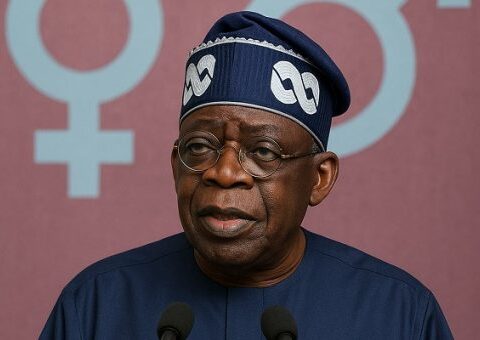
In a stirring call for national unity, Bola Ahmed Tinubu has urged Nigerians to take an active role in supporting security agencies, declaring that the fight against insecurity cannot be left to uniformed personnel alone. His message, delivered on Tuesday at the 2026 National Police Day Grand Parade in Abuja, underscored a growing recognition that sustainable peace requires a partnership between the government and its citizens.
Represented at the event by Vice President Kashim Shettima, the President spoke with urgency and conviction, addressing a nation that has in recent years grappled with rising security threats—from banditry and kidnapping to communal clashes and insurgency. Against the backdrop of a ceremonial parade meant to celebrate the resilience and sacrifices of the police force, the message carried a deeper significance: security is everyone’s business.
Standing before a gathering of top security officials, dignitaries, and officers of the Nigeria Police Force, Shettima conveyed the President’s belief that national safety must be built on trust, cooperation, and shared responsibility.
According to Tinubu, relying solely on law enforcement agencies, no matter how well-equipped or trained, is not enough to overcome the complexity of modern security challenges.
“The safety of a nation cannot be outsourced to uniforms alone,” the President declared through his deputy. “Every Nigerian has a role to play. Community leaders, traditional rulers, religious institutions, civil society groups, and the private sector must all become active partners in policing.”
The statement struck a chord with many observers, particularly in a country where mistrust between citizens and law enforcement has often hindered effective security operations. Tinubu acknowledged this gap, warning that suspicion and lack of cooperation between the public and security agencies could deepen the crisis rather than resolve it.
He stressed that intelligence gathering—one of the most critical tools in combating crime—depends heavily on community participation. Without credible information from citizens, security agencies are often left to operate in the dark, reacting to incidents rather than preventing them.
In many parts of Nigeria, local communities have already begun to demonstrate the power of collaboration.
Vigilante groups, neighborhood watch associations, and community policing initiatives have, in some cases, complemented the efforts of formal security agencies. However, these efforts remain uneven and, at times, uncoordinated.
Tinubu’s call seeks to bridge that gap by fostering a more structured and trusting relationship between citizens and the police. He emphasized that building this trust requires not just cooperation from the public, but also accountability and professionalism from security agencies.
Observers note that the success of such a strategy will depend largely on reforms within the police force itself. Issues such as corruption, abuse of power, and inadequate welfare for officers have historically undermined public confidence. Addressing these concerns, analysts argue, will be essential if the government hopes to win the trust it is calling for.
At the parade, the atmosphere was both celebratory and reflective. Officers marched in formation, showcasing discipline and readiness, while speeches highlighted both achievements and ongoing challenges. Yet beneath the pageantry lay a sobering reality: Nigeria’s security landscape remains fragile, and urgent, collective action is needed.
Tinubu’s message also extended to the private sector and civil society, urging them to invest in security initiatives, support technological advancements, and contribute to building safer communities. From surveillance systems to community outreach programs, the role of non-state actors, he noted, is increasingly vital.
As the event drew to a close, the President’s words lingered in the minds of many: a reminder that security is not merely a government function, but a shared duty. In a nation as diverse and complex as Nigeria, unity of purpose may well be the most powerful weapon against insecurity.
Whether this renewed call for collaboration will translate into tangible change remains to be seen. But for now, it sets the tone for a broader conversation—one that challenges every Nigerian to look beyond the expectation of protection and instead become an active participant in safeguarding the nation.