By Oluwasore Alabi
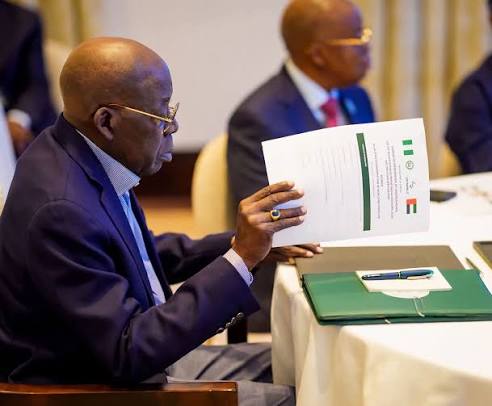
When a government asks to borrow more than $20 billion, the first question is usually what the money is for. The second, in Nigeria these days, is what happened to the last loan. On Tuesday, President Bola Tinubu sent the Senate a letter seeking approval for a supplementary external borrowing plan of $20,517,755,901 and €1,045,083,643, covering 2026 and 2027.
Senate President Godswill Akpabio read the letter at plenary and sent it to the Committee on Local and Foreign Debts, led by Senator Haruna Manu. The committee, working with the committees on appropriations and finance, has one week to report back. In the letter, the President said the funds would go to infrastructure and development projects in power, transportation, healthcare, education, agriculture, water supply, security, job creation and financial management reforms.
He said the projects were chosen after technical and economic evaluations, and he asked lawmakers for early approval to ensure “prompt implementation of our projects.” The borrowing, he argued, supports the wider reforms his administration has pursued and the need to accelerate growth in the economy. The request arrived alongside another.
A separate letter asked the House of Representatives to approve a Promissory Note Programme worth ₦269.44 billion, or another amount the National Assembly sets, to settle verified government liabilities. Secretary to the Government of the Federation George Akume urged the House to treat it urgently, pointing to the size and age of some of the debts and the risk that interest and costs will keep piling up.
The reaction was quick. The African Democratic Congress, in a statement by its Director of Media and Publicity, Kola Ologbondiyan, questioned why the government is seeking fresh foreign financing without, in the party’s words, giving a clear account of earlier borrowing. It called for the terms of the loans, the repayment arrangements and a report on how previous facilities were used.
Former Vice President Atiku Abubakar and the ADC have also raised the alarm over the request. In the Senate, Victor Umeh questioned the results of earlier approvals, and economists have pointed out that the lack of project-level detail makes it hard to tell which investments really need public money and which could attract private capital. Their point is not hypothetical.
The Senate has approved a string of requests in recent times, including a $7.8 billion and €100 million external borrowing plan, a $2.2 billion loan to finance budget deficits, a $1.5 billion World Bank loan, and a $6 billion plan approved in March. Each time, the government has said the money would fund roads, power, health and schools. Each time, critics have asked to see the receipts.
The timing adds to the sensitivity. The request comes only a few months before the 2027 elections, with the debate over the cost of the administration’s reforms still raging, and any large borrowing will be read through that lens. Supporters of the President will say the country needs infrastructure and that foreign loans are a standard way to build it. Opponents will say that repaying dollars and euros eventually falls on citizens who are already stretched.
For now, the decision sits with a Senate committee and a one-week deadline. How closely it examines the figures, and whether Nigerians get to see a project-by-project breakdown before the vote, will say a lot about how seriously Abuja takes the questions that follow it every time it borrows.