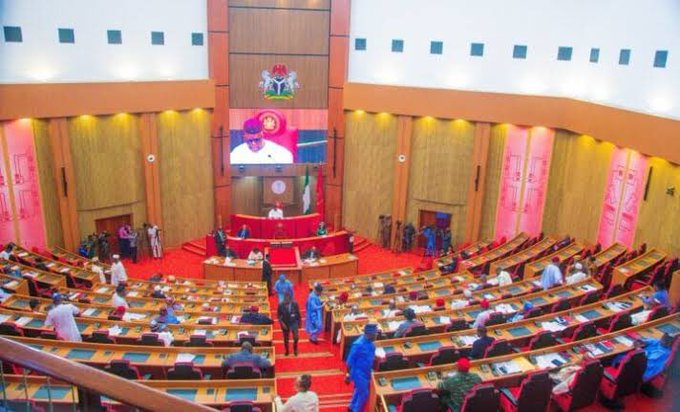
Reports, the other week, that the Senate, presided over by Senator Godswill Akpabio, has passed the long-awaited Electoral Bill and approved non mandatory electronic transmission of election results in real time, is tantamount to giving license for all manner of electoral frauds to be committed in the forth-coming 2026 general elections. It is like a death sentences on Nigeria’s electoral system.
Simply put, the bill spells doom for all the elections that wou ld end up in rancour and acrimony. Candidates would be imposed on the electorate by fraud, instead of the rightful winners. This scenario is the bane of Nigeria’s electoral system that has gained international opprobrium and by extension the cause of misrule, misgovernance, impurity, under-development.
The bill has taken Nigeria back more than five decades. The only way out is for the Senate to reverse itself and do the needful, which is to allow mandatory real time election transmission of election results from the voting centre.
The Senate, reportedly, rejected the proposal to make electronic transmission of election results mandatory, thereby sparking intense controversy and concerns about electoral transparency. The decision was made during the consideration of Electoral Act Amendment Bill 2026, with senators citing technical and logistical challenges, particularly, in areas with poor network connectivity.
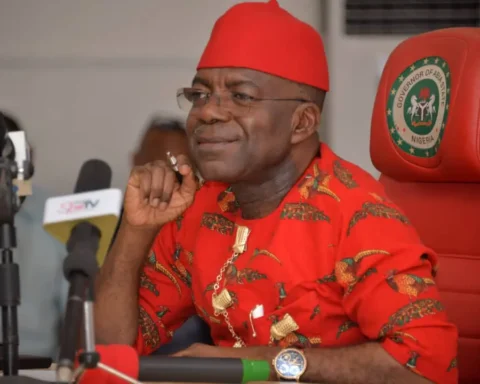
Speaking on the development, Senate president Godswill Akpabia said that the Senate did not reject electronic transmission entirely but rather retained the existing provision allowing the Independent National Electoral Commission (INEC), to determine the mode of result transmission. This decision clearly undermines transparency and reverses all the gains recorded in Nigeria’s electoral evolution in recent times.
The decision amounts to handing the country’s elections over to the INEC chairman to do as he likes – and the INEC chairman is appointed and controlled by President Bola Ahmed Tinubu. That is to say any election result that does not favors Tinubu would not be allowed.. In order words, Nigerians should simply hand the election over to President Tinuba and his acolytes to conduct and announce results.
The rejection has triggered strong and wide ranging reactions from opposition parties, civil society groups and citizens alike, who view the development as a grave setback for democratic process. Some people have warned that removing mandatory electronic transmission would reopen all the ills associated with elections and the electoral system that, for decades, have kept Nigeria on her knees.
Perhaps, the climax of the reactions was the mass protest that erupted at the National Assembly in Abuja, led by the former Labour Party presidential candidate Peter Obi, against the decision of the Senate to reject mandatory electronic transmission of election results. The protesters include civil society groups, students and opposition parties. They were demanding for transparency and credibility in the electoral process.
Obi emphasized the need for real time electronic transmission to prevent manipulation of election results. As a matter of fact, there ought to be a nationwide protest to resist the blatant betrayal of trust by the Senate, men and women put in the saddle to help re-direct a country moving towards the abyss. It is not that the Senate is ignorant of what the failed electoral process has done to Nigeria. They know but don’t care even if their decision would collapse Nigeria.
The buck of the betrayal stops on the desk of the Senate President Godswill Akpabio, who since he assumed office has always passed bills that favor Tinubu instead of Nigeria. The mounting foreign debt hanging on the neck of Nigeria came as a result of unbridled loan requests from Tinubu, which Akpabio caused to be approved without looking back.
The implications of the Senate’s decision against e-transmission of election results are enormous. To start with, there would be increased electoral irregularities since there is “License” for people to do what they like to meet a predetermined outcome. As Obasanjo would say, a culture of “anything goes”.
Without real-time electronic transmission of results, there would be no need going to vote. Nigerians should assume that result have already been written; thus going to vote is to give chance for INEC to announce the predetermined results. That amounts to selection instead of election.
The reasons given by the senate to reject e-transmission of result are watery. To say that poor connectivity is why election results cannot be transmitted is dishonesty considering the meticulous assessment made by the Federal Government in collaboration with INEC prior to the 2023 general elections.
It would be recalled that the idea to transmit election result electronically in real time came from INEC’s Professor Mahmoud Yakubu and not from President Buhari in the run up to the 2023 elections. Professor Yakubu, poised to conduct a hitch-free, transparent election, proposed the electronic transmission strategy. Records show that INEC under Professor Mahmoud spent approximately a whooping N313.4 billion out of the N355.2 billion approved by National Assembly. The sum of N177.3 billion was spent on Electoral Technology alone to ensure a hitch –free e-transmission of results. How come that barely three years following the 2023 elections, all the technological infrastructures put in place for the elections have disappeared and no longer available for the next election in 2026?
Besides, the assessment was not done by INEC alone. INEC collaborated with all the major network service providers including MTN, GLO, Airtel, and 9Mobile, to address the potential network challenges during the 2023 elections.The commission assured Nigerians that it had taken sufficient steps to fortify and protect its system and processes against malicious attacks, leveraging on its experience in transmitting results via the iREV and BVAS. Apart from the assurances given by the Nigerian Communications Commission (NCC), the Association of Telecommunications companies of Nigeria (ATCON), assured that the country’s telecoms architecture is capable of supporting the electronic transmission of results.
The veracity of this assurance is seen in the fact that bandits, terrorists and kidnappers holed in Sambisa forest, Lake Chad region and across diverse landscapes in Nigeria, communicate freely unhindered in their evil missions. If those are possible without logistical hitches, why can’t INEC, a critical government institution not be able to do it. The decision of the senate at its emergency meeting to allow both electronic transmission and manual transfer is manipulation. There is reason to believe that the ruling APC administration has a hidden agenda about the 2026 elections, and it wants to hide under the Senate decision to accomplish it. Period.
Dr. Onyekakeyah, a former member of The Guardian Editorial Board, is a public affairs commentator and Daily Query columnist.